Category Archives: Places

Above the Bamburgh Sands

Bamburgh1

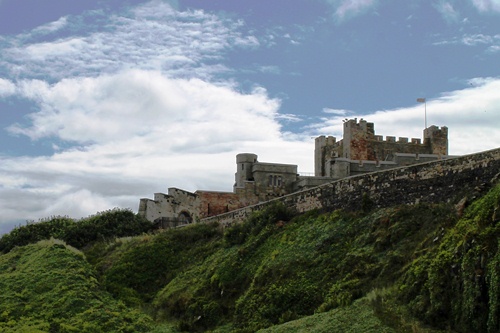
We had seen it from afar, across the water. From the lookout point on Lindesfarne, and later from further out to see, on the Farne Islands, the castle standing solid and proud on the crags, beneath a turbulent sky and above a rocky sea. This has been the site of a fort since the 6th Century, from the Iron Age through the crowning of Northumbrian kings, brought to heel by Vikings and Normans and then rebuilt to apparent indestructability until the War of the Roses, the arrival of artillery fire, and the creation of a ruin for the ages.

And then came the Industrial Revolution, and Bamburgh Castle got a second (or is it third, fourth, or fifth…?) life thanks to the arrival of one Lord Armstrong who had enough loose change in his Victorian pant pockets that he could restore the castle to its former glory, and give visitors a glimpse a hundred years later of something that we – on first glance at least – imagine to be much older than it is.

Continue reading

Fog on the Water: Waren and the Müritz

Water1

The captain of the boat is sceptical.

“Are you sure you want to go out?”

There only about eight of us hanging around on the jetty, hands stuffed in pockets against the cold. We nod, perhaps as much in order to get aboard and indoors. He sighs.

“OK then. But you won’t see much…”

And it is true. We arrived in the town of Waren at the north end of the Müritz lake about three hours ago, with fog engulfing the town and visibility at about fifty metres. We hoped that by waiting until later in the afternoon it would have the chance to clear. And it had, a little, but as the boat made its slow progress out from the harbour it was hard to make out the opposite bank.

Continue reading

Alpacas be praised, Saltaire

Saltaire1

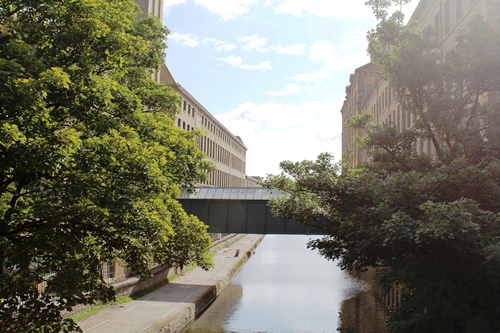
The sound of an alpaca’s hooves on tarmac, a muted cricket appeal and a group warming up on a band stand set against a backdrop of giant Victorian industrial architecture. By Tom Salmon:

A walk around Roberts Park in Saltaire, a world heritage site near Bradford in the north of England, earlier this year gave us an opportunity to reflect on the impact that the industrial revolution still has on the way that we organise our lives. It’s August, the Sunday after the bank holiday – a Victorian invention created in 1871 – and families are walking around the park enjoying weekend time together – the weekend-off-work concept started for most people in the 1890s.

Continue reading

Across the water to the Farne Islands

Farne1

At Seahouses we found a pay and display parking space amongst the bucket-and-spade shops and award winning fish and chip restaurants, and made our way through the ice cream slurping crowds towards the collection of ticket shacks down by the harbour. We wanted to go to the Farne Islands – that scattered collection a couple of miles off the Northumberland coast – but other than that we had no preference for which of the companies competing for our custom would take us across the water, so we picked based on size of queue and the picture of the boat on the side of the ticket shack.

Continue reading

Walking the old customs wall, Berlin

Wall1

The idea for the walk came from Patrick, who had sent me a copy of his map. It showed the route of the old customs wall of Berlin, a fifteen kilometre circle that until 1861 was the limit of the city. There is nearly nothing remaining of the old wall today – just a set of foundations not far from Anhalter Bahnhof and – of course – the Brandenburg Gate, but it lives on in other ways. The route of the U-Bahn line through Kreuzberg for instance and the stations along the way; Kottbusser Tor, Hallesches Tor, Schlesisches Tor… the gates are no more but they live on in these names.

Patrick had walked the route of the old customs wall before and invited me to join him as he did it again. Along the way we would see, as our footsteps followed the path of the invisible wall, how it shaped the development of the city and how you can still see its influence more than 150 years after the city broke through its limitations to become the Weltstadt of the early twentieth century, its population swelling to a number that the old wall could never have contained.

Continue reading

Hey ho, let’s go

Tom1

By Tom Salmon:

I don’t know when or why the opening lines of the punk classic Blitzkrieg Bop became the rallying cry for a day out with the kids. But the Ramones’ most famous lines are now a part of a soundtrack of the weekend for our three under-fives. ‘Hey ho, let’s go’ they chant as we put our boots on.

We leave home with the kids packed up with their bikes and wrapped up for the chill in the autumnal Yorkshire air. As they clamber over each other’s car seats into the back of the car they play to another Blitzkrieg Bop lyric, “They’re forming in straight line, they’re going through a tight one, the kids are losing their minds, Blitzkrieg Bop”.

Continue reading

Three hours drive and only six miles from home

Treptow1

We were supposed to go to the Saxon Switzerland, that dramatic landscape alongside the Elbe between Dresden and the Czech border. The visit had been a long time planned, because we had last visited in autumn 2004 – a Lotte-lifetime and then some – and we wanted to experience again the great colour-change of the leaves on the trees, the mist on the river, and the spectacular rock formations that make this place one of Germany’s natural wonders. And we would get some excellent photographs for Under a Grey Sky whilst we climbed a low mountain at the edge of the National Park. That was the plan.

Continue reading

In the Tiergarten, Berlin

Tier1

On my first ever day in Berlin, roughly twelve years ago in October 2001, I walked across the Tiergarten. It wasn’t planned. I had started my day at Alexanderplatz before walking down Unter den Linden with the idea of seeing the Brandenburg Gate. I was almost through it, with the buses and cars, when I realised that it was completely covered in scaffolding. I remember thinking that it was a shame that I would not see it on my visit to Berlin, for who knew when I would return.

Continue reading

Sand, Starlings and The Small Heart of Things

OLYMPUS DIGITAL CAMERA

Julian Hoffman writes the wonderful blog Notes from Near and Far, and last week he celebrated the publication of his book, The Small Heart of Things:

The two Prespa Lakes are split by a flat isthmus, a spur of sand which pelicans glide across in summer as they swap one body of water for the other. Those two lakes, though, were once one, a single blue bowl encircled by steep slopes. Over thousands of years, silt and sediment from the mountains were sluiced down their gullies and creeks into the river that drains the valley. As the river emptied, spilling its mountain hoard into the lake – all the spoil of sand and silt that had been worn down by wind, rain and time – those tiny grains built up in a slow process of accumulation until they spread out across the water, building a bridge one particle at a time, turning one lake into two.

Continue reading

Cities built on sand

Image 1

By Ian Hill

I cross the square, and the damp sand squeaks beneath my feet. Wet from rain, it seams the cobbles of the pavements, sifts into the gutters and drains. The sand smells of gunmetal and earth, with a scent of the sea, as though tides once lapped these ancient squares. It is a reminder of our proximity to water, the shifting base of rivers on which we build our monuments to progress.

Here, sand is like the innards of the city; its hidden viscera, its soft core beneath a carapace of buildings and roads. I pass a construction site where a vacant plot is being excavated for development, and I see a vast hole in the ground, foundations for a new building, which is layered with stacks of yellow and ochre sand, like the glass lighthouse-shaped paperweights I remember from beach holidays of my youth, filled with striped layers of coloured sediment, like a history of geological time. As the construction deepens, older and older layers are exposed, each one a slightly different colour to the last, each one telling a story of water, holding a memory of currents gently teasing the sand into ripples and banks.

Continue reading