Monthly Archives: May 2013

Physicality and Art by Mark Tweedie

mark_steps

(above: Steps by Mark Tweedie)

The pinhole photography of Mark Tweedie is stunning… I cannot be the only person that finds the images of places, and indeed the series of self portraits, atmospheric and haunting. I have never been to Dartmoor, but I have an imagination of the landscape shaped by things that I have read or perhaps even seen. The photographs in this series are fairly close to what I see in my own imagination.

On Mark’s website he also has a blog, and the articles are well worth a read. It was the most recent piece that drew me there in the first place, and one which – when I think about my own feelings about walking and the creative process – resonates in such a way that I really wanted to share it here…

A good day’s walk makes you feel like your heart has overflowed, that it cannot be contained by the physical confines of the body. It spills out into the trees and hills, it is carried in the wind, winds its way through the air-blown grass like a serpent, runs at your heels like a happy dog. Joy is impossible to describe, for what lifts me may not have any kind of effect on you. But when I walk I feel a part of the world and not apart from it. This sense mixes with everything, I mix with it and, quite literally, en-joy.

Walking, when done in the right spirit, is creative, or at least fills me with the same ineffable sense that something essential, something visceral is happening. It is a feeling that anyone who has created something satisfying will recognise. Moving across the world slowly – from a distance little appears to change, just as an artist’s pencil second by second alters the paper insignificantly – it feels like the landscape and the walker have at the day’s end become a manifestation of more than the sum of themselves.

Travelling on foot gives so much time for mental release thanks to its basic slowness. It creates a psychic momentum which carries one’s thoughts and emotions onward long after the stepping out is finished. It gives a mental space, an openness, which is ripe for fledging ideas and firming up reflections. There is so much in its inherent, rhythmical slowness which is essential to the emotive understanding of all kinds of issues, problems and inspirations. Much of this is also down to the being there, wind on face, earth under foot, straining, feeling muscle and sinew as they negotiate a passage through the elements. The physical engagement transforms everything, makes our sometimes leaden lives golden once more – the philosopher’s stone for those of us who by necessity live our modern lives once removed from the elemental.
Read the rest of Physicality and Art on Mark’s website here

At the Prater Beer Garden, Berlin

prater1

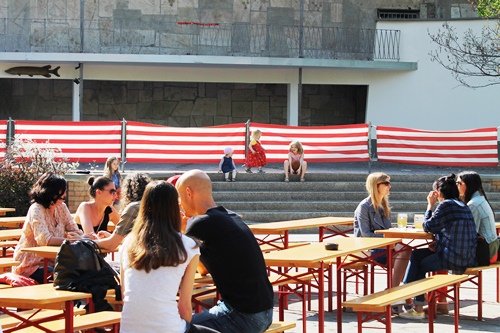
It does not matter how long I have lived in Berlin, how many new experiences I collect or new places open which grab my attention for a night or an afternoon or more, we always return to the Prater. The beer garden is at the top of the hill, I tell our guests who are usually staying at The Circus on Rosenthaler Platz, down at the bottom. We can walk there, after work or school, for a beer and a sausage under the chestnut trees, and although we no longer walk home it is not far, by tram or bike, to Wedding and so it has remained a fixture of our spring and summer months even after we moved out and away from the neighbourhood.

The Prater – restaurant, theatre and beer garden – is not only a fixture of my Berlin, but of the city in general. People began drinking here in 1837, back when the city limits were down at Rosenthaler Platz and the Prater was a day trip into the countryside, a place of escape and refuge from the city. Berlin would break out over the next seventy years, swallowing the beer garden and surrounding it with streets and buildings, but it would remain not only a place of leisure and Sundays free from cares and worries but also, reflecting its position in the heart of the new working class districts providing the labour for Berlin’s rapid industrialisation, a place of political gatherings and agitation as well.

Continue reading

On the Heather Train to Groß Schönebeck, Brandenburg

Bahn1

On a Saturday morning we took the S-Bahn north of Wedding to a suburb of Berlin that sits on the Panke River not far from the Berlin-Brandenburg border. I had read about Karow as being home to a series of ponds, small lakes and wetlands that are popular with the local birdlife, but that exploration would have to wait for another day. We were there to catch the Heidekrautbahn or the Heather Train to Groß Schönebeck, the town at the end of the line and on the edge of the Schorfheide, one of Germany’s biggest forests and a place we had been once before.

This time we were going to stay overnight at the cabin of some friends, shoot bow and arrows at makeshift targets in the woods, and cook dinner on an open fire that would keep us warm as we drank beer until the early hours. And that is what we did, but first we had to get there and it was time for one of those funny little trains that operate on the branch lines of Brandenburg to take us north to the edge of the forest.

Continue reading

In an old railway yard, Berlin

RAW5

Alongside the railway tracks at Warschauer Straße, in the Friedrichshain neighbourhood of Berlin, is a former railway repair yard that has been turned into a post-industrial cultural oasis, with bars and clubs, a skatepark and a climbing centre, amongst many other small and medium sized projects. This is the “RAW-Gelände”, from the wonderfully German word “Reichsbahnausbesserungswerkstatt” – the repair yard of the national railways.

This was the oldest company Friedrichshain, founded in 1867 for the Prussian railways and in particular, the “Ostbahn” which ran from Berlin to Königsberg and East Prussia (present day Kaliningrad). By the end of the nineteenth century the repair yard was employing over 1000 workers, and it continued operations through the GDR years when it was named for the Bavarian communist Franz Stenzer, who was murdered by the Nazis. In 1991, following reunification, the yard was closed, and since the end of the twentieth century it has begun its new life as a cultural hub, although walking through the complex you still get a sense of what it used to be – which is part of the attraction.

Continue reading

Botanischer Garten, Berlin

Bot1

No, this post is not about the Botanic Gardens of Berlin, so wonderfully captured recently on the überlin blog. The reason for this post is somewhat more personal, as I caught the S-Bahn this morning from Bornholmer Straße south to Steglitz and the Botanischer Garten stop. This was my first neighbourhood in Berlin, back in the winter of 2001/2. Having moved to the city without a place to stay, one of my colleagues who was also studying at the Free University offered me a room in his apartment. The flat was on the ground floor, which made it a little dark – and happily cool when it came to the summer – but this was made up for by the fact that we had an overgrown garden out the back door that only Thomas and I had access to.

Altogether I lived down by Botanischer Garten for about nine months, before Thomas returned to Australia and I moved north, to Prenzlauer Berg, Mitte and, eventually, where we are now in Wedding. But I have very strong memories of that time, perhaps because it was my first months in the city. We would travel into the city on the S-Bahn, although if we were caught in town after the last train we would catch a night bus that took us on moonlight ride through deserted streets for over an hour, from Hackerscher Markt through Checkpoint Charlie to Kreuzberg and Schöneberg, before finally stopping in the shadow of the Rathaus tower in Steglitz. Sometimes, when Thomas had worked late and I was on an early shift, we would meet on the platform of the Botanischer Garten station, both of us bleary-eyed at opposite ends of our respective days.

Continue reading

Through the streets of Dresden, Germany

Dresden4

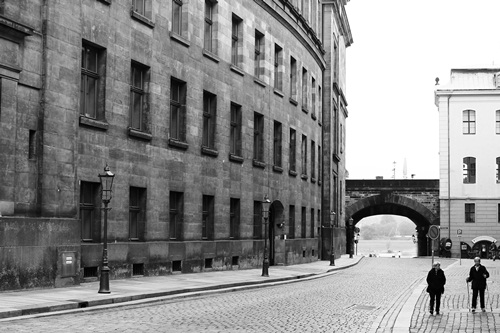
Since I moved to Germany I have made a handful of trips south to Dresden, that grand old city on the Elbe with its beautiful Altstadt and bustling and buzzing Neustadt on opposite banks of the river. The first time we went there we caught the train sometime in January, walking through the snow past some suitably eastern bloc socialist modernist architecture before we reached those buildings that made the city famous and that can, with a squint and a bit of imagination, return us to the city as painted by Bellotto during the 18th Century, a period when Dresden was renowned for its art and architecture, and which inspired Schiller to write his Ode to Joy, his poem celebrating brotherhood and unity of all mankind.

The wide sweep of the river separates the old and the new towns – and the flood meadows that seem to stretch almost as wide as the Elbe itself highlight the sense of distance between either side. On another visit I came south with a friend to play Petanque, tossing those boules along pathways in the manicured gardens of the Japanese Palace on the northern bank, our view back across to the old town distracting in its beauty. It was around about then that they finished the reconstruction of the Frauenkirche, and it is at this point we come to the unavoidable fact about Dresden and one which cannot help but shape your view of the city however many times you visit.

Continue reading

Tour along the Berlin Wall Trail

spy bridge

The tours that we have started running over at Slow Travel Berlin seem to be taking off in a big way, and if you go to this page you will see many different fascinating tours coming up in the next few weeks. I have another cultural-historical neighbourhood tour of Wedding next Sunday (19th May) which I am really looking forward to, and a week later on Sunday 26th May I will be heading south with a small group to walk a 12 kilometre stretch of the Berlin Wall Trail, between Griebnitzsee and Wannsee.

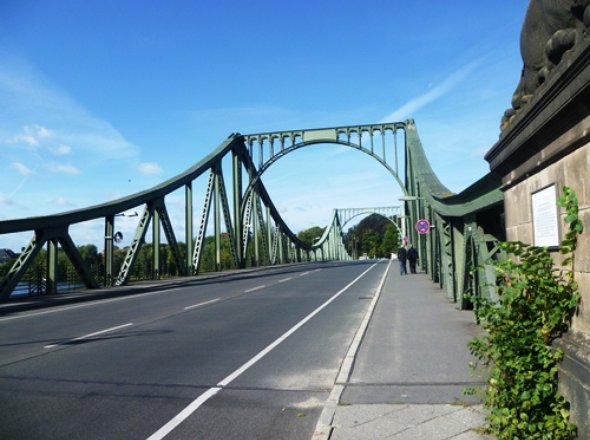
Last summer I did a test walk of this route, which I wrote about here, and it is one of those walks that proves that the very edge of the city can be as interesting as the centre. The walk begins with the villas that housed Churchill, Truman and Stalin during the 1945 Potsdam Conference, takes us past enclaves completely surrounded by the Berlin Wall, old royal palaces and a bridge where spies were exchanged during the Cold War, before a beautiful walk along the banks of the Havel towards Wannsee – West Berlin’s “beach resort” where, in a shady villa at the end of a leafy street, leading members of the Nazi government met to discuss plans for the “final solution” and the murder of six million Jews in Europe.

The walk will take around four to five hours, and there are still a few spaces left. The best place to book is on the tour page at Slow Travel Berlin. And please take the time to look at some of the other tours that are happening over the next couple of weekends… a great way to explore some different corners of the city, and to hear some stories you might otherwise have missed.

A place you can’t find – the Book Mill in Montague, MA

Bookmill1

A few miles north of Amherst we found Montague, driving slowly through the sleepy town to try and find the Book Mill, a bookshop that we had heard about that claimed to offer the winning combination of “books you don’t need, in a place you can’t find.” In the end it was not too difficult, as we followed the map until we reached the point where it crossed the Sawmill River and there it was, painted red and clinging to the embankment above the rapids that rushed beneath the road.

Stepping inside we found a treasure trove of used books, in a number of different rooms that all seemed to be on different levels, with low ceilings and reading corners tucked away on window ledges or under the eaves. There were tables, where people spread out their papers and got on with some work surrounded by millions and millions of words, and when they were stuck, or in need of sustenance, they headed down to the pub on the downstairs level, for a sandwich and a beer and  a view over the river. The selection is large and varied, and it would take days to really work your way through the shelves. It is hard to imagine a more perfect bookshop.

Continue reading

From Hermsdorf to Rosenthal – a walk across the top of Berlin

Hermsdorf1

The first section of our walk took us along the busy road from Waidmannslust S-Bahn station and into Hermsdorf, past garden centres and discounter supermarkets, a couple of rough and ready corner pubs and an organic grocers, before we ducked through the railings where the Tegeler Fließ passes beneath the main road and within a handful of footsteps we had left the traffic behind and were left only with the sound of birds singing in the trees. We had been here before, a few months ago in fact, when it looked as if spring was upon us as we explored the old village of Hermsdorf before picking up the trail down by the river, but this time we really had moved beyond winter, and our walk would take us further as well.

We made our way alongside the Hermsdorfer See before the path became a wooden walkway along the bottom of pleasant gardens, raised on stilts above the soggy bog of the wetlands that spread out from the river bank in either direction. Here the Tegeler Fließ is two things… it is incredibly bendy, twisting this way and that, and it also happens to be the border between Berlin and Brandenburg. From the division of Germany after the Second World War until the events of 1989 and the reunification of 1990 this was an international border, although the planners building the Berlin Wall obviously did not fancy doing battle with the swamp and so set their fortifications further to the north, which left one bank of the river and its wetlands technically part of the German Democratic Republic, but sitting on the West Berlin side of the concrete and barbed wire barrier.

Continue reading

Remembering the Annie Maguire, at Cape Elizabeth, Maine

Annie1

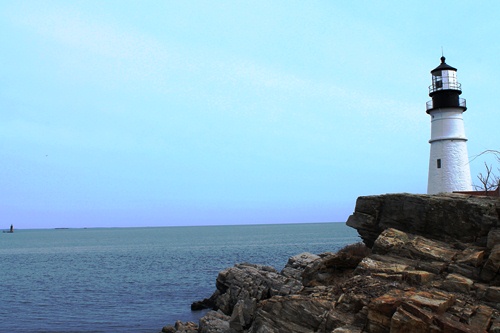
In December 1886 Captain Daniel O’Neil climbed aboard his ship, the “Annie Maguire” for a voyage north from Buenos Aires to Quebec. With him for the voyage were thirteen crew, two mates, his wife and his twelve year old son. Caught in bad weather just off the coast of Maine on Christmas Eve, O’Neil was aiming for Portland Harbour in order to take shelter and ride out the storm. On land, in the Portland Head Lighthouse atop the rocky cliffs of Cape Elizabeth, lighthouse keeper Joshua Strout was keeping watch as the clock approached midnight. It may have been Christmas Eve, but it would not be a quiet shift.

Continue reading