The Prora Nature Reserve, Rügen

Natur1

By Katrin Schönig:

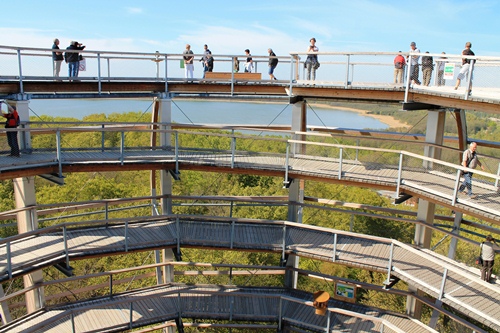
A month or so ago, I spent a week on the island of Rügen. During my stay I took a walk in the Natur Reservat Prora and its treetop trail. Indeed, it was the idea of walking amongst the treetops that drew me there.

The Prora Nature Reserve is located between the Jasmunder inland sea – the Bodden – and Baltic bay known as the Prora Wiek, therefore bringing together different ecosystems. To protect these ecosystems, but at the same allowing people to experience the area, the park was closed off and you can only walk through it on a guided tour. The idea is that the Urwald (primeval forest) should be able to form itself again without human interaction. For example, dead wood is not taken away, and no new plants are planted. Yet, to still be able to enjoy this beauty of nature, the Naturerbe Zentrum of Rügen built a big wooden trail through the treetops.

Continue reading

A Favourite Place: Britzer Garten, Berlin

Britz

My friends at Slow Travel Berlin have just released the second print run of their most excellent 100 Favourite Places book… it is a collection of, well, a hundred of the Slow Travel Berlin writers favourite places in the city, from museums and bars to shops, parks, architecture… and more. Everyone I know who owns a copy – including Berliners such as Katrin – are impressed by the choices, the writing and the photography, so if you are coming to Berlin at any time soon it is the only guide you need.

I asked the founder of Slow Travel Berlin, Paul Sullivan, to select an extract from the book that he thought would suit Under a Grey Sky, and he choose one of his own favourite places, the Britzer Garten in Neukölln:

Given its reputation for industry, war and high-rise buildings, visitors are often surprised at how pleasantly green Berlin is. With almost a fifth of the city covered in trees, it’s quite possible to be diverted regularly from the city’s turbulent past by at least one of the city’s 2,500 parks and gardens. One of the loveliest is the Britzer Garten, which laps at the southern fringes of Neukölln.
Built in 1985 for the Federal Garden Show, the garden was originally designed to provide a green escape for local residents whose excursions into the countryside were, at the time, impeded by the Berlin Wall.

Continue reading

Running home from Bernau

Bernau1

This morning I woke up, caught the S-Bahn to the end of the line, and ran home again. The route I chose was to follow the Panke river from Bernau for 25 kilometres until it arrived just a couple of footsteps away from our front door. It is a journey I have wanted to make for a while, passing through the north of the city alongside the river. As it happened, for the first third of the journey the Panke kept itself fairly well hidden. It was little more than a ditch when I began, running through an allotment colony just south of Bernau station, and then it swung away into some fields, only to appear periodically until I reached Buch, the Berlin city limits, and the overgrowth of the Schlosspark.

Continue reading

Scenes from South Stack, 1833 and 2014

SouthStack1

“Amongst the auxiliaries which art has contributed to give interest to Holyhead, the most picturesque and not the least important is the lighthouse, erected upon the South Stack. This singular Pharos stands upon a rocky island, the surface of which is elevated one hundred and twenty feet above the sea. It is separated from the mainland by a deep chasm, across which a chain suspension foot-bridge is thrown, from the mural cliff on the land side to the island. The descent from the top of the cliff to the bridge is effected by many flights of steps, cut in the front of the rock. The transit of the bridge is rather a nervous ceremony, and the fine craggs of serpentine rock, which overhand the gulf, are unequalled in the mineral kingdom, for variety of pattern and brilliancy of colouring …

Continue reading

Under blue skies in Waren, Germany

Waren1

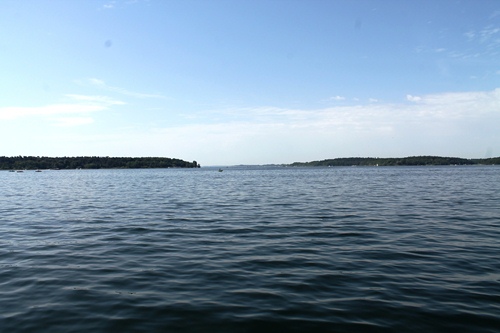
It is just over half a year since our last visit to Waren, the town that sits at the head of the Müritz lake, and the experience couldn’t be more different. Last time around we could barely see the other side of the bay as the lake was shrouded in mist, our boat tour was halved by the captain as it was nearly impossible to see anything, and many of the restaurants, cafes and bars that surround the harbour were closed for the winter. Now the harbour is alive. From the balcony of our apartment we can look across the marina, filled with boats of many sizes, and we can hear the general chatter of the drinkers and diners who occupy the waterside terraces seemingly from breakfast until late in the evening. The pleasure cruisers fill up quickly, exiting the harbour for the lake with a blast on their horn, the top decks packed with passengers. You get a sense, on this bank holiday weekend, that most of northern Germany has descended on this lakeside town, to walk and swim, explore the nearby Müritz National Park, rent bikes and canoes, or simply stroll between the cobbled market square and the harbour, where they can feast on locally-caught fish stuffed in crusty bread rolls, or Italian ice cream.

Continue reading

From the river to the canal, Berlin

Panke1

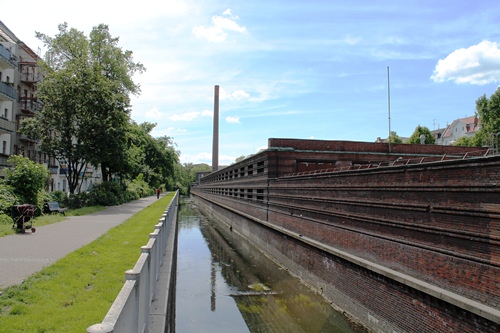
At the site of old mineral spring – the Gesundbrunnen that gives our district it’s the name – the Panke river flows between the red-bricked halls of a former vault-factory and the clumpy grass of an underappreciated park, complete with a football court that local legend has it started the careers of at least one of the three Boeteng brothers. Their faces look down upon the nearby Badstraße from a Nike-sponsored mural. The sports company also dressed up the football court and invited the brothers along to launch an advertising campaign in the gritty urban decay that is our ‘hood. The sign that hung over the gate to the concrete pitch was stolen within days.

Continue reading

A love letter to my favourite place in the world…

Rhos1

We arrived in Rhoscolyn at around midnight, the headlights of our hire car jumping with each rut of the gravel track as we made our way to Cerrig-yr-Adar. Otherwise we were surrounded by darkness. At the bottom of Holy Island, in the north western corner of Wales there are very few streetlights, and though the stars can give you some spectacular illumination, on this occasion they were hidden behind the clouds. But of course it did not matter that we could not see the view in front of us as we crested the small hill just before we finally got there, for we know it so well, as regular readers of Under a Grey Sky will know. This is a place that I spent most of the summers of my childhood, a place that is close to the hearts of so many of my friends and family that if they were all to descend on Outdoor Alternative at the same time we would fill all the beds and probably most of the campsite for good measure. So it did not matter that we could not see across the bay to the beacon, or to the coastguard lookout on top of the hill, or across to the bay windows of the White Eagle pub, as we knew it was all there, in place, waiting for us as it ever does.

Continue reading

If you know your history… Prora, the Colossus of Rügen

Prora1

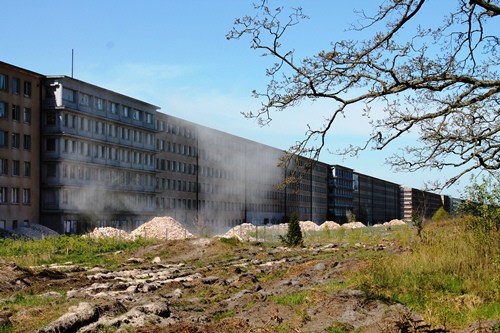
I first visited Prora, just up the coast from the seaside town of Binz, back in 2006. As we pulled into the car park on that November day, surrounded by tall pine trees, it did not seem up to much. There was a ramshackle building topped with a sign advertising “Rügen’s Largest Nightclub”, a building beyond the trees that was under renovation – it would open a year later as a youth hostel – and otherwise not much else beyond an eerie sense of abandonment.

The building clad in scaffolding was just part of an enormous complex that had been conceived of by the Nazis in the 1930s as the first of five massive resorts that would be run under the organization Kraft durch Freude (Strength through Joy). Prora was to house 20,000 holidaymakers at a time, sleeping in one of eight buildings each half a kilometre long that were to be laid out along the Prora Wiek, arguably Germany’s finest beach.

Continue reading

In Koserow, Usedom…

Koserow1

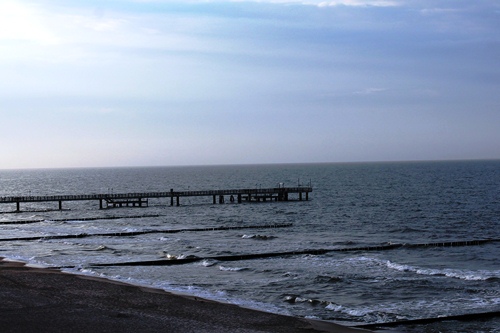
You might have noticed something of a theme on Under a Grey Sky in recent weeks, and that is a series of articles on the German Baltic Coast. This not only because we have made some trips there recently, but also a reflection on the fact that when the temperatures hit 30 degrees in Berlin – as they have this week –many Berliners begin to dream of the lakes of Brandenburg and the sea breeze of the Ostsee coast, and we are no exception:

Long before the island of Usedom became of popular destination for sun-seekers, bathers, and anyone looking to escape the dirt and grime of rapidly industrialising cities, it was a place where life was dominated by the twin goals of attempting the harvest the produce of the field and the sea. The village of Koserow dates back to the 13th Century, when fishing and agriculture were the main activities for the small population living in the shadow of the Streckelsberg hill. By the beginning of the 19th Century the first Salzhütte had been erected, thatched huts where the herrings caught under royal license where packed in salt and stored, before transportation across the German-speaking lands.

Continue reading

Photojournalism and the interest of proletarian revolution

Farbe_fuer_die_Republik_7_DHM_Altenheim_Koepenick_Martin_Schmidt__c__DHM

With the weather in Berlin suddenly reaching summer-like levels of warmth, it might seem like a funny time to write about and recommend a museum visit, but the skies were grey last weekend when we headed to the German History Museum, and the special exhibition we found there is definitely worth a look the nice time the temperatures drop.

FARBE FÜR DIE REPUBLIK (Colour for the Republic) is a collection of images taken by the photojournalists Martin Schmidt and Kurt Schwarzer in the German Democratic Republic. The two men were both freelance photographers, but were hired by different companies and mass organisations in the GDR to take images to be used for trade fairs, products, cookbooks and more. As the introduction to the exhibition makes clear, the images were supposed to depict elements of a fulfilled life under socialism in the GDR, and the fact that they were in colour was no accident:

Continue reading