Through the Granitz Forest, Rügen

Granitz1

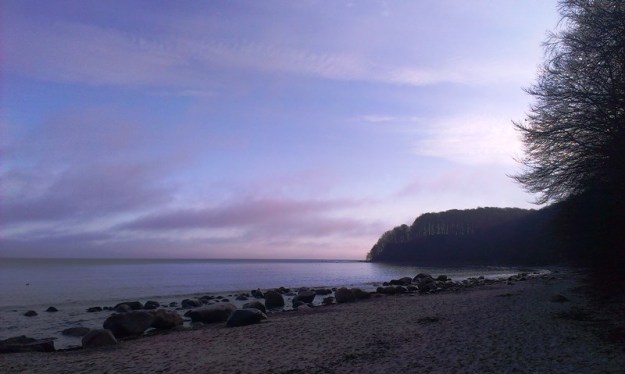
From the resort of Binz, on the coast of Rügen island, the path into the Granitz forest starts at the point where the promenade runs out, the neat paving stones giving way to a sandy track of dirt that skirts the beach until it plunges inland and up towards the high cliff-top trail. Germany’s Baltic coast can in general be pretty flat – a landscape of big skies, dykes and dunes, where the only things reaching up towards the clouds are electricity pylons or windfarms. But Granitz is a bit different, formed as it was during the ice age; an undulating moraine landscape that marks the furthest extent of a glaciers journey, like rubble pushed across a wasteland by a mechanical digger.

Continue reading

A walk in white Wedding, Berlin

Wedding1

We caught the tram having walked through smooth, unmarked snow on the pavement outside our house. As we walked a cyclist passed, cutting a solitary line ahead of us where the caretaker of a neighbouring building leaned on his shovel and considered the work that was to come. The tram was soggy, with puddles of water surrounding islands of grit, our neighbourhood of Berlin-Wedding passing by on the other side of steamed-up windows.

We took the tram to the end of the line. Is this where we came for my arm? Lotte asked, as she always does when we come to this corner of the city, as we disembarked opposite the Virchow Klinikum. Yep, I replied, but turned her away from the hospital and crossed over towards the graveyard that stands like a gothic warning to patients walking the grounds on the other side of the street. Here the road, our road, makes its last hundred metres as an ordinary city street before it becomes the motorway, next stop Dresden, Leipzig or Magdeburg…
Continue reading

Fragments from Rostock, Germany

Rostock1

Stoltera

We arrived as the storm picked up, the narrow lane to our destination already beginning to freeze. In the darkness the trees whipped back and forth and we hurried across the slippery car park to lock ourselves away… it’s just a breeze our receptionist said. Welcome to the Baltic. The next morning it had blown itself out, and we walked the icy cliff-top path and then along the crunchy, frozen sands beneath. The water was glassy and still. We spied boats offshore and birds in the shallows. A long figure stalks the clifftop, picking his way along an overgrown path with large, unbalanced steps. Stay away from the edge! Only we could see that beneath his feet was a curving lip of sandy rock, punctured by holes that had been last-summer’s sandmartin nests, and beneath that… nothing.

Rostock2 Continue reading

Snow by the Panke, Berlin

Panke1

Overnight the familiar world changes. The city under snow is a different place. Edges are softened. Sound is muffled. Lotte and I walk out from our apartment onto the street we see every single day and it feels like a place in a dream, one which you recognise, where you know where you are but that doesn’t seem quite right. Not that Lotte cares, as she sees the clean, untouched expanse of snow covering the terrace of the hotel next door.

Can I?

Continue reading

Twin Peaks in West Berlin

TF1

From Teufelseestraße the path leads through the winter woods for only a few metres before it begins to rise. Although we have come across to the other side of Berlin to climb a hill, in this the flattest of cities the steepness of the slope still comes as something as a shock to the system, not to mention the thighs. As we walk it is clear what this hill, the 99 metre Drachenberg, is made of. Beneath the young trees that guard its slopes, poking through the crumbly top-soil, is the rock of the mountain. Here it is granite. There it is marble. A slab of concrete. Red brick.

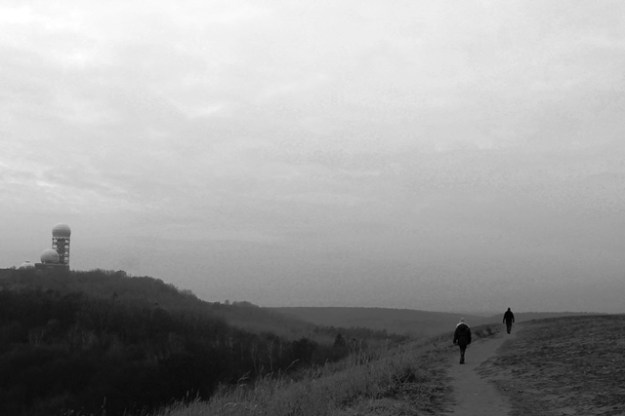
The Drachenberg and its neighbouring Teufelsberg (120m) were created out of the rubble of the Second World War. The latter hill is made up of an estimated 400,000 bombed houses, and buried underneath it all is the remnants of Albert Speer’s Nazi military training school. Pre-war Berlin is what these mountains are made of and as we walk towards the “tree line” and the open plateau at the top of the Drachenberg, it feels as if the history of those countless buildings is clamouring for attention at our feet and at the base of those bare trees. Continue reading

Above the invisible city – Black Mountain, Belfast

BM1

The day after Christmas we drove through the streets of West Belfast until they began to rise to meet the lower slopes of Black Mountain. Not that we could see it. As we reached the last house on the left, where Feargal lives, the fog not only blocked our view of anything above us but also the city we had left behind. So the visibility was poor and the ground was surely to be sodden, after the rain of the previous couple of nights, but we gathered together with Feargal and his friends the mood was good.

Just past the house a river runs beneath the road and there is a sign dedicated to Feargal’s dad Terry, whose poetry has appeared on these pages and who did more than anyone to get access to the Belfast Hills. The story is on Under a Grey Sky here, and sadly Terry died not long after. I never got to meet him, but my dad and Deena did and by all accounts he was a remarkable man. So we were walking in his memory, and that of Feargal’s brother – also called Terry – who was killed in 1998 and who had also loved these hills and the outdoors in general.

Continue reading

A year to elsewhere and back

Rannoch

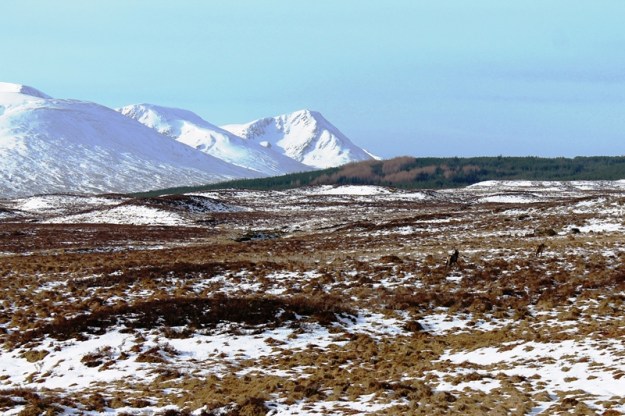
It was in these quiet days between Christmas and New Year in 2011 that I started Under a Grey Sky, so as well as a look back on what has been going on over the past twelve months it is also something of a birthday. Although I haven’t been able to keep up the intensity of posting here over the last year or so, I remain very proud of the writing that I have published here in 2015 and remain incredibly pleased that so many people continue to read about my (and our) adventures beyond the front door.

At this point a year ago I had a couple of plans for the 2015. I had just finished work at The Circus after five years looking after their company communications and a decision to return to the world of freelance work. The first major plan was the launch of Elsewhere: A Journal of Place with my friend Julia. We published Elsewhere No.01 in June, followed by Elsewhere No.02 in September. Along the way we built a small team here in Berlin who helped us get the journal out there and put on a couple of events, as well as working with some excellent writers, photographers, musicians and illustrators from around the world. I am incredibly proud of Elsewhere and can’t wait to show everyone No’s 3 and 4 which will be published in 2016.
Continue reading

Caught by the Lagan, Belfast

Lagan3

Upstream

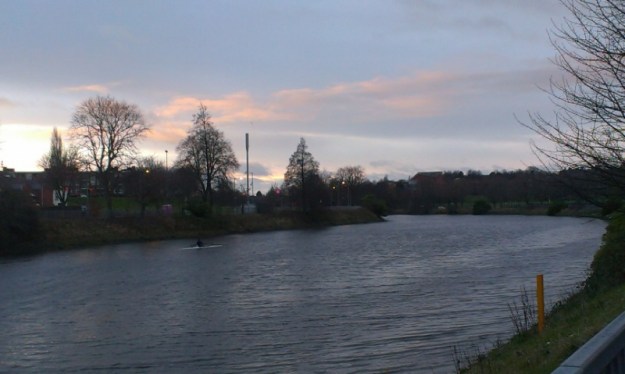
On a Sunday morning I meet the river by the entrance to Ormeau Park and turn left along the embankment, heading upstream. On the bridge railings a ghost bike hangs, painted white in memory of a fallen cyclist. Below me, on the water, a solitary rower aims downstream, towards Belfast Lough and the sea, towards the waterfront developments of the city centre and the yellow cranes of the shipyard, stroke after powerful stroke.

My route takes me past the gable end of terraced houses and the entrance to Botanic Gardens. There is no life in the Lyric Theatre this early, and I share the pavement with a couple of cyclists and a young woman walking purposefully past me towards town. Across the street tattered flags stake territorial claim on an estate lining a ridge above the river, looking down on an open grassy space where the bonfire will be built. An underpass takes me beneath the road about to cross the river and I pause at a sign marking the riverside route. The inscription begins: Continue reading

Meeting Julius Fučík in Pankow, Berlin

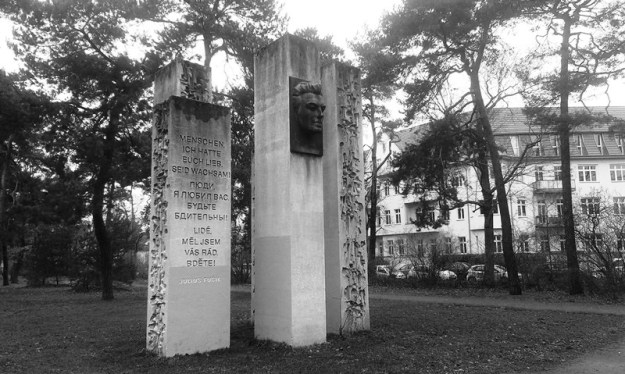
JuliusFucik

The park is deserted. I have walked here from home, a couple of kilometres along the Panke river from our apartment, past the garden colonies and old factories, past the football pitch and where the Berlin Wall once stood. It is a walk I have made many times, a corner of Berlin I have written about many times. More often than not we go this way in the summer, aiming for green open spaces of the park or the beer garden at its heart. We have celebrated birthdays here. Met friends. But on a weekday in December we have the park to ourselves.

The playground is empty, the swings gently rocking in the breeze as the sound of a plane coming in to land at Tegel fills the scene. The path by the river is muddy, churned by the bicycles of the school run or the journey to work. I look for the grey heron but he is not around today, just a handful of ducks on the embankment, heads buried in their own feathers. The bandstand is deserted. The beer garden too. A solitary runner enters at the far end, a flash of reflective orange from her jacket, but then she is lost to the path through the trees. Continue reading

Chasing memories and the sound of church bells, Berlin

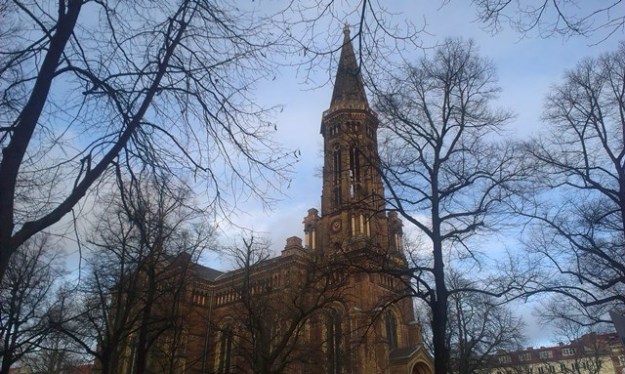
IMAG0842

Last Saturday as part of our Printed Matters indie publishing day in Berlin that we hosted through Elsewhere, I led a neighbourhood walk in the area around the venue. The walk took us to two squares – Arkonaplatz and Zionskirchplatz – my home neighbourhood for about a decade before we moved a few kilometres north about five years ago. So as I was telling stories of industrialisation and the divided city, I was also walking through some very personal memories. A few days later I decided to go back on my own and chase some of them down.

Arkonaplatz. One of the first pieces I ever had published was a short piece in the Guardian Weekly. I wrote about the Sunday flea market at the end of the road and the bargain hunters chasing GDR-kitsch. I wondered whether we had a potential goldmine in our basement on Wolliner Straße, just around the corner, or whether Katrin’s family had such treasures in theirs. I wrote that piece in the summer of 2006, not long after we had moved to Wolliner Straße and just after Lotte was born. Now she is approaching her tenth birthday, we have been gone from the apartment on Wolliner Straße longer than we ever lived there. We have lost some of our family too. I write this at Katrin’s grandmother’s desk. Wine glasses and bowls stand in the cabinet. Too many memories from when we knew each other, and for Katrin, even longer. Too precious for any flea market.

On the square I stop and watch a couple of guys play table tennis on the concrete tables, despite the single-digit temperatures and the cold late-November wind racing through the cobbled streets. These streets were built as part of Berlin’s great expansion in the second half of the 19th century, when the city was transformed from garrison town to Weltstadt. Northern Mitte, Prenzlauer Berg and Wedding were industrial neighbourhoods, working class and poor. Heinrich Zille, the cartoonist famous for his illustrations of working class life in Berlin, once painted the Christmas Market at Arkonaplatz, the twinkling lights losing the battle against the grime and the smog. Now Arkonaplatz has some of the highest real estate prices in the city. Continue reading