Category Archives: Memory

Photojournalism and the interest of proletarian revolution

Farbe_fuer_die_Republik_7_DHM_Altenheim_Koepenick_Martin_Schmidt__c__DHM

With the weather in Berlin suddenly reaching summer-like levels of warmth, it might seem like a funny time to write about and recommend a museum visit, but the skies were grey last weekend when we headed to the German History Museum, and the special exhibition we found there is definitely worth a look the nice time the temperatures drop.

FARBE FÜR DIE REPUBLIK (Colour for the Republic) is a collection of images taken by the photojournalists Martin Schmidt and Kurt Schwarzer in the German Democratic Republic. The two men were both freelance photographers, but were hired by different companies and mass organisations in the GDR to take images to be used for trade fairs, products, cookbooks and more. As the introduction to the exhibition makes clear, the images were supposed to depict elements of a fulfilled life under socialism in the GDR, and the fact that they were in colour was no accident:

Continue reading

A Gift from the Road: Walking the Woods and the Water

walking the woodsA review of Walking the Woods and the Water by Nick Hunt

Review by Paul Scraton:

In 1933 Patrick Leigh Fermor began a walk from the Hook of Holland that would take him across Europe, a journey he would later immortalise in three books – A Time of Gifts, Between the Woods and the Water, and (published posthumously) The Broken Road. The first two have, since publication, been long regarded as classics of travel literature. Reading them today you are struck with the sense that these are books written about a time when Europe was at a tipping point – much of A Time of Gifts for instance is set in a Germany where the Nazis are in the ascendant – but also and especially later in Fermor’s journey, in the lands to the East, where the books are filled with tales of aristocrats and peasants it is a world that became decidedly less “modern” the more he walked.

Continue reading

Down by the canal

Canal1

I spent most of my childhood in a small town called Burscough in West Lancashire, where the Preston-Ormskirk railway crosses the Southport-Wigan line. Once upon a time the lines were linked, but the Burscough Curves were long closed by the time we moved there – having been victims of the railway cuts at the end of the 1960s – leaving us with a couple of “dead railways” that were the perfect, hidden, spot for den-building and, later, the first tentative sips from cans of warm beer.

Continue reading

Fragments of Tokyo – Part Two

2_Shrine

Just less than a week in a Japan and it remains a jumble of memories in my head. Here is the second half of my fragmentary tale of a journey to the other side of the world…

On a Sunday morning we take the train to Hibuya and then walk through the wooden gate into the grounds of the Meiji Shrine. This was once parkland where the Emperor Meiji – the man who opened Japan and ushered in a half century of incredible change, including a social, economic and industrial revolution – and his Empress Shōken has been known to visit for periods of rest and reflection. The paths leading through the woodland to the shrine that was built in their honour is flanked with billboards telling some stories of the Emperor and the Empress, as well as their poetry and other reflections. Only a short stroll from busy city streets, and despite there being a lot of people walking the gravel trails with us, it is a peaceful place. The crowds get thicker at the shrine itself, drawn to the site of the wedding party walking through the grounds. At the front the couple are in traditional dress. Behind then men are in smart suits, the women in dresses, and all the bags that dangle from their arms carry the name of famous designers from around the world. The bag that it comes in, it seems, is as important as the gift contained inside.

Continue reading

A tiny collection of Dublin myths

Marcel1
[1]

By Marcel Krueger:

The German tourists on the bus laugh as the pack of feral dogs crosses the street at the airport roundabout. And why should they not? There are three dirty Jack Russell terriers and one lanky greyish-brown greyhound, an odd-looking combination for a modern day pack of hounds. The tourists do not know that the dogs hunt hares in the bushes and undergrowth around the business parks in Dublin 15, tearing them to pieces. The dogs leave shreds of paws and ears and bits of bone lying around the car parks for unsuspecting call centre workers. Dublin in autumn is a nice and gentle city only upon first glance.

Two days later, I take the local commuter train, the DART, from north Dublin to the city centre. Along the canals that the train passes and on the small squares next to the playgrounds in the estates kids in tracksuits and in grubby-white sneakers erect pyramids of wood; temporary pyramids to burn. They pile old wooden pallets, doors, window frames upon twigs, mouldy floor boards, plastic rubbish and the occasional refrigerator to form large heaps of tinder; offerings to the old Irish harvest gods and their own juvenile lust for destruction. One of the piles I see is crowned with a decapitated doll’s head on a wooden pole, its blue plastic eyes staring into nothingness.

Continue reading

Still trying to make sense of South Africa

Cape Town

(above: View from a balcony, Cape Town)

With the death of Nelson Mandela recently, and the acres of newsprint and billions of pixels devoted to the past, present and future of South Africa now that he has gone, I have been thinking a lot about Mandela and the country that I visited three and a half years ago during the World Cup, the final of which happened to be his last, major public appearance. I have also been thinking further back, to those posters on the wall at our home in the 1980s, the two concerts we went to as kids at Wembley Stadium, and standing in the drizzle of Millennium Square in Leeds a decade later as he addressed the crowd.

I thought about the fact that Nelson Mandela was – along with Vaclav Havel – one of the heroes of my political education, and one of the inspirations for my long-standing and continuing interest in societies in transition and how we manage our collective past and memory to move forward to a more positive future. Both men were flawed, because – after all – everyone is and must be, but in post-apartheid South Africa and post-communist Czechoslovakia (and later the Czech Republic), both Mandela and Havel offered examples of how we can bring together a fractured and damaged society, and how appealing to the good in people, the positive and the progressive, can shape that society for the better.

Continue reading

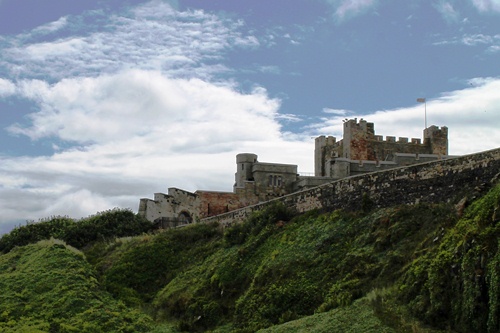
Above the Bamburgh Sands

Bamburgh1

We had seen it from afar, across the water. From the lookout point on Lindesfarne, and later from further out to see, on the Farne Islands, the castle standing solid and proud on the crags, beneath a turbulent sky and above a rocky sea. This has been the site of a fort since the 6th Century, from the Iron Age through the crowning of Northumbrian kings, brought to heel by Vikings and Normans and then rebuilt to apparent indestructability until the War of the Roses, the arrival of artillery fire, and the creation of a ruin for the ages.

And then came the Industrial Revolution, and Bamburgh Castle got a second (or is it third, fourth, or fifth…?) life thanks to the arrival of one Lord Armstrong who had enough loose change in his Victorian pant pockets that he could restore the castle to its former glory, and give visitors a glimpse a hundred years later of something that we – on first glance at least – imagine to be much older than it is.

Continue reading

A journey through memory and the imagined city

Volksbühne [1]

I arrive in Berlin at Ostbahnhof, from where I catch the train to Alexanderplatz. They are ready for Christmas in the heart of the square, the wooden market stalls clustered on the wide expanse of concrete. Smoke and steam rises and the crowds stream and warm along the paths of an imagined village attempting to return the visitors to some mythological past on the very site where the leaders of a regime attempted to create a new mythology for the future. Is that what I think, looking down on the scene? Not really. Instead I think, like the people do, of a sausage and some glühwein, distracted by the bright lights of the department store, ushering in those of us who are searching for the perfect gift.

No shopping today – I am not sure who I would buy for – and so I walk away, towards Rosa-Luxemburg-Straße. It is darker here, just the street lights and their reflection in the damp pavement. Soon, at some point in the future, there will be fashion stores and burritos that will be exported to Wittenbergplatz, but not yet. Just the old Kneipe with the wooden benches outside and a cavernous kebab shop built by an investor who was ahead of his time. I wonder if, in years from now, he walks the Rosa-Luxemburg-Straße and regrets calling it quits. If he had only hung on a year or so longer…

Continue reading

In the Tiergarten, Berlin

Tier1

On my first ever day in Berlin, roughly twelve years ago in October 2001, I walked across the Tiergarten. It wasn’t planned. I had started my day at Alexanderplatz before walking down Unter den Linden with the idea of seeing the Brandenburg Gate. I was almost through it, with the buses and cars, when I realised that it was completely covered in scaffolding. I remember thinking that it was a shame that I would not see it on my visit to Berlin, for who knew when I would return.

Continue reading

On Ilkley Moor…

Ilkley

This weekend we were back in Yorkshire for just a couple of days, celebrating a very special birthday with close friends and family, including quite a few Under a Grey Sky contributors! The images and text below were actually put together during a trip a month or so ago… this time around there were no views from the airplane as Leeds Bradford was shrouded in mist. In fact, we were unable to land and we were diverted to Doncaster…

Coming in to land at Leeds Bradford airport I look out of the window and can see Ilkley Moor, squat and smooth, not so much towering over the surrounding towns and villages as hulking in its presence. Perhaps it is because we don’t have much in the way of moorland in Germany that the sight of it always makes me feel as if I have returned home, even if the wheels have yet to touch down on the runway tarmac.

Continue reading