Category Archives: Diary

A visit to the Karow Ponds, Berlin

karow1

Earlier in the summer Lotte and I headed to the Karow Ponds in the north of Berlin. It resulted in an article that I wrote for Caught by the River, some nice pictures and some great adventures. On the walk to the ponds, Lotte told me: “Quiet Papa, I want to hear the nature…” and so we did, walking in silence towards the ponds set amongst the trees:

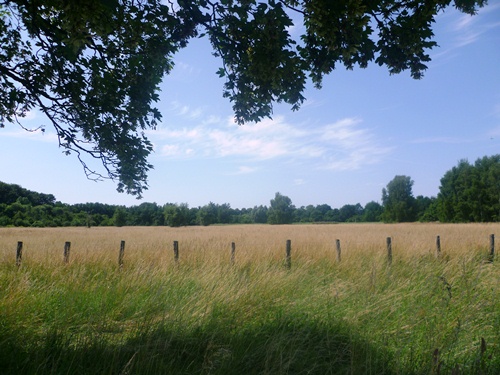
On a sunny Sunday we decide to escape the heat of Berlin by catching the S-Bahn north to the very edge of the city, where the Panke River runs alongside a small patch of marshland and meadows, pasture and ponds. We walk through suburban streets until a path takes us along the river bank and then in towards the Karow Ponds, a peaceful spot popular with strollers, runners and birdwatchers, where we can see bulls lounging in the fields and gaze across the ponds from viewing platforms to see cormorants, grebes, and a grey heron sunning itself on the far bank. Butterflies and dragonflies dart above the reeds, and an otter pulls itself ashore with a shake of its back. Berlin is a city filled with green spaces, but at moments like this I still marvel at the access we have to such places within a handful of minutes of our apartment, and how they managed to escape the rapid growth of the city that swallowed not only fields and forests, but entire villages, during the second half of the nineteenth century.

Read the rest of Caught by the River

Continue reading

Saturday afternoon in Volkspark Friedrichshain, Berlin

FH1

It is early afternoon on Saturday and we follow a cobbled road into the Volkspark Friedrichshain. It is a driveway to the hospital, twisting one way and then the other, flanked by ornate lamps. The park was laid out in 1848 and the hospital, the first of its kind in the city, was opened twenty years later, and it is not hard to imagine a rudimentary ambulance pulled by horses, rolling clackety-clack across the cobblestones towards the brick entrance gate and the hope of the hospital beyond.

So many of Berlin’s most interesting sights are tied up in that period of rapid growth in the second half of the nineteenth century, and walking along with the park on one side and the high walls of the hospital on the other, it is very easy to picture how it might have been, the city growing rapidly, swallowing the fields and villages surrounding it through rapid growth… until the spell is broken by a gang of orange-shirted “stags”, who turn the corner pushing a stolen shopping trolley laden with beer bottles and dripping from melting ice. We will see them again, in the beer garden, and then later, a few of their number AWOL, hanging out in a bus stop and singing German football songs at the cars passing by in the street.

Continue reading

The Highest Mountain and the Deepest Lake, Berlin

TF1

Of course, if you live in Berlin this is all relative. After all, we live in a city where the local Alpine association uses the northern wall of a Second World War flak tower as one if their main training spots, as the nearest actual, real mountains are at least a couple of hours drive away. The Teufelsberg, complete with an abandoned US Listening Station on top, is not even a “real” hill, let alone a mountain… built as it is from the rubble of 15,000 destroyed  buildings that fell victim to the American and British bombing raids of the Second World War.

Still, Lotte and I enjoyed the walk up through the northern Grunewald woods, past the bald Drachenberg hill popular with kite-flyers and mobile airplane pilots, until we reached the double barbed wire fence, recently strengthened to prevent urban explorers accessing the listening station without paying the €7 “tour fee”, advertised at the (locked) main entrance scrawled with a marker on a piece of cardboard. Still, every so often, as we traversed around the hill alongside the fence, the trees moved away every so often to allow us a view out across the western districts of Berlin or east, across the treetops of Brandenburg.

Continue reading

Soapbox Derby on the Badstraße, Berlin

Bad1

Wedding, oh Wedding. Sometimes when I think my neighbourhood has no more surprises for me, another one pops up in a place where you least expect it. The Badstraße, the street that is the extension of Brunnenstraße and runs down from Humboldthain and the Gesundbrunnen station towards Pankstraße and the river where the original spa once stood, was once the main drag in an entertainment and shopping district whose cinemas, theatres, beergardens and restaurants attracted custom from across the north of Berlin. Then the Berlin Wall was built, cutting off this corner of the Wedding district on three sides.

Continue reading

The Sportforum Hohenschönhausen, Berlin

forum1

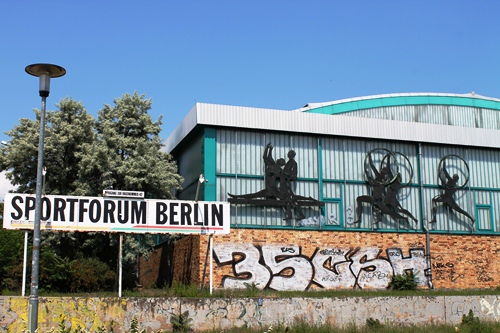
The tram dropped us in front of the Sporthalle, where a couple of people stood at the top of the steps, waiting in the sunshine for a moment longer before heading in to pay admittance to a cheerful women sitting behind a trestle table just inside the front door. From inside we could hear the sound of spectators – cheers and drums and whistles – but there was no clue to what kind of event was taking place. We headed around the side of the hall, where weeds grow through the paving stones and coaches were parked in lines in the sunshine, but it remained a mystery. As we pressed on, deeper into the Sportforum complex, we caught a glimpse of numbered-shirts pressed up against a frosted window. Crossing the car park we heard a sudden outburst of enthusiasm, a “come on lads!” kind of a sound, and then the numbered-shirts were gone, ready to do battle.

The Sportforum complex is one of Berlin’s “Olympic Training Bases” and has facilities for all kinds of different sports. Built in the 1950s, its heyday was during the years of the German Democratic Republic when it was the main training complex for the athletes of the socialist country, whose regime had identified sport as a way of the small nation punching above its weight and who saw its elite athletes as “diplomats in sports gear”. On opening it was the largest such training complex in Europe, and thanks to a system devoted to success – including of course the use of more unhand, chemical techniques – the GDR did indeed win over five hundred medals in the Summer and Winter Olympics combined, a number which has East Germany still standing eighth in the all-time records.

Continue reading

On the Heather Train to Groß Schönebeck, Brandenburg

Bahn1

On a Saturday morning we took the S-Bahn north of Wedding to a suburb of Berlin that sits on the Panke River not far from the Berlin-Brandenburg border. I had read about Karow as being home to a series of ponds, small lakes and wetlands that are popular with the local birdlife, but that exploration would have to wait for another day. We were there to catch the Heidekrautbahn or the Heather Train to Groß Schönebeck, the town at the end of the line and on the edge of the Schorfheide, one of Germany’s biggest forests and a place we had been once before.

This time we were going to stay overnight at the cabin of some friends, shoot bow and arrows at makeshift targets in the woods, and cook dinner on an open fire that would keep us warm as we drank beer until the early hours. And that is what we did, but first we had to get there and it was time for one of those funny little trains that operate on the branch lines of Brandenburg to take us north to the edge of the forest.

Continue reading

Racing across the water in Grünau, Berlin

???????????????????????????????

We took the S-Bahn south to the edge of the city, not far from Schönefeld and the mythological new airport that we hope our grandchildren will have the pleasure to use. We did not really know what to expect… the last time any of us had been to Grünau, this green and leafy corner of what was once East Berlin was almost twenty years ago and it was hard to imagine the changes that must have taken place since then. From the station we followed a path through the trees in the direction of the water, until we reached a small park with a jetty, and some friendly chaps enjoying the sunshine with a scowl as their fishing rods rested on the rusty railings.

At the end of the crumbling pier it felt as if we were on top of the water, and could see down the Langer See to where a large scoreboard flickered in the shadows of a grandstand. On the water itself we could see the first rowers of the day warming up for the regatta, that was about to take place. As we walked down the street towards the grandstand it suddenly began to get very busy. Broad-shouldered men and women jogged up and down, the name of their rowing clubs stitched into the back of their tracksuit tops – Tegel, Wannsee, Königs Wusterhausen, Pirna…

Continue reading

Springtime and memory in the Schönholzer Heide, Berlin

Bike1

Just underneath the S-Bahn tracks, crossing from Wedding into Pankow not far from the Wollankstraße station, there is a collection of cherry trees gifted to the people of Berlin by the people of Japan, and which are currently in blossom. It remains one of my favourite “memorials” in a city that as so many, if only for its fleeting appearance every springtime. And thankfully spring has arrived, even if it is almost three weeks later than the Sunday last year when I captured the pink blossom at this exact point for another entry on Under a Grey Sky.

It was also possible to see the arrival of warmer weather by the coating of pollen on our bikes as we lifted them out from the rack in the courtyard of our apartment block, and in the number of people walking, riding and running along the Panke and Berlin Wall trails, which we followed to reach the Soviet Memorial in the Schönholzer Heide. We had decided to ride up there to capture some pictures of what is the third largest such memorial in Berlin, behind those in Treptower Park and the Tiergarten, and the final resting place for over 13,000 of the 80,000 Red Army soldiers who died during the final battle for Berlin. Unfortunately, we timed our trip during a period when the memorial is being restored, and so Katrin picked her way through the trees to try and get some pictures, but otherwise it was not possible to get any closer than the gates.

Continue reading

Off season in Ogunquit, Maine

Ogun1

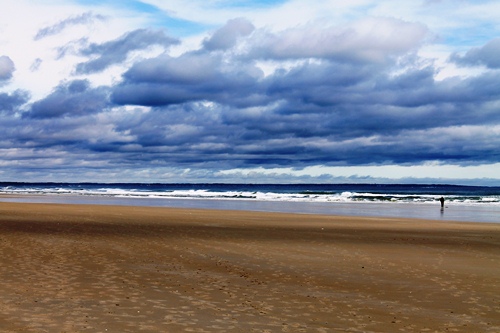
It is the Easter weekend and we have headed for the coast. Despite the fact that lawn signs advertise Egg Drops and oversized bunnies are posing for photographs in shopping malls, the seaside resort of Ogunquit, just north of the New Hampshire border, has a decidedly off-season feel to it. Many of the motels, inns and hotels are not yet open for the season, and the little trolley bus that travels around the town and its neighbouring resorts will not emerge from the garage for another month or so. Still, as we follow the Marginal Way trail along the coast from Ogunquit village to the boutiques, lobster shacks and clapboard houses of the scruffily-posh Perkin’s Cove, there are a good number of people on the trail, enjoying the first real warming sun of the year. Enough, in fact, to image what kind of a traffic jam must occur on these low cliffs during the high season.

Continue reading

Spring at last in Berlin

IMAG0193

It has been a long winter. The snow fell and was still on the ground way into April, even after the bathing lakes of Berlin were supposed to be open for business. Last year we welcomed spring with a walk around the lakes of Hohenschönhausen in the middle of March. This year we have had to wait almost a month longer to cast aside our winter jackets, but we were finally able to do so this weekend for a walk around the Weißensee.

Continue reading