Ending the year on the small heart of things

small things

Just before Christmas I was invited once again by the lovely folks of Caught by the River to write my “Shadows and Reflections” for 2013 as the year comes to an end. I got down to it on the train back to Berlin from Munich, and my thoughts as the German countryside rushed beside me outside the window turned to this land and its landscape, and feelings of home and belonging:

Continue reading

Christmas under grey skies…

.

…we can hope, because that might mean we get a little snow with the holidays. Under a Grey Sky will be cuddling up under a warm blanket by a lake for the next week or so, with service resumed in the New Year. So all that is left is to thank everyone who read and contributed to the site over the past twelve months. During this, the second year of Under a Grey Sky, we welcomed a lot of old friends to these virtual pages but also many new ones as well. No-one gets paid and we are extremely grateful to everyone who has shared their words and images with us.

On a personal level, Katrin and I have once again found that Under a Grey Sky has not only been a great place to collect our words, our thoughts, and what we capture through a lens, but also inspires us to get out the door and look for new adventures. This year we made it over to the United States as well as a couple of trips to England, but we have also enjoyed many smaller trips out from Berlin, up to the Baltic sea or the Oder river, the lakes and forests of Brandenburg and Mecklenburg, or even days exploring corners of our city both familiar and otherwise. Over the two years of the website it has definitely proved to be kick-start to get us out the door on a Saturday morning…

Hope you have a great couple of weeks and we will see you on the other side.

Music: Seanin and Trubadore

The Bavarian English Garden, Munich

Munich1

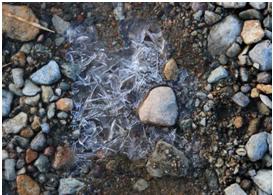
We step out of the hustle and bustle of Münchner Freiheit and make our way down sleepy side streets until we reach the edge of the Englischer Garten, central Munich’s large park that runs alongside the river north of the city centre. We are at the very edge of winter, wrapped up warm against the cold, the joggers blowing steam along the pathways as dogs chase each other over the frosted grass. As we make our way to the lake at the heart of the park we are frozen in our tracks at the sight of a flock of geese, taking to flight from the grass about half a kilometre away and now flying low in our direction. Instinctively we duck as they pass on the way to the water, the air filled with squawks and squeals and the beating of wings.

Continue reading

A tiny collection of Dublin myths

Marcel1
[1]

By Marcel Krueger:

The German tourists on the bus laugh as the pack of feral dogs crosses the street at the airport roundabout. And why should they not? There are three dirty Jack Russell terriers and one lanky greyish-brown greyhound, an odd-looking combination for a modern day pack of hounds. The tourists do not know that the dogs hunt hares in the bushes and undergrowth around the business parks in Dublin 15, tearing them to pieces. The dogs leave shreds of paws and ears and bits of bone lying around the car parks for unsuspecting call centre workers. Dublin in autumn is a nice and gentle city only upon first glance.

Two days later, I take the local commuter train, the DART, from north Dublin to the city centre. Along the canals that the train passes and on the small squares next to the playgrounds in the estates kids in tracksuits and in grubby-white sneakers erect pyramids of wood; temporary pyramids to burn. They pile old wooden pallets, doors, window frames upon twigs, mouldy floor boards, plastic rubbish and the occasional refrigerator to form large heaps of tinder; offerings to the old Irish harvest gods and their own juvenile lust for destruction. One of the piles I see is crowned with a decapitated doll’s head on a wooden pole, its blue plastic eyes staring into nothingness.

Continue reading

Still trying to make sense of South Africa

Cape Town

(above: View from a balcony, Cape Town)

With the death of Nelson Mandela recently, and the acres of newsprint and billions of pixels devoted to the past, present and future of South Africa now that he has gone, I have been thinking a lot about Mandela and the country that I visited three and a half years ago during the World Cup, the final of which happened to be his last, major public appearance. I have also been thinking further back, to those posters on the wall at our home in the 1980s, the two concerts we went to as kids at Wembley Stadium, and standing in the drizzle of Millennium Square in Leeds a decade later as he addressed the crowd.

I thought about the fact that Nelson Mandela was – along with Vaclav Havel – one of the heroes of my political education, and one of the inspirations for my long-standing and continuing interest in societies in transition and how we manage our collective past and memory to move forward to a more positive future. Both men were flawed, because – after all – everyone is and must be, but in post-apartheid South Africa and post-communist Czechoslovakia (and later the Czech Republic), both Mandela and Havel offered examples of how we can bring together a fractured and damaged society, and how appealing to the good in people, the positive and the progressive, can shape that society for the better.

Continue reading

Little Langdale

chris1

By Chris Hughes:

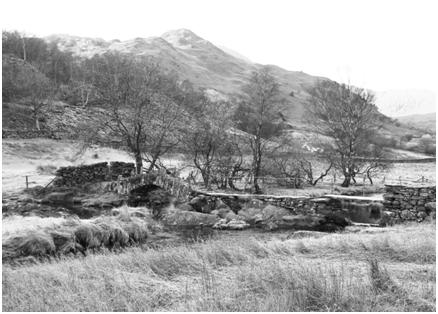
I have driven along the small valley of Little Langdale many times. En route for the Wrynose Pass and Hard Knott and then on to Wasdale in the 1960s, over the Blea Tarn road and down into Great Langdale for the climbing on Gimmer, Raven Crag, White Ghyll and Pavey Ark and visiting the hugely impressive Big Hole slate quarry containing the vast and wonderful cathedral hole, but rarely stopping very much back then – just the occasional pint in the tiny back bar of The Three Shires Inn. With our children we often visited the ford on the track to Tilberthwaite to play in the clear waters of the River Brathay but it is many years since we had actually stopped in the valley and spent some time there. So when visit to Grange-over-Sands was necessary it gave us the excuse – unnecessary really – to have a short stay at The Three Shires Inn and revisit the little gem of the south Lakes, Little Langdale. The hotel was excellent and to be recommended – especially their winter offers – but it was the day, a Monday in late November, which made a little gem into a real, and hugely valued jewel of a place.

Continue reading

Above the Bamburgh Sands

Bamburgh1

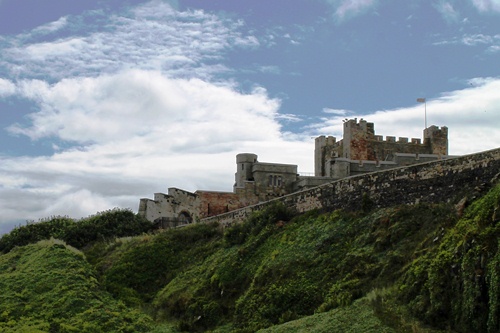
We had seen it from afar, across the water. From the lookout point on Lindesfarne, and later from further out to see, on the Farne Islands, the castle standing solid and proud on the crags, beneath a turbulent sky and above a rocky sea. This has been the site of a fort since the 6th Century, from the Iron Age through the crowning of Northumbrian kings, brought to heel by Vikings and Normans and then rebuilt to apparent indestructability until the War of the Roses, the arrival of artillery fire, and the creation of a ruin for the ages.

And then came the Industrial Revolution, and Bamburgh Castle got a second (or is it third, fourth, or fifth…?) life thanks to the arrival of one Lord Armstrong who had enough loose change in his Victorian pant pockets that he could restore the castle to its former glory, and give visitors a glimpse a hundred years later of something that we – on first glance at least – imagine to be much older than it is.

Continue reading

Fog on the Water: Waren and the Müritz

Water1

The captain of the boat is sceptical.

“Are you sure you want to go out?”

There only about eight of us hanging around on the jetty, hands stuffed in pockets against the cold. We nod, perhaps as much in order to get aboard and indoors. He sighs.

“OK then. But you won’t see much…”

And it is true. We arrived in the town of Waren at the north end of the Müritz lake about three hours ago, with fog engulfing the town and visibility at about fifty metres. We hoped that by waiting until later in the afternoon it would have the chance to clear. And it had, a little, but as the boat made its slow progress out from the harbour it was hard to make out the opposite bank.

Continue reading

A journey through memory and the imagined city

Volksbühne [1]

I arrive in Berlin at Ostbahnhof, from where I catch the train to Alexanderplatz. They are ready for Christmas in the heart of the square, the wooden market stalls clustered on the wide expanse of concrete. Smoke and steam rises and the crowds stream and warm along the paths of an imagined village attempting to return the visitors to some mythological past on the very site where the leaders of a regime attempted to create a new mythology for the future. Is that what I think, looking down on the scene? Not really. Instead I think, like the people do, of a sausage and some glühwein, distracted by the bright lights of the department store, ushering in those of us who are searching for the perfect gift.

No shopping today – I am not sure who I would buy for – and so I walk away, towards Rosa-Luxemburg-Straße. It is darker here, just the street lights and their reflection in the damp pavement. Soon, at some point in the future, there will be fashion stores and burritos that will be exported to Wittenbergplatz, but not yet. Just the old Kneipe with the wooden benches outside and a cavernous kebab shop built by an investor who was ahead of his time. I wonder if, in years from now, he walks the Rosa-Luxemburg-Straße and regrets calling it quits. If he had only hung on a year or so longer…

Continue reading

As darkness falls: a walk through Berlin

Darkness1

On Thursday afternoon I took a walk through Berlin. I had decided to follow the Berlin Wall Trail from Potsdamer Platz to Ostbahnhof for my project Traces of Border, a walk of five kilometres through the south of the city centre along the boundary between the districts of Mitte and Kreuzberg. As always with these walks it was a combination of the familiar and new discoveries, but for the first time I was walking as darkness encroached on the city which gave it a very different feel.

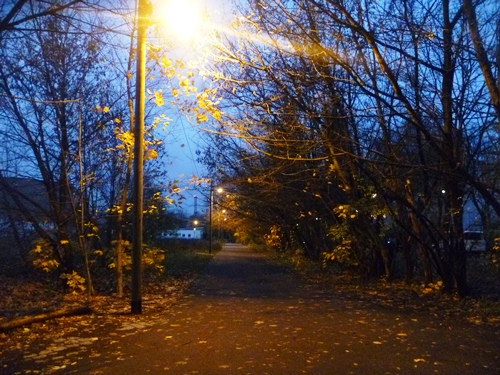
It was my own fault, only starting to walk at about half past three, and at this time of year the streetlights have already flickered into action and the main roads are a stream of white lights approaching and red lights retreating by the middle of the afternoon. Through the half-light I followed the line of cobblestones that marks the route of the wall past the Topography of Terror and through Checkpoint Charlie and its collection of memorials, exhibitions, souvenir shops and fast food joints, and then the site where Peter Fechter died and the enormous Axel-Springer building that houses publishing company of the same name.

Continue reading