Category Archives: Walks

Above the invisible city – Black Mountain, Belfast

BM1

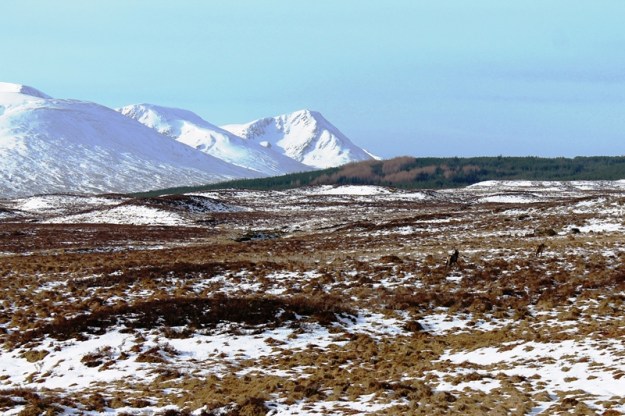
The day after Christmas we drove through the streets of West Belfast until they began to rise to meet the lower slopes of Black Mountain. Not that we could see it. As we reached the last house on the left, where Feargal lives, the fog not only blocked our view of anything above us but also the city we had left behind. So the visibility was poor and the ground was surely to be sodden, after the rain of the previous couple of nights, but we gathered together with Feargal and his friends the mood was good.

Just past the house a river runs beneath the road and there is a sign dedicated to Feargal’s dad Terry, whose poetry has appeared on these pages and who did more than anyone to get access to the Belfast Hills. The story is on Under a Grey Sky here, and sadly Terry died not long after. I never got to meet him, but my dad and Deena did and by all accounts he was a remarkable man. So we were walking in his memory, and that of Feargal’s brother – also called Terry – who was killed in 1998 and who had also loved these hills and the outdoors in general.
Continue reading

A year to elsewhere and back

Rannoch

It was in these quiet days between Christmas and New Year in 2011 that I started Under a Grey Sky, so as well as a look back on what has been going on over the past twelve months it is also something of a birthday. Although I haven’t been able to keep up the intensity of posting here over the last year or so, I remain very proud of the writing that I have published here in 2015 and remain incredibly pleased that so many people continue to read about my (and our) adventures beyond the front door.

At this point a year ago I had a couple of plans for the 2015. I had just finished work at The Circus after five years looking after their company communications and a decision to return to the world of freelance work. The first major plan was the launch of Elsewhere: A Journal of Place with my friend Julia. We published Elsewhere No.01 in June, followed by Elsewhere No.02 in September. Along the way we built a small team here in Berlin who helped us get the journal out there and put on a couple of events, as well as working with some excellent writers, photographers, musicians and illustrators from around the world. I am incredibly proud of Elsewhere and can’t wait to show everyone No’s 3 and 4 which will be published in 2016.
Continue reading

Caught by the Lagan, Belfast

Lagan3

Upstream

On a Sunday morning I meet the river by the entrance to Ormeau Park and turn left along the embankment, heading upstream. On the bridge railings a ghost bike hangs, painted white in memory of a fallen cyclist. Below me, on the water, a solitary rower aims downstream, towards Belfast Lough and the sea, towards the waterfront developments of the city centre and the yellow cranes of the shipyard, stroke after powerful stroke.

My route takes me past the gable end of terraced houses and the entrance to Botanic Gardens. There is no life in the Lyric Theatre this early, and I share the pavement with a couple of cyclists and a young woman walking purposefully past me towards town. Across the street tattered flags stake territorial claim on an estate lining a ridge above the river, looking down on an open grassy space where the bonfire will be built. An underpass takes me beneath the road about to cross the river and I pause at a sign marking the riverside route. The inscription begins: Continue reading

Meeting Julius Fučík in Pankow, Berlin

JuliusFucik

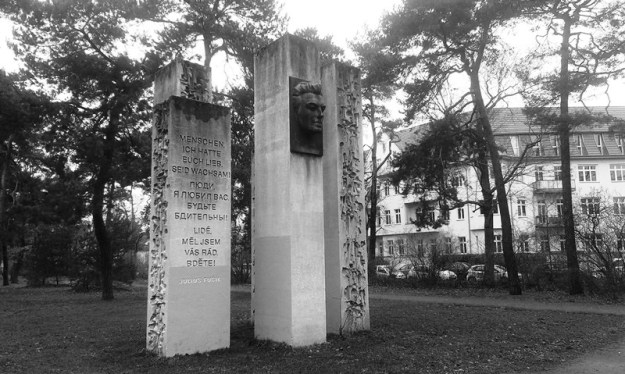
The park is deserted. I have walked here from home, a couple of kilometres along the Panke river from our apartment, past the garden colonies and old factories, past the football pitch and where the Berlin Wall once stood. It is a walk I have made many times, a corner of Berlin I have written about many times. More often than not we go this way in the summer, aiming for green open spaces of the park or the beer garden at its heart. We have celebrated birthdays here. Met friends. But on a weekday in December we have the park to ourselves.

The playground is empty, the swings gently rocking in the breeze as the sound of a plane coming in to land at Tegel fills the scene. The path by the river is muddy, churned by the bicycles of the school run or the journey to work. I look for the grey heron but he is not around today, just a handful of ducks on the embankment, heads buried in their own feathers. The bandstand is deserted. The beer garden too. A solitary runner enters at the far end, a flash of reflective orange from her jacket, but then she is lost to the path through the trees. Continue reading

Discovering the ruins at twilight, Berlin

Ruins1

The subtitle of this blog includes the phrase “dispatches from beyond the front door” and what I was getting at when I came up with it was the idea that you don’t have to look far for adventure and discovery, and that to find something new among the familiar you just have to look up or down, stop for a second, and basically just open your eyes. I thought of this again this morning as I read this short but interesting article on the polis blog by Min Li Chan, that included a quote from the Australian writer Gail Jones:

I’m very interested in psychogeography, and the idea that we must walk around our own place with an active intelligence and a degree of radical attention to what is there. … We ought not be the flaneur who is idly and languidly consuming the sights of the city, we must look at its shapes, at its motions, attend to its sounds, corridors between spaces, the unexpected things looming up or falling away as we turn a corner. Continue reading

Among the trees and above the ruins, Beelitz

Beelitz1

The Beelitz Heilstätten stands in the forest some 35 minutes by train south of Berlin’s Zoologischer Garten station. This hospital and sanatorium complex opened in 1898 as one of the biggest tuberculosis clinics anywhere in the world, and by the outbreak of WW1 had developed to include its own power station, water tower, laundry and restaurant, farm and post office. Between the wars it developed even further to occupy over 200 hectares of the forest, and following its use as a military hospital during WW2 it was occupied by Soviet forces until their final withdrawal in 1994.

The Beelitz that we explored earlier this week under soft October sunshine is the crumbling ruins of an almighty complex abandoned with the Soviet retreat and pretty much left to nature and the attentions of (sub-)urban explorers and graffiti artists. The buildings are landmark protected, but the scale of the complex makes it hard to imagine what kind of project could bring life back to these structures in the woods. And so they are left, trees and plants growing on balconies and roof-tops, the buildings slowly being swallowed by the forest as people walk amongst them, for it seems that ruins – and not just of the antique variety – hold an endless fascination for many. Continue reading

On foot through Epping Forest

EF1

Buckhurst Hill

The underpass beneath the tracks at Buckhurst Hill tube station had that smell, that mix of urine and rain and absence of natural light, and so I quickened my step. I was running, not from anything in particular but because this is what I do most mornings and just because I was in Essex I saw no reason to change my habits. On the ramp up, back to fresh air, my footsteps startled an Arsenal fan, dressed for the match and on his way into town.

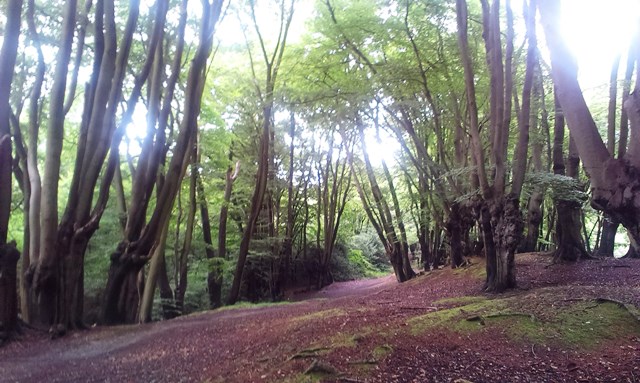
I had no real plan of where I was going to run, except a quick look at Google Maps offered up a green space on the other side of the railway from where we were staying. Lord’s Bushes and Knighton Wood. From the tube station I picked my way through residential streets until I came to a road called Forest Edge, and began to look for a way in. Forest Edge, because this collection of trees surrounded by the suburban streets of Buckhurst Hill and the north end of Woodford belong to Epping Forest, that ancient woodland that stretches from Forest Gate, not far from Stratford and the extravagant and impressive folly of the Olympic Park in the south, to Epping in the north. Continue reading

What can be found at the end of the line… Wittenau, Berlin

Wittenau1

It has been a crazy month. It appears that launching Elsewhere, a new journal of place, even more than a blog about adventures beyond the front door, means you spend more time in front of a screen, behind piles of paper, or in climate-controlled storage facilities (that are at least a kind of Elsewhere because they could indeed be anywhere) than you do exploring the world around you. I am reading submissions based on places in Australia and Rwanda, the islands of Scotland and the two sides of Budapest, and it is all very inspiring if only we had the t…

No. There is no need for this. In my diary I have a note, scribbled every Monday. UaGS. It means don’t neglect the blog. Don’t forget the blog. But I have been neglecting and forgetting, and then I remember… adventures beyond the front door. That is how all this started in the first place. You can go to Rwanda and leave it all behind. You can go to the islands of Scotland. Or you can take a morning and, if you live where I live, you can go to Wittenau.

Continue reading

A walk to (and along) the border, Ahlbeck

Ahlbeck1

This post is from a trip Katrin and I made to Usedom in February this year… another Baltic exploration:

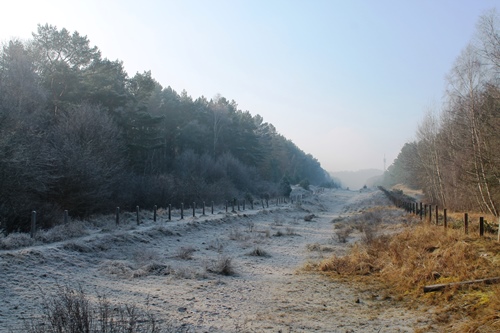
The Europapromenade leads the walker or the cyclist, the jogger or the rollerblader, out from the town of Ahlbeck on the island of Usedom in a straight line between the trees. The surface is smooth, the path lined with benches to rest and public toilets and bike parks at the points along the route where there is access to the beach beyond the trees and the dunes. Ahlbeck is the last town in Germany, and the promenade is well-named, linking as it does the bathing resorts of Usedom on both sides of the German-Polish border.

Continue reading

Great Reed Warblers, Rowing Clubs, and Fat Mary… Tegel, Berlin

Tegel1

Just around the headland, having left the small village of Tegelort behind to once again be walking between the woods and the water, we were halted on the path by the noise. It was an incredible racket, disturbing and otherworldly, of frogs impersonating birds or birds impersonating frogs. We gazed down from the path, into the reeds, but there was no sign of what type of life was making the sounds that seemed to be surrounding us. Later, I listened to sound files on the internet, trying to trace it to source. The Great Reed Warbler seemed to be the closest, and once more I marvelled; this time at footage of a small bird capable of such an uproar.

Continue reading