Category Archives: Places

To the market – Kollwitzplatz, Berlin

The market at Kollwitzplatz takes place every Thursday and Saturday, on this square in the neighbourhood of Prenzlauer Berg – a neighbourhood that was once the centre of bohemian life in East Berlin and has become, since the fall of the wall, one of the trendiest districts of the city and a central flashpoint in the gentrification debate. Here’s what our friends at Slow Travel Berlin have to say about the market itself:

Continue reading

A Wintery Flinders Sunday Afternoon…the Fondest of Childhood Memories

By Bree Carlton:

After a frantic Sunday morning spring cleaning and gardening, we decide to venture out with Isaac and Oskar down to Flinders Beach. It’s a wintery, devilishly freezing day but the weather is changeable. On our drive down the coast we move from fits of drizzle to bursts of sunshine. The sky is yellowy golden and dramatic; the big billowy white and purple clouds scattered and interspersed with deep patches of blue and dramatic rainbow arcs.

Flinders is located on the tip of the Australian state of Victoria where Western Port Bay flows into the Bass Strait. It is well known for its picturesque national parklands and wildlife, crisp air blown fresh off the Antarctic, and its beautiful safety and ocean beaches. But for me Flinders holds the richness of fond childhood memories. Mum and Dad used to take my brother and me there when we were kids. Years ago Dad made our livelihood as a ceramic artist. On weekends he used to deliver his wares -crockery; vases; tea and dinner sets- to various art galleries and craft outlets up and down the Peninsula coast. Bittern, Red Hill, Balnarring and Flinders were just some of the places we visited on listless Sunday afternoon drives.

Continue reading

Storkower Straße, Berlin

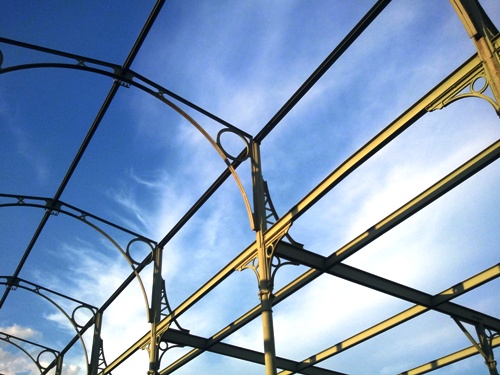
Walking to Sean’s new apartment on Friday we had to pass through the strange open spaces just south of the Storkower Straße S-Bahn station. This was once the central stockyard and slaughterhouse for Berlin although on even my old GDR maps this was referred to as its “former” function and until the 1990s it appears to have been little more than a wide open space. In the past decade or so the area immediately around the station has been filled with car parks for box-like shopping halls, some of the stores have built themselves into the old frameworks of the former buildings. Other metal frames have been left open and uncovered, standing in a patch of parkland, with grass growing beneath the iron skeleton, and locals drinking beer or grilling on those disposable barbecues as kids ride their bikes along ad hoc, dusty pathways.

Continue reading

On the Baltic coast, Wustrow

A late springtime trip three hours north of Berlin…

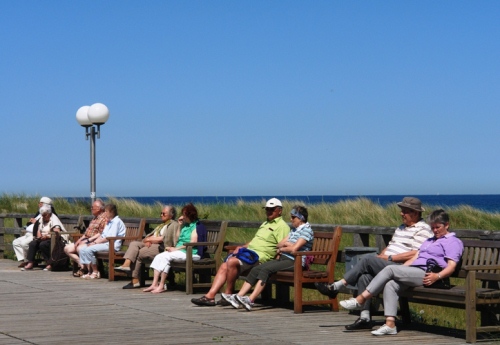
We walk along the dune-top path towards Wustrow, occasionally moving to one side to allow lycra-clad cyclists to whizz past, some on their way to the next town – perhaps to grab the last available beach chair down on the sands – others stretching their legs on the Ostsee-Radweg, the Baltic bike path that hugs the German coastline between the Polish border and the Danish. At Wustrow the pier stretches out above the calm waters. All the benches are taken. Walkers and cyclists rest. Couples enjoy the view. An old man scratches the solution to crossword clues onto a folded paper.

Down on the sands tattooed sunworshippers are building their their little patch of territory around their striped, rented beach chair, but only their dogs are hardy enough to brave the chill of the May waters. A kindergarten class walks along in formation, and is surprisingly quiet, but the kids still receive a look of distaste from the angler on the pier who wishes he had the whole place to himself.

Continue reading

Green revolutions in Cloughjordan

By Barry Sheppard:

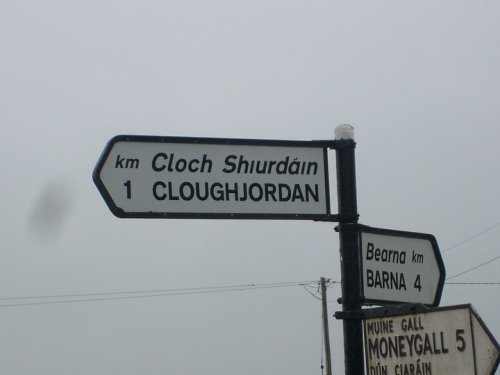
The town of Cloughjordan, Co. Tipperary, is what can be described as a typical rural one-street Irish town in the ancient province of Munster.  It straddles the invisible county border of North Tipperary and Co. Offaly and is situated only several kilometres away from what was the centre of the world for about an hour almost exactly one year ago when a man named Obama came to drink Guinness and tread the footsteps of his ancestors.   Shortly before he embarked on that Irish-American vote clocking journey to Moneygall I embarked on a similar one to Cloughjordan to view the land of my forefathers.   Armed with a camera and a quest for my own personal history I embarked on the 714 mile round trip from Belfast, which inexplicably took me through Limerick, to the small town of Cloughjordan.   Disembarking from the train with slightly less fanfare than the ‘leader of the free world’ I walked a further kilometre to reach the town and on that pleasant spring day it was easy to see why its most famous inhabitant, the poet and revolutionary Thomas MacDonagh, once described it as a place ‘in calm of middle country’.

Continue reading

Of pens and pencils – sketching and a sense of place

(above: Charlottenburg, Berlin – Rolf Schröter)

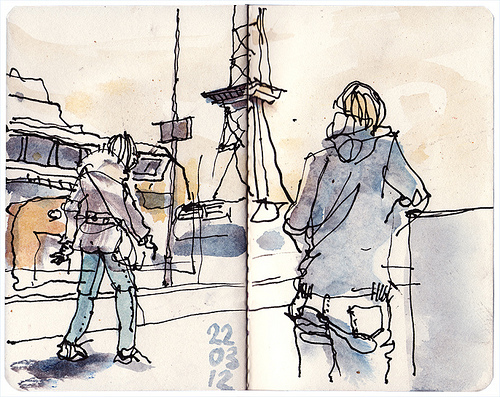
I first met Rolf Schröter when we organised a Slow Travel Day at the Circus last year, and he came along with the other members of Urban Sketchers Berlin to put together a sketching tour for people who fancied the chance at trying to capture their immediate environment on paper. Since then we have seen each other a handful of times, usually at a similar events, and I think that I probably would not recognise Rolf if he did not have his trusty sketchbook in hand.

Continue reading

Walking through memories, Berlin-Hohenschönhausen

This is the hundredth post on Under a Grey Sky. Before we begin, I would like to take the chance to thank everyone who has contributed to the website, as well as all of you who have taken the time to read it. Here’s to the next hundred…

A week or so ago we took the tram from where we live in Berlin-Wedding across the north of the city to Hohenschönhausen; part family outing, part mission to discover some of the secrets of this neighbourhood. It is not the most famous of Berlin’s districts, but as with everywhere in this city the streets of Hohenschönhausen had plenty of stories to tell.

There was Berlin history of course – from the site of the first Plattenbau built in the early 1970s to solve East Berlin’s housing shortage, via the only private house designed by Mies van der Rohe and a lesser-known housing estate by modernist architect Bruno Taut, to the thick walls of the Stasi Prison and a small, sidestreet Soviet memorial – but more personal than that were Katrin’s stories, as this is the neighbourhood where she lived throughout her teenage years.

Continue reading

In the Pankow Bürgerpark, Berlin

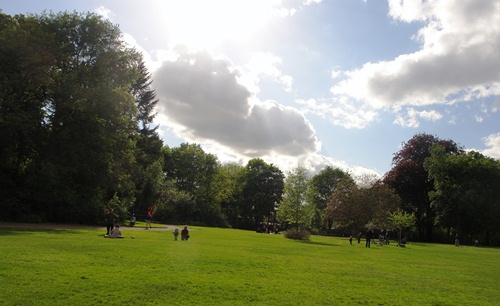
Saturday afternoon and the weather is unpredictable. In May you have to hope for a nice weekend, and this one is not sure how exactly it wants to be. When the sun comes out it is too warm for a jacket. When it hides behind the cloud it is too cold for a jumper. It is a reminder that summer is not yet here.

But still, with the first sign of sunshine and the first blossom on the trees Berliners head outside, to the beer gardens, the playgrounds, and most of all, the parks. At the Bürgerpark in Pankow families kick footballs around on the grass, or attempt to launch kites into the blustery sky. The goats grazing behind high fences look unimpressed at being watched by young kids in football shirts, waiting for a cup final that will take place past their bedtime. The beer garden is half-heartedly open, with sausages on the grill and beer on tap, but the shutters are down on the ice cream stand as if to say, “come on guys, not yet…”

Continue reading

No history on the long ridge?

Barry Sheppard looks back on the town he grew up in, and reflects on the stories you can discover in the places that you thought you knew so well…

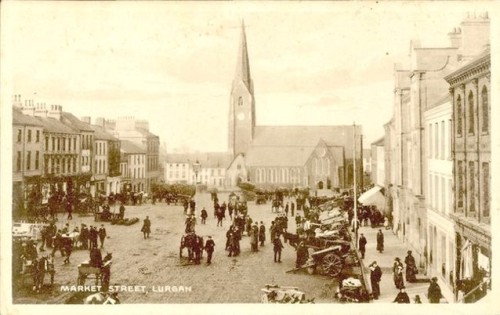
When I was told the name ‘Under a Grey Sky’, only one thought popped into my head; home. Growing up in Lurgan there were plenty of grey skies overhead.  I’m not saying it was dull, grey and boring – although it was at times like that – it is merely a passing comment on the usual state of the weather in that part of Ireland.  For the sake of clarity I should point out there are several town lands of Lurgan in Ireland, one in Co. Galway, one in Co. Mayo and one in Co. Cavan.   The Lurgan I spent the first nineteen years of my life is situated in Co. Armagh in the often disputed six north-eastern counties of Ireland.  For those who don’t know, the name Lurgan is the anglicised re-branding of the original Gaelic name an Lorgain which means ‘the long ridge’.

In the nineteen years I spent in Lurgan before departing its designated electoral boundaries, I can honestly say that not much out of the ordinary really happened.   Some may dispute this or say I have lightly glossed over the previous number of decades of conflict, but to that I would say that for my generation that was the ordinary.   Anyway, back to the long ridge.  In the norm people did the everyday things as they do everywhere; school, jobs, marriages, pub and bookies, and not always in that order.  It seems that it was the normal drill since time immemorial, or since the plantations.  It would be fair to say that there were not many who thought too hard about the history of their surroundings.

Continue reading

RSPB Marshside, Southport, UK

Chris Hughes on the birds of Marshside at the Ribble Coast and Wetlands Regional Park:

The River Ribble flows from Yorkshire via Settle, through Clitheroe and Preston in Lancashire and out into the Irish Sea between Lytham St Annes and Southport, a total length of 75 miles.  It is tidal for 11 miles up to Preston and the estuary is 10 miles wide.

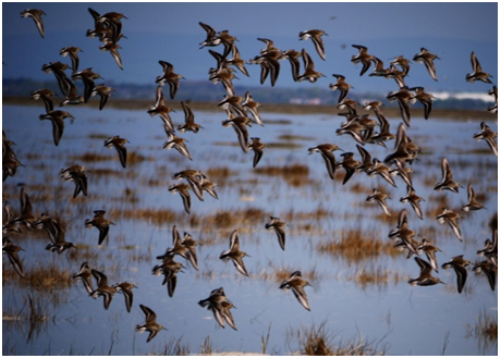
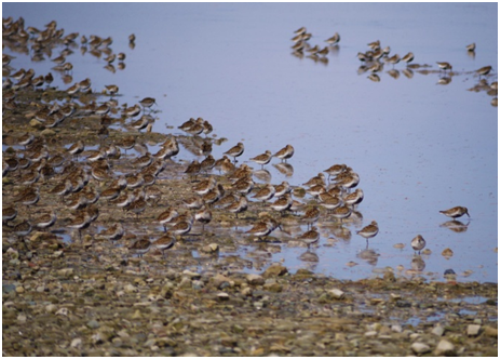
Up to 340,000 water birds over-winter on the Ribble estuary making it the most important wetland site in the UK.

In the 1960’s the last new sea bank was built north of Southport using household rubbish for the core of the bank and later the coastal road was built on top. Finished in 1976 it enclosed a large area of salt marsh which later became fresh water marsh. In 1994 the RSPB leased the marsh from Sefton Council and the RSPB Marshside Nature Reserve was created.

The reserve is now part of the Ribble Coast and Wetlands Regional Park, and is recognised as internationally important for several species of waterfowl.

Continue reading