Category Archives: Places

Beers under a grey sky at Berlin’s Prater Garten

At Berlin’s oldest beer garden it is the first weekend in May, the flowers are blooming on the trees, but the shutters are most definitely down, behind which are locked beer taps that will not be flowing with Prater Pils. It seemed like the perfect time to head out for the first beer garden afternoon of the year. The skies may have been overcast all morning, and there is a slight chill in the air, but we have sipped beers in the rain here before, sheltering under those generous branches that provide shade on better days, or under the roof where they place the big screens for football tournaments.

Luckily the Prater has a restaurant, and they are more than happy to serve us some drinks to take out into the beer garden which we then have pretty much to ourselves. The kids do not have to wait for the swing in what is often both Berlin’s smallest and busiest “playground”, and we have our pick of the benches and tables. There is no sausages on sale, pretzels or pasta salad, but the burger place across the street is open and for once, there is no-one to object to us bringing in our own food.

Continue reading

Above the cliffs of Duino

In January 1912 the poet Rainer Maria Rilke was staying with the Princess Marie von Thurn und Taxis-Hohenlohe at the castle in the small village of Duino, just up the coast from Trieste. It was whilst staying there and walking along the clifftops, that the first line of what would become the Duino Elegies – one of his most celebrated works – came to him.

Who, if I cried out, would hear me among the Angelic
Orders? And even if one were to suddenly
take me to its heart, I would vanish into its
stronger existence. For beauty is nothing but
the beginning of terror, that we are still able to bear,
and we revere it so, because it calmly disdains
to destroy us. Every Angel is terror.

(Translated from the German by A.S. Kline, here)

Continue reading

By the Rummelsburg Bay

And we went down to the river…

We climb down from the S-Bahn inside the new hall at Ostkreuz station, all shiny and bright before dropping down the staircase to street level and into edgeland. Somewhere beyond the junkyard is a football pitch. Abandoned buildings peel in the shadow of the new train station. A lonely pair of houses still show some sign of life, and the memory of when they must have been part of a much longer row before… what? Bombs? Socialist planning? A change of mind?

One patch of wasteland by the river Spree has been snapped up, no doubt cheaply, by a company specialising in team-building exercise, and they have turned it into a giant playground for adults, complete with tree-houses and rope-slides, beach volleyball courts and a launch to get corporate middle-managers and their kayaks out onto the open water. As we pass it seems as if the day’s activities have come to a close, as the group sits on benches, with bottles of beer to toast a good day’s work.

Continue reading

The Ardnamurchan Peninsular

A journey to Scotland, by Sheila Scraton:

It all began with one of ‘those conversations’. “If you could have a holiday this April anywhere in the world where would you go?”  Well, having thought of Cuba, Costa Rica and other destinations that have always been on my wish list, I suddenly said “ Well, taking all things into consideration, what I’ve always wanted to do is rent a van and go to Scotland!” So, with partner in agreement the planning began and just before Easter we set off to pick up our rented vehicle in a little village called Saline, near Dunfermline, Scotland. Early April is always a weather risk in the UK but we were given great confidence by the unseasonable heat wave that hit Britain in March. However, as we packed to move north, snow was forecast with weather warnings reverberating around our ears.  I’m sure all who know us were saying, “A camper van in April in Scotland – you must be mad!”

We had decided to focus on the Ardnamurchan peninsular containing the most westerly point of the British mainland.  Ardnamurchan (Áird nam Murchan, headland of the great seas) is one of the most stunning and remote parts of the Scottish coast.  I have always loved the west coast of Scotland, walking and climbing in the Cairngorms, Torridons, Glencoe, Skye, Kintail. It just feels so special with dramatic, rugged mountains rising up straight from lochs and the sea, inspiring feelings of remoteness and majesty.

Continue reading

Saturday Morning in Belfast

Phil Scraton on a springtime walk through the city:

I’ve always resisted routine, not sure why. Saturday morning in Belfast is an exception. Out of the house, through the park, along the river, across Botanic Gardens, pick up the Guardian, into the University, water the plants, catch up on work and home for lunch. How did this sequence, steps retraced time and again, become so regular? Is there a suppressed inner self yearning for sequence, a wandering spirit in search of a comforting route? Even when I took up running, I altered course each day, rarely covering exactly the same ground.

Mid February and there’s been no snow, no frost, no winter. What a difference a year makes. Returning from Berlin a year ago the challenge was water pouring through ceilings. Today the news tells of a drought in South East England and record high temperatures in the Midlands. Tomorrow the mercury falls to almost freezing. The seasons have levelled to a kind of constant Fall.

Leaving the quiet of the house, the noise is deafening. A cacophony of birdsong as the choristers assume Spring’s premature arrival … little wonder – the buds on the horse chestnut trees have broken, their new leaves dancing free of constraint. School hockey matches are under way and shrill voices echo through the houses. Within minutes I’m walking the tarmac track through the golf course leading into Ormeau Park.

Continue reading

Climbing the Flak Tower at Humboldthain

Last weekend we decided to climb the rubble hill of Humboldthain to take a look at the remains of the Flak Towers that stand there among the trees, looking out across the city. I have been in this park many times, but for whatever reason I had never been up to look at the towers that were built between 1941-42 as part of the anti-aircraft defences of the city during the Allied bombing raids of the Second World War. The tower, that was designed to be bomb-proof, also provided an air-raid shelter for up to 15,000 civilians.

Continue reading

Remembering 15 April: Reflections on Memory and Place

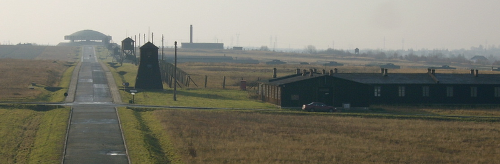
(above: Majdanek concentration camp. Photo: Ralf Lotys)

by Phil Scraton:

We left the coach quietly, idle conversations of the journey overtaken by due reverence to our destination. Wandering the path through well-kept grass speckled by bright red poppies, I entered the red brick building alone. Inside it was barren, empty. Above my head were rusting shower heads. A bath house, a death chamber into which Zyklon B was released to gas people of all ages and diverse backgrounds; naked not for showering, but for swift transportation to mass graves or incineration.

Overwhelmed and without warning I sobbed uncontrollably. Leaning on the wall against which the dying collapsed, I pressed my flushed cheek against cold brick as if to self-inflict pain. On leaving the desolation of the chamber to the blue sky, bright sun and rustling trees I trembled, overcome by vicarious grief. Walking slowly I looked across Majdanek where some 80,000 perished, over 18,000 on one November day in 1943. In the foreground stand the huts, fences, watch-towers and the Mausoleum containing the excavated ashes of so many who died. The backdrop is the busy Polish city of Lublin. Continue reading

Walking the Neighbourhood

Do you remember when, we used to sing…

This week the Pictoplasma festival of character design and art is taking place in Berlin, and alongside the conference and screenings that make up the central focus of the event, twenty venues mostly in the neighbourhood of Mitte (including The Circus) are hosting small exhibitions. Pictoplasma have distributed maps as part of this Character Walk, and people are tramping the streets to see what weird and wonderful things they can discover.

It is a lovely idea, and we joined in. What struck me as we were walking, first along the Torstraße and then along the Rosa-Luxemburg-Straße to Alexandeplatz and then back up past Hackescher Markt to Rosenthaler Platz, is that this triangle has been the centre of my Berlin life ever since I moved here over a decade ago, despite the fact that apart from the first weeks at the hostel, I never actually lived within it. It was in the small hostel bar on Rosa-Luxemburg-Straße (now an office) and then Kaffee Burger that I spent my first evening in the city. I ate kebabs from a shack where now the Wombat’s Hostel now stands.  I walked down to Alexanderplatz to buy the Guardian, and stopped for a coffee in a café that has long since disappeared.

Continue reading

Requiem for a Sycamore – Hatchet Field

(above: Hatchet Field, photo: Ciarán Ó Brolcháin)

In yesterday’s article, Beatrix Campbell interviewed Terry Enright, whose poem Requiem for a Sycamore, pays homage to the small clump of trees that populate the Hatchet Field. The field is unique, its grassland and sycamores contrasting with the bracken and heather of the hillside.

Requiem for a Sycamore

I saw you looking down,
Majestic
Your mighty branches spread,
Like muscles on a giant,
500 thousand leaves, and more,
Love letters carved on your bark
The beauty of the hill

You were my shelter from the sun,
Cover from the rain,
I sat in the silence of winter snow,
A single Wren stared at me,
Wondering
Voices whispering in the wind,
High above everything

War in the streets below,
Spies in the grass,
Watching
Happy children swinging on a single rope,
Flying over Belfast without wings,
Oblivious
To the pain and joy you have seen

Now I sit on your prostrate corpse,
Felled by November storms,
I lament your passing,
Nature, like life itself,
Demands a price, we all must pay,
Still I cherish, the pleasure we have shared,
High up in the Hatchet Field Continue reading

Open to all – the tale of Black Mountain

(above: Divis and Black Mountain, taken from Cave Hill. Photo: Phil Scraton)

This month is the 80th Anniversary of the Mass Trespass of Kinder Scout, an act of disobedience by ordinary ramblers that had a massive impact on public access to open countryside, but there would remain many places that were off limits. In 2005, the people of Belfast finally regained access to the Black Mountain that overlooked their city. The following article by Beatrix Campbell originally appeared in the New Statesman, and we are grateful to Bea for her permission to re-publish it here:

The man stands at the peak of the Black Mountain and his eyes scavenge the startling Mediterranean blue of the sky above Belfast. “Where is the little bastard?” he murmurs. “Ah, there he is. Now isn’t that lovely?”

He’s spotted a skylark. The soundscape is silence and skylarks and meadow pipits and his feet on heath and heather and lush, black bog. It is the beginning of June 2005, and before the month is out the Black Mountain will be open for the first time to the people.

Terry Enright slowly turns 360 degrees. “I’ve never seen this before,” he says. “It’s never been so clear.” What he sees is Scotland far over to the east, and the Isle of Man, and when he turns inland there is Lough Neagh – the biggest lake in these islands – five of the Six Counties and Donegal on the west coast. Down below is the bowl of Belfast. “The people of Belfast never saw this. They live here but it’s not been part of their life.” Enright lives here, too, on a Ballymurphy council estate nesting at the bottom of the mountain that skirts the city skyline. But he made it his mission to move around the mountain. Continue reading