Category Archives: Places

On Morecambe Bay

.

by Phil Scraton:

It is often remarked that death knows no hierarchy: born naked, die naked. Yet how the living transform death’s meaning. Understandably when tragedy strikes we stand emotionally and physically alongside the bereaved as they mourn their loved ones. In the aftermath of multiple deaths the intensity is collective. The randomness of disasters, of who survives – who perishes, reminds us that it could have been me, my brother or sister, my mother or father, my son or daughter, my friend or neighbour. Towns, cities, villages become forever blighted by the deep sadness associated with their names.

Throughout the year, particularly in summer, the sands of Morecombe Bay, to the west of Lancashire’s coastline and the south of Cumbria’s beautiful Lake District, attract thousands of walkers. The most famous Morecambe Bay walk crosses the mouth of the River Kent, from Arnside to Kent’s Bank. Guides understand the complex movement of the tides and the channels they weave between and within the ever-shifting sand banks. What attracts walkers – the miles of flat sand against the backdrop of the northern mountains, the desolation and openness – is also its inherent, seemingly benign, danger. Continue reading

A Favourite Walk – The Rhoscolyn Headland

By Paul Scraton:

If there would be one walk I would love to have available to me every Saturday morning, it would be the short loop from Outdoor Alternative, around the headland to Borthwen, and then back up the gravel track to home. It is not a long walk, and if you don’t stop for the views across Anglesey to Snowdonia, or to explore the rock pools and sandy cove of Shelly Beach, or a quick ascent of Red Devil Rock, you can be out and back in less than half an hour. Continue reading

Giddy with the first taste of spring

Or how Berliners feel when they can finally leave the winter behind…

It is the first fine weekend of the year, and it feels as if the streets and the transport system are being over-run by the crazies and the daytime drinkers who have been – where? – throughout the winter but have re-emerged into the beautiful sunshine that makes Berlin and Berliners (a grey city with gruff locals) threaten to even smile at one another and share a kind word.

The first few sunny days of the year are always slightly disconcerting, as if everyone has forgotten how to deal with the freedom of walking the uneven pavements without the restriction of heavy coats, hats and gloves, or the freedom to sit at outside tables or take a blanket to the park… it is not that those people on the U-Bahn are really crazy, or that the daytime drinkers are going to necessarily make a habit of it, it is just the excitement of spring. Everyone is simply a little giddy. Continue reading

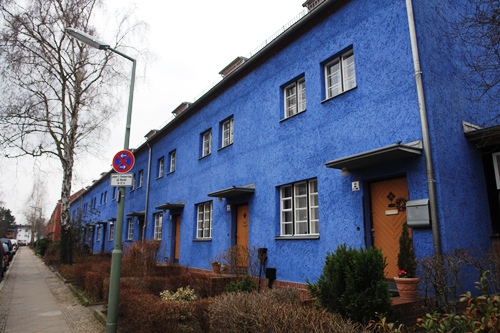
The Horseshoe of Berlin-Britz

Exploring the social housing estate that is recognised by UNESCO as one of the finest achievements of modernist architecture:

Between 1875 and 1900 the population of Berlin more than doubled from 970,000 to over two million, a growth that began with the unification of Germany and industrialisation driven by the development of the railways. Many of these newcomers ended up living in tenement blocks built around a series of dank and dreary courtyards. By the end of the First World War the average one-bedroom apartment was shared by five people. This situation obviously had health implications, but was also a social and political challenge for the post-War Weimar Republic.

It was this challenge that led to the birth of a number of different cooperative building societies in the 1920s, whose stated aim was to bring social reform approaches to solving the housing crisis. In contrast to the tight and cramped tenement blocks of the 19th Century, the Modernist architects employed by the building societies laid out plans for housing that would be open and airy, with green spaces, public areas and playgrounds, and part of a re-imagining of the city that was to have both positive social and political consequences. Continue reading

The Ted Hughes Poetry Trail at Stover Country Park

By Tim Halpin:

I sat on a rustic bench – a sawn section of trunk mounted onto two stumps – beside The Warm and the Cold, point two on the Poetry Trail. Twenty metres behind me was my car. I could have heard it ticking as it cooled down, but the sound was drowned out by wave after wave of cars on the A382, just the other side of the car park. Equally incessant was the birdsong. A robin sat halfway up a young oak growing beside The Young and the Cold, furiously exchanging trembling phrases with another robin in the trees shading the car park. The South West of England was blanketed by a warm trough of air in a stable high pressure system whose centre covered the whole of the Bay of Biscay. It was a warm Spring day, and Ted Hughes’ similes seemed strangely out of place.

Moonlight freezes the shaggy world
Like a mammoth of ice.

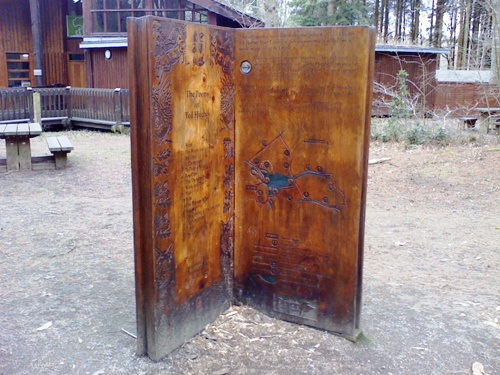
Of course, they were out of place. The trail began at a giant book carved out of wood, engraved with a map of the park and a short introduction to Ted Hughes. The poems themselves had escaped from the book, to be written on granite tablets along the Poetry Trail. The Stover Country Park had done what I do, and taken the writing outdoors. But it seemed that they’d gone further than me, taking the poems so far out of their literary context that they do not even mention which poetry collection they are from. The idea was that the poems would add to the visitors’ enjoyment of the park. I was more interested in what the park does to the poems. Continue reading

Twice around the Schäfersee, Berlin

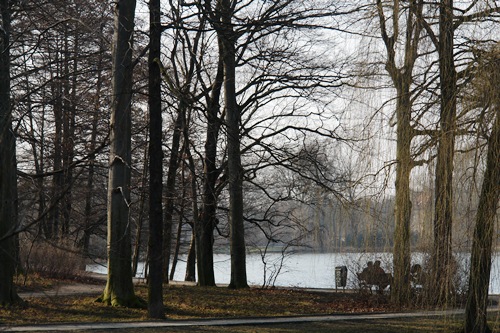
A weekend morning at the Schäfersee, a small body of water just inside the Reinickendorf border, a few hundred metres from the local chapter of the Hell’s Angels, in the north of Berlin. It is only a few kilometres from our apartment, but apart from perhaps on the bus up to Tegel, this is a corner of the city I have barely touched in the ten years I have been living here. The buildings around a typical for the neighbourhood – old worker’s apartment blocks from before the war, when Wedding and Reinickendorf were centres of industry in the city, plus a few post-war blocks of flats that look more peeling and crumbling than their older neighbours. An then there are the open spaces, perhaps planned or where, maybe, stray bombs fell. During the Second World War a nearby flak tower shot down a Soviet plane which then landed in the lake and, as yet, it has never been recovered from the depths. Continue reading

Walking the Berlin Wall Trail

Berlin’s Mauerweg – The Berlin Wall Trail:

Borders are always interesting places. As someone who grew up on an island where a land border meant waiting for the first signs of ARAF painted on the tarmac as we left Cheshire for North Wales, the idea of crossing from one country to another by car or, even better, by foot remains a fascinating proposition. For the urban wanderer borders are also the location for much that is worth discovering, whether it is the border between neighbourhoods, between the inner city and suburbia, or the edgelands that mark the often muddled and blurred boundary between the urban and its hinterland.

In Berlin of course we have a structure – or for the most part the memory of a structure – that if you follow its 160 kilometre length will offer up all of the above, as well as the reminder that once where Wedding becomes Prenzlauer Berg or Mitte becomes Kreuzberg was not just the matter of crossing a street from one neighbourhood to the next, but an international border guarded by concrete slabs, barbed wire, and guards with guns. Continue reading

Winter walking in Austria

By Chris Hughes:

The vast majority of people who choose winter holidays in Austria do so for the skiing – great downhill and spectacular cross-country skiing exists in many villages all easily accessible from the UK after a short flight and coach transfer. If you prefer to make your own travel arrangements then many villages are on the railway line out of Innsbruck. Seefeld and the next valley of Leutascsh are especially good for cross-country skiing having hosted the winter Olympics events, there are kilometres of prepared ‘loipertrails’ of all levels of difficulty.

But best of all, from the point of view of the walker, there are equally large amounts of cleared winter walking paths. The paths are well signposted, set out on maps available from the Tourist Information office and offer flat or slightly hilly walking through beautiful countryside, woodland and riverside locations. The snow conditions do vary from year to year and month to month but December to march is a pretty reliable time from good winter walking conditions. Continue reading

Starlings on the pier, Brighton

By Matt Lancashire:

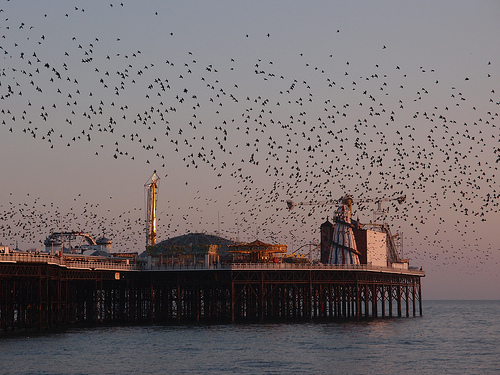
Brighton has a split personality – it can’t shake off the fact it’s a Victorian seaside town of arcades on the pier and sticks of rock, but it’s also a vibrant, gay-friendly and modern town which hasn’t just rested on its laurels wondering why no-one comes to visit any more. Commonly known as London-by-the-sea, it’s only an hour away from its big brother by train and similarly filled with boutique shops and fashionable media-types. It exists as a half-way house for Londoners to dip our toes into the rest of the country and clear our lungs, without ever feeling that we’re out of our depth or too far from home. Continue reading

Embassies of Prenzlauer Berg

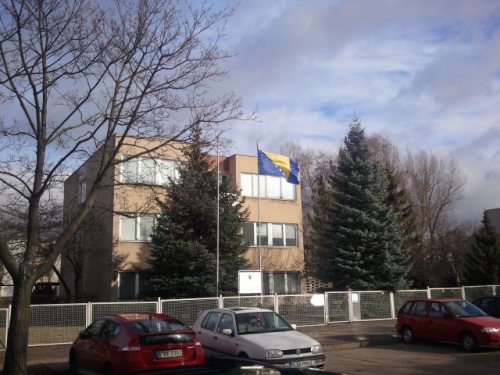
Walking through Berlin you often stumble across reminders of the long division of the city. There are of course the famous examples, such as the stretches of Berlin Wall at the East Side Gallery or on Bernauer Straße, the Checkpoint Charlie museum or the line of cobblestones that cross city streets along the path of the wall to remind you how this incredible, brutal structure split Berlin in two. There are other symbols as well that are perhaps less obvious. The tram that runs past my house is one of only a couple of stretches of working tram-track that run through the western districts of the city. Before the division the whole of Berlin was served by the tram network, but in the west they were replaced by buses. Now, in parts of the city, they are returning but in general you can apply the rule; if you can see a tram, you are in the old east. Then there are the differences in architecture, the newspaper reading habits in different neighbourhoods, and even voting patterns… Berlin is coming together, but it could take more years than the wall actually stood before all the traces of the division have been removed from the city. Continue reading