Category Archives: Places

Weather and the sense of a place

By Sharon Blackie:

We are told by the older residents of our local crofting townships that this autumn and winter have been the worst in living memory here in the Outer Hebrides. Wetter and windier. It’s true that we seem to have been battling gales since October, and the already boggy ground has been sodden for months. In November, on our personal blog, I wrote a post, The Gods of Days, in which I talked about wind and suggested that there was little point in living in a place where the dominant weather was wind and rain, and then sitting indoors and complaining about it when it was windy and raining. Of course, a lot of wind and rain has happened to us since November … and a couple of normally hardy friends are now jumping up and down and demanding that I recant and admit that wind and rain is a terrible thing and that I wish it were mild and sunny like everyone else does.

At one level there’s no question about it – I’m tired of battling the wind and sloshing about in the mud when it’s time to feed the animals and walk the dogs twice a day, because this has to be done whatever the weather. I’d be ecstatic if a few mild and sunny days happened along, and I’m eagerly anticipating spring like everyone else … but the truth about weather, about our relationship with weather, is very much more complicated than that. Continue reading
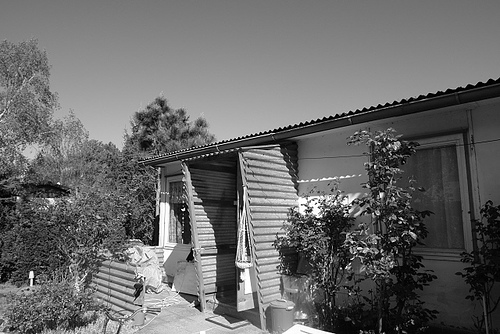
A bungalow by the sea

Sea mist hangs over the rutted, ploughed fields. It hangs between the long line of poplar trees and the narrow dirt track that leads from the bungalows, through the dunes to the beach. Down there, looking out to sea, visibility is perhaps fifty metres at most. Waves roll through the mist, the world enveloped in grey, the air damp and chilly.

Most of the bungalows that stand in this colony beneath the poplar trees during the days of the German Democratic Republic. They are in varying states of repair, some peeling and flaky as if the last substantial work was done during the socialist era, whilst others are mini-palaces complete with satellite dishes and fine collections of cheerful garden gnomes. Continue reading

Postcards from the Panke, Berlin

Last week I sent an email to the guys at Caught by the River about the Panke river here in Berlin, and today they published it on the site. You should take some time to read through the archives, as it is a website I really enjoy that was quite an inspiration for Under a Grey Sky. I also thought, having picked out a few pictures to send them, I would take the opportunity to show a few more. Continue reading

Last exit before the autobahn: the Plötzensee, Berlin

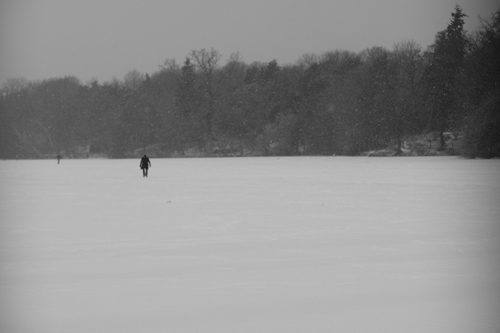
We took the tram from outside our building to the end of the line. There were only a handful of passengers when we got there, the tram stopping just before the point where the Seestraße becomes the autobahn and normal city life is handed over to the roar of car engines or, more likely, the traffic jams of rush hour. A disembodied voice told us in two languages to climb down from the tram and into the cold. Most turned left, into the enormous campus of the hospital. We crossed the street in the other direction, towards the frozen expanse of the Plötzensee. Continue reading

Dance of the paddles: A reflection on sea kayaking to the Skerries

Andy Short on a winter paddle off the coast of Anglesey:

The Isle of Anglesey, off the North coast of Wales, is renowned within the sea kayaking community. Its location may be a mystery to many in the UK, but sea kayakers from Scandinavia to the States wax lyrical about classic trips the island offers, and ‘the Stacks’ and ‘the Skerries’ are foremost among them. These are trips which conjure among the initiated visions of epic tide races and awesome overfalls.

Anglesey – Ynys Mon in Welsh – is a large squarish lump of rock 25 miles from end to end, protruding impudently into the Irish Sea. Its very existence is like a challenge to the sea, whose tides sweep past on their daily lunar rituals, filling the Irish Sea with waters from the Atlantic and then returning them to whence they came. On stormy days it seems the Island is about to be washed away but the rock here is made of stern stuff. The exposed north and west coasts bear the brunt of the sea’s ravages, and include some of the oldest rocks in the UK. Psammites and Pelites formed some 550 million years ago with pre-cambrian limestone thrown into the mix provide for the robust cliffs that give sea kayaking trips here such a dramatic backdrop. Continue reading

Ghosts from my bookshelves: Exploring Paris

“Probably there is no real Paris, except if you have always lived there. For those of us who arrive only to go away, the place teems with ghosts.” – Clive James, A Postcard from Paris, 1980.

This trip to Paris was the first time I visited the French capital. It seems amazing that it took so long to get there. After all, it was always the cheapest flight from England, or a simple train ride from Berlin. We passed through it on our way to Versailles on a French exchange trip but I remember only the traffic beneath my window, the rain on the streets, and the fact that we were not allowed out of the bus. So that doesn’t count.

I always thought that I did not make it to Paris because it was so close. It wasn’t going anywhere and it was always going to be easy to get to so why not try something else? But now I think there was something else at work, namely those ghosts that Clive James was talking about in his article written over thirty years ago, who lived in the pages of some of my favourite books and that had painted a picture of the city that I was convinced the real thing could never live up to. Of the places represented on my bookshelves only New York can probably compete with Paris, and I have never made it there either, and it was this realisation that has made me sure that it was the fear of disillusionment and disappointment that kept me away from these cities for such a long time. Continue reading

After the work is done – the Völklinger Hütte ironworks

At its peak the Völklinger Hütte ironworks employed 17,000 workers, mostly men, who rotated through three shifts a day to keep the plant operating around the clock. It is said that when the works closed in 1986 after over a century of operation the people of Völklingen found it difficult to sleep, so unused were they to the silence. In 1994 UNESCO placed the ironworks on their list as a World Heritage Site, the first such structure from the heyday of the industrial revolution to be granted this status. Now there are exhibition halls and over six kilometres of walkways made safe and signposted for visitors. There is a café and a “paradise garden”, where plants and wildlife make a new home in this most industrial of settings. But the Völklinger Hütte is simply too large to be completely sanitised as a pure museum-piece.  Continue reading

Above the white horses, South Stack

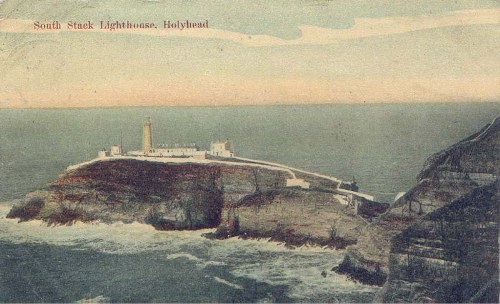
(South Stack Lighthouse in the 1910s, reproduced with permission from www.oldukphotos.com)

There are countless special places along the coastline of Wales, let alone the British Isles, but the cliffs around South Stack seem to stir the imagination of a great number of people. Bird-lovers head for nearby Ellins Tower and the RSPB centre, and the chance to aim their binoculars and telescopes at the guillemots, razorbills and puffins, not to mention seeking out the incredibly rare choughs, of which the nine pairs on the reserve make up 2% of the entire UK population. Continue reading

Close to the border, the Franco-German Garden

Saarbrücken straddles the river Saar up against the German-French border, and this part of the world has been much disputed by those two great European powers as the Saarland passed back and forth depending on the movements of history. After the Second World War there was much discussion about what to do with this little wedge of territory, and it was only at the end of the 1950s that a decision was finally made and Saarland became the 10th state of the Federal Republic of Germany.

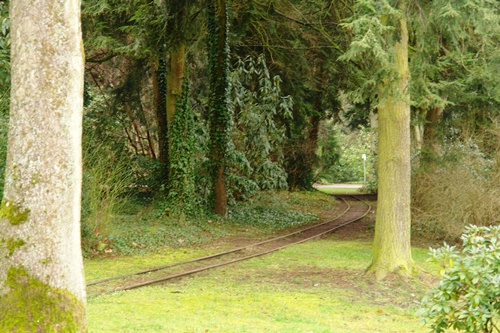
To mark the occasion, and in the spirit of friendship between the two nations, the Franco-German garden was built, a stone’s throw from the border. The park occupies two valleys; one named in memory of the victims of the infamous Battle of the Spichern Heights in Franco-Prussian war of 1870, and the other for the mill built by Teutonic knights in the Middle Ages. Continue reading

Between the Baltic and the Bodden

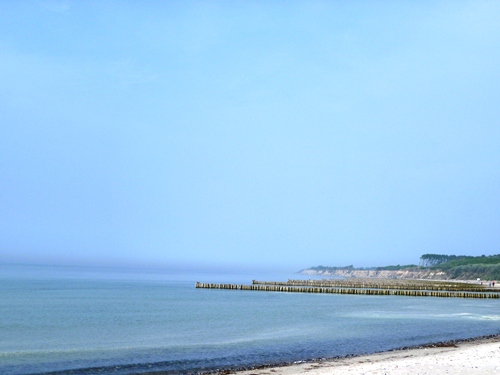
The walk took us along a narrow, sandy path that followed the top of the dyke. It was not so high, perhaps half a metre above the road and the gates to the cottages on one side, and the field of reeds that stretched out into the Bodden – the inland sea – to the other. Somewhere, beyond the cottages and the fields and dunes was the Baltic Sea, but we were taking the long way around.

The peninsula, curving around like a crooked arm to create the Bodden, goes by the trip-off-the-tongue name of “Fischland-Darß-Zingst”. Each of the three territories along the peninsula’s length are tiny, but they each are marked at different points along the road and at one point there was even an international border between two of them, back when the German lands were a patchwork of kingdoms, principalities and duchies, and the Swedes came across the sea to claim some portion of this flat and melancholic landscape all for themselves. Continue reading