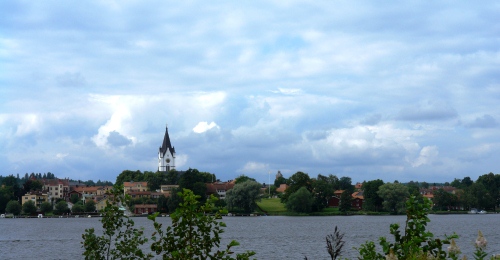
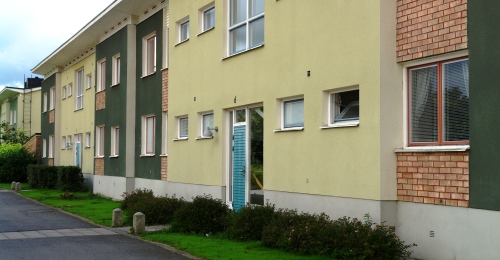
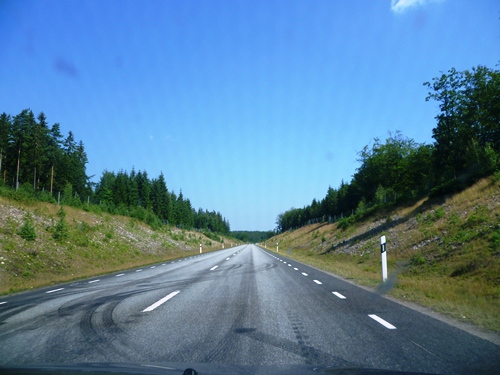
The towns of Nora and Gyttorp are separated by a short stretch of road through the woods, and each look out onto a different lake; stand on the shore in Nora and you are staring West across the Norasjön, from Gyttorp you gaze to the east across the wind-ripples of the Vikern. You can easily visit the two in a single morning, walking amongst the picturesque wooden houses of Nora before exploring the functional terraced townhouses of Gyttorp. These two neighbouring towns couldn’t look more different, and it is this contrast that makes them together a fascinating look at how we imagine a town or community should be designed and organised.
Category Archives: Places
In Leiden, the Netherlands
By Barry Sheppard
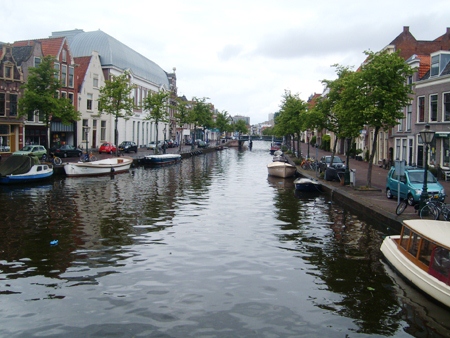
Approximately 35km southwest of the hustle, bustle and mind-altering tourist attractions of the city of Amsterdam lies the much smaller and quieter university city of Leiden. And for me it is a homecoming of sorts, for it was twelve years to the day that I, along with approximately twenty other fine upstanding young men and women from the four corners of Ireland, made picturesque and historic stretch of land our home for those hot summer months. Today though, I’m part of a much smaller yet equally fine and upstanding party getting ready to take in the familiar sites of the place I called home for a short time.
Although I have been back in the Netherlands on several occasions since the glorious summer of 2000 it is the first time I have decided to venture back to this location, and departing through the train station front doors the first thing to grab my attention is the pristine four story building to my left where formerly stood a large bricks and mortar brightly covered canvas for a commune of artistic punk types who called it home. As the vast majority of buildings throughout the centre of Leiden are of that unmistakable tall and thin Dutch style the gang of punk’s squat should really have looked out of place. But now that it appears to be no more, this monument to modernity which has taken its place looks decidedly out of step. However, I am not prepared to let the demise of a building I never set foot into spoil this walk down memory lane.
Glory days at an (East) Berlin race track
.
“I want to tell you I’m not here for or against any government. I came to play rock ‘n’ roll for you East Berliners in the hope that one day all the barriers will be torn down.” – Bruce Springsteen in Berlin, 1988
The race track in the north of Weißensee was once home to trap- and cycle-racing, but on July 19th 1988 it became the location for one of those events where even people who saw it on television felt they had been part of something special. Over a hundred and fifty thousand East Berliners packed into the Rennbahn – way over capacity – to watch a concert from Bruce Springsteen.
For the Communist authorities to allow the invitation of an American rock star to cross the wall to put a show on in the East might seem like a strange decision, but as a songwriter who often highlighted the plight of the working man it was felt that “the Boss” was ideologically sound. Unfortunately for the regime, and as this Reuters article marking the twentieth anniversary a couple of years ago shows, it did not quite turn out like that:
Traces in the Landscape – The Bergslagen, Sweden
We booked a house in Sweden more or less at random. We knew we wanted to be somewhere north of Vimmerby, and within a couple of hours of Stockholm. The house we found by the Järleån river was about halfway between the towns of Nora and Lindesberg, less than an hour’s drive north of the university city of Örebro. We made that drive for the first time through driving rain, the windscreen wipers working overtime to keep the street ahead somewhat visible. What we could see, through the blurred windows and the spray of passing trucks was a landscape of thick forests, the occasionally rocky outcrop, and the knowledge that somewhere, amongst the trees, were hundreds of lakes, great and small.
What was not immediately clear was the influence on the landscape of centuries of mining, of forestry and iron production, that made this region – known as the Bergslagen – the resource-rich heart of Swedish industry. The Bergslagen is a place where Alfred Nöbel had a dynamite factory, with three-metre thick walls to survive an accidental explosion of the product, and which was used to excavate the earth. In the eighteenth century a quarter of all of Europe’s iron production came from hundreds of small foundries in the region. We met an English guy who is working in the region, and he told us that mines and mining remain an important industry, although the number of employees needed is down from its peak and many of the mines have been long abandoned and the scarred landscape returned to some form of nature.
Journey through the north of Berlin
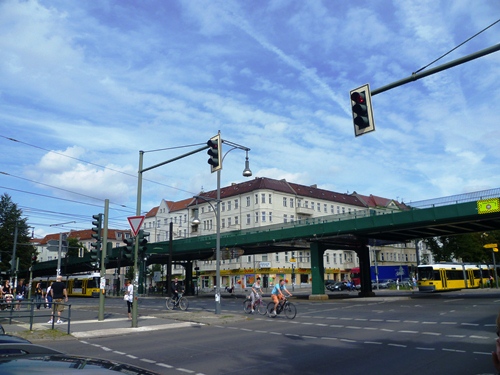
We spent our first weekend back in the German capital on our bikes, riding from one lovely meal to the next, from Wedding through the north of Prenzlauer Berg and Weißensee to Hohenschönhausen, and then back through Heinersdorf to Pankow. We did this little tour over two days, and after four weeks of enjoying the Swedish countryside it was a timely reminder of why living in a city such as Berlin can be such an interesting and rewarding experience.
In many ways our bike trip was very ordinary. We set off with a destination, rather than a route in mind, and with little legs working the pedals furiously it was more important to be direct rather than scenic or interesting. But still, in those 20-odd kilometres of Berlin streets and pathways we crossed the old Berlin Wall via the place where it first opened on that famous November evening in 1989, skirted the fringes of a neighbourhood street festival, and rocked and rolled along the cobblestones between three of the city’s most lovely lakes.
Farewell to Sweden
…but hello to Berlin and the return of Under a Grey Sky. We hope that there will be lots of other wonderful tales of adventures beyond the front door to come as normal service is resumed.
On the final morning in Sweden we were sitting by a lake somewhere in the south of the country, at a campsite we had discovered the previous evening once we had reached over halfway in our journey between Stockholm and our ferry port at Trelleborg. It was a beautiful and quiet spot, a basic camp site with just a few pitches for caravans and those monster mobile homes, and a reception that doubled up as a kiosk for the mini golf. No-one was playing in the morning, as most of the nearby town were at school or work and the campers were still having breakfast on the grass or the balcony of their mobile home.
I opened my notebook to jot down some thoughts and I was struck by how little I had written during the three and half weeks in Sweden. Perhaps it was because I knew that I would be coming here once we returned to Berlin, to write about the different places and experiences on Under a Grey Sky so there was no need to commit any thoughts to paper. In any case, over the next few weeks there will be a number of different posts about our time in Sweden, plus other interesting things that have been collected and submitted whilst I was away.
A walk through the woods, Schorfheide
With each turn off the road dropped a category, from autobahn to overland street, to village lane, to dirt track. We were invited to a cabin on the edge of the forest, for a summer party around an open fire even if it was punctuated with bursts of rain. We stole the only solid dry hour of the afternoon to take a walk in the woods, following one of our hosts along the trails between the birch and pine trees, whilst the kids picked their way through the trees and the undergrowth. We were penetrating just a little way into the Schorfheide, one of Germany’s largest forests and part of the UNESCO-protected Schorfheide-Chorin Biosphere, that starts about fifty kilometres north of the Berlin city limits.
Roadside Britain
In Toby Litt’s debut novel “Beatniks” the characters are driving from Bedford to Brighton when one of them exclaims: “England is such a small island. You drive to the edge, then all you can do is stop. There is nowhere else to go… I want to keep going. I never want to stop. North, south, east, west – I don’t care. Just get me off this island! Take me away! Take me to America!”
It is hard to image a British road novel or movie in the tradition of our cousins on the other side of the Atlantic, but Britain has its own traditional roadside culture, tied in to place and environment that can be every bit as iconic as Route 66 or a bedraggled Jack Kerouac thumbing a lift.
St. George’s Market, Belfast
Markets have been something of a theme on Under a Grey Sky in recent weeks. Thanks to Barry Sheppard for his exploration of the St George’s indoor market in Belfast:
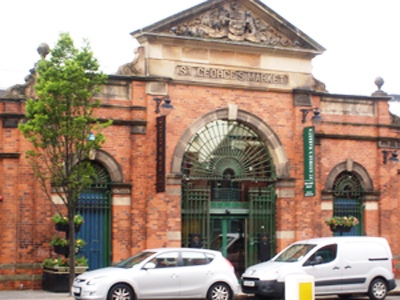
St George’s is situated in the south east corner of Belfast city centre, a stone’s throw away from the relatively recently redeveloped waterfront area. I know it is a stone’s throw away because many a stone has been thrown in this general area over the years. However, on a relatively sunny Sunday morning in a more placid era the cycle from home to the market is a somewhat more pleasant experience.
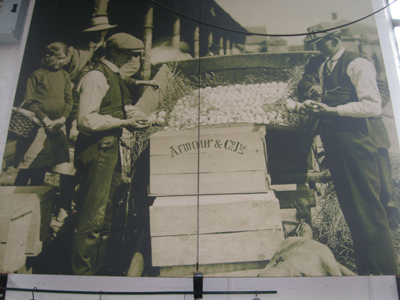
The market is well over 100 years old, having been commissioned by The Belfast Corporation in 1890 and completed in three stages by 1896. The market is one of my oldest and fondest memories of Belfast. In the very early 80s I remember quite vividly being brought to the market by my mother and being amazed by the sheer size, smells and colours of the place. What amazed me most of all was the swarm of strange and unusual faces, not that there was anything Picasso-esque about Belfast people in those days. It was just exciting as a four year old to see that many people in the one place towering over me going about their business. The place was a great spot for people watching, a pastime that I’m still partial to today.
Palace of Tears, Berlin
Just outside the Friedrichstraße station is a simple building that – when I first came to Berlin – housed a nightclub called “Tränenpalast”… Palace of Tears. The name came from its former function, as the border departure hall for people travelling from East to West Berlin. The doors of this pavilion would have been last point of goodbye, as western visitors headed back across the border that split the city in two, and left their family and friends behind.