Category Archives: Places

From Grünau to Friedrichshagen

Grünau1

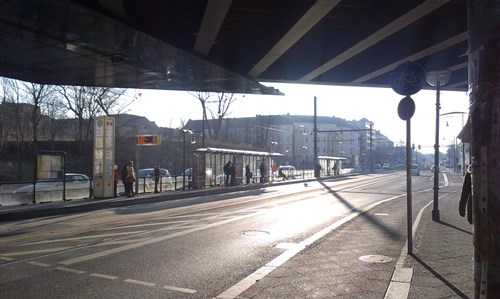
We started the walk at Grünau S-Bahn station where the huge tiled mural on the wall reminds you that this is the very edge of Berlin and a land of villas, lakes and forests. On a Sunday morning Berlin is a quiet city, and Grünau especially so… the only signs of life came from the bakery open for bread rolls and weekend tabloids, and a malfunctioning pay-toilet whose doors were opening back and forth.

We walked down to the ferry, and waited for the short journey across the lake to Wendenschloß and its villa colony and out-of-season bathing beach. This stood at the end of the road, where the tarmac turned into a dirt track which led us along the lake past abandoned boat jetties and the foundations of lost buildings before we headed in and up, into the Müggelberg hills that (at around a hundred metres) are the highest natural elevation in Berlin.

Continue reading

The Dutch Quarter, Potsdam

Dutch1

In Las Vegas, European cities are recreated as mega casinos. In Dubai, the canals of Venice are reimagined as a shopping mall with a view of the Persian Gulf. And in Potsdam, in northern Germany, there are a couple of streets that would make you think you were a few hundred kilometres to the west, in the neighbouring country of the Netherlands.

As with the more modern examples in the deserts of Nevada and the Arabian peninsula, the Dutch Quarter of Potsdam was built on the whim of someone with enough wealth to shape his city any way he chose. That man was Friedrich Wilhelm I, soldier king in Prussia who, as well as resettling the lands to the east following devastating plagues and establishing primary schools in his domain, also wanted to shape Potsdam. Unfortunately there was a distinct lack of qualified craftsmen in Brandenburg, and so he looked to his neighbours for help.

Continue reading

Seventy years since Auschwitz-Birkenau

???????????????????????????????

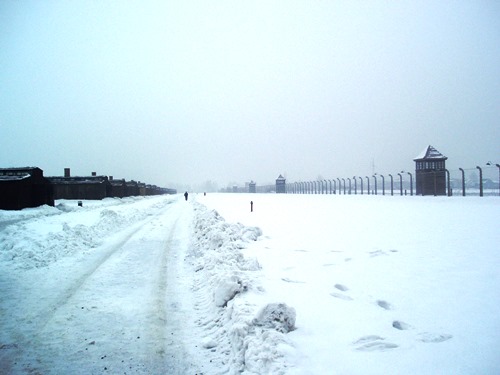
Today is the seventieth anniversary of the liberation of the Auschwitz-Birkenau extermination camp in German-occupied Poland. As events are held across the world to commemorate the anniversary, I dug out an article I wrote based on a visit to Krakow in the early months of 2006. Katrin was pregnant, and we had travelled to the Polish city to scout locations for an international hostel conference she was organising. A few months later, when the conference took place, we had to travel overland as Katrin was no longer allowed to fly, but on the first visit we landed at the airport and were driven into town through socialist-era suburbs that reminded us of Berlin to the beauty of the old city centre:

On a clear winter’s day, with a light mist hanging overhead, weak sunshine bathes the Old Town of Krakow in a gentle, almost dream-like light. It softens the cobbled streets, the towers and spires, the market square – a more beautiful city in Europe is hard to imagine. In the bone-chilling cold people move at a brisk pace. Young women students scurry between university buildings wrapped in heavy scarves and jackets, hats pulled low, their round, pretty faces open to the elements. Only tourists loiter – that’s what tourists do – framing the city through digital lenses. But in January they are few in number. As the city ebbs and flows, people go about their daily business. For them beautiful Krakow is commonplace; while visitors gaze in wonder, local eyes rarely rise above street level.

Continue reading

A loop through the north of Berlin, Sunday morning

IMAG0474

Sunday morning in the north of Berlin, starting out along the Panke and through the Soldiner Kiez, the last of the remnants of the New Year’s Eve fireworks – wooden sticks and tubular casings – mingle with the gravel of the footpath. Prinzenallee is quiet, the shops shut and the cafes not yet open. A woman in a headscarf is sweeping the floor of a shisha bar. There is a small queue outside the bakery. A fellow runner nods as he passes. Secret club. Under the bridge and I step over the line of cobblestones. West to East. Welcome to Pankow.

Continue reading

At the end of the road – the Hans Fallada Haus, Carwitz

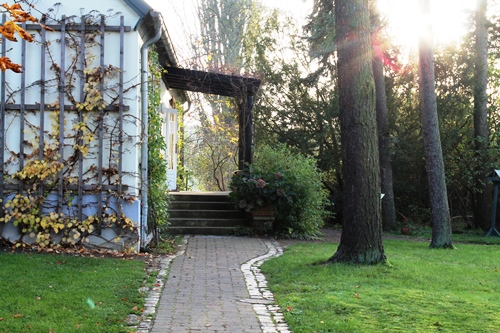
Fallada1

The writer Hans Fallada, perhaps best known in the English speaking world for his 1947 classic Alone in Berlin, was born as Rudolf Ditzen in Greifswald in 1893. He died, fifty three years later in the year Alone in Berlin was published, at the age of 53. The headlines of his biography suggest an extremely eventful, often tragic, half century of a life:

Sustains injuries, kicked by a horse
Contracts typhoid
Kills friend in a duel as part of a suicide pact
Continue reading

Familiar Spaces… New Year Exploration

FRONT

On the first weekend of the year we decided to escape not so much the madness – for that was all reserved for New Year’s Eve and the early hours of the following morning – but the debris and the feeling of the morning after the night before. Outside our apartment on Osloer Straße the street was strewn with firework casings, empty and smashed bottles, piles of grit from the snow flurry earlier in the week, and first of the abandoned Christmas trees, branches drooping and the needles scattered across the pavement.

We caught the S-Bahn from Bornholmer Straße, that famous bridge where the Berlin Wall was first opened and – with its dramatic views south towards the city centre – the venue for one of the larger impromptu firework displays on the 31st December. The half-empty train took us north, through Pankow and towards the suburbs, always close to the Panke river that flows, mostly hidden, by the raised railway tracks. At Karow – still Berlin and yet, with its detached houses and neat village centre, feeling like a place apart – we sought out the river and the route to the Karow ponds.

Continue reading

Looking back on three years… and forward to elsewhere

UaGS Image

Three years ago the first post on Under a Grey Sky was published, reflecting on a year of travels and explorations that took Katrin and I to familiar corners of north Wales and Spain, as well as new experiences not only on the road but also within our home city of Berlin. Under a Grey Sky was always intended to reflect on the fact that you don’t need to travel long haul to find fascination (although you can), and that there are plenty of adventures to be found just beyond the front door.

Looking back on those three years and the writing and photography we have published here, from friends old and new, and our own explorations both here in Germany and beyond, Under a Grey Sky has been not only a great place to reflect on what we have experienced but has also served as a motivation to get out of the house, even on the gloomiest of February days. It has become such a fundamental part of our life, even if the frequency of new articles has tailed off a little in the past eighteen months, and we are always on the lookout for what to write about or photograph next.

At the same time, the project has also connected me with likeminded people – such as the wonderful community around Caught by the River – as well as making many new friends along the way, many of whom are fantastic and inspiring writers, even if I have never met them face to face. It has also informed the writing and other activities with Slow Travel Berlin, included the creation and launch of our series of guided walks and the publication of a book, Mauerweg, with STB-founder and great friend, Paul Sullivan.

That book was also tied to Traces of a Border, another “spin-off” project from Under a Grey Sky, exploring the 160 kilometre length of the Berlin Wall Trail. With the 25th Anniversary of the Fall of the Wall in November 2014 and the publication of the book, there has been a little break from Traces of a Border, but that project won’t stop because there are still many more stories to tell.

So as Under a Grey Sky moves into its fourth year I am very proud not only of the website, but of the change in my own writing (and indeed approach to life) that the project has very much been central to inspiring. I have walked, talked, written and read more… and it has led, eventually, to another new project that some of you may already know about. In 2015, along with another good friend and incredibly talented designer Julia Stone, we will launch a quarterly print journal of place. Julia and I had long spoken about a project together, and during the course of 2014 we developed the idea that you can read about on the Elsewhere website.

I am really excited and nervous about this step, but my experiences over the past three years since I sat down to write that very first post on Under a Grey Sky convince me that we have a good chance to make it work. I hope some of you will come along for the ride.

See you in 2015,

Paul Scraton

The Strange Beauty of the Anklamer Stadtbruch

Anklam1

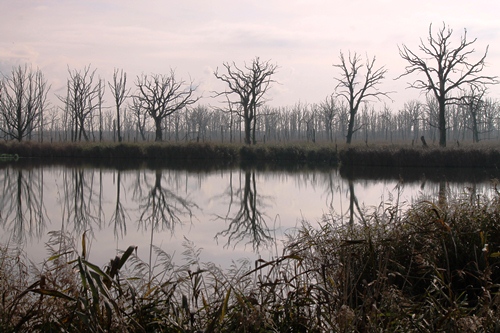
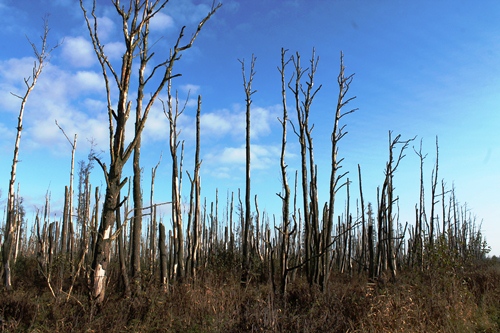
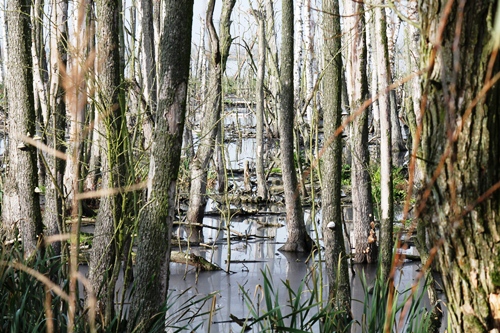
The strangeness began on the approach to Anklam, a massive collection of dead trees swamped at their base with water and surrounded by reeds, like something out of an apocalypse movie. It looked spooky and brutal, as if some cataclysmic event had taken place here, and so of course we stopped for a photograph.

Anklam2

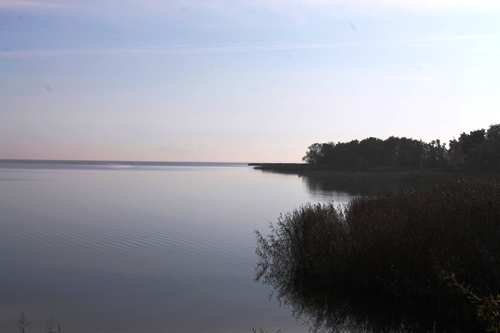
Half an hour later we were sitting in a minibus being driven through the streets of Anklam. We did not spend any time in the town, so we have to be careful not to rush to judgement, but it looked like a place that had seen better days. Many of the old Wilhelmine buildings were crumbling, but they looked more solid than the GDR-era plattenbau that looked ready to fall down at any moment. We were being taken by a guide from the city out into the Stadtbruch, a marshland and peat bog area on the edge of the inland sea that divides the mainland of Germany with the Baltic island of Usedom.

The walk was between two peat bog areas that had been drained for farmland but over the last twenty years allowed to return to something approaching a natural state. This is the case for a lot of the land between Anklam and the inland sea, and along the banks of the Peene river, which explained those dead trees we had come across earlier. We would see a lot more of them over the next couple of hours.

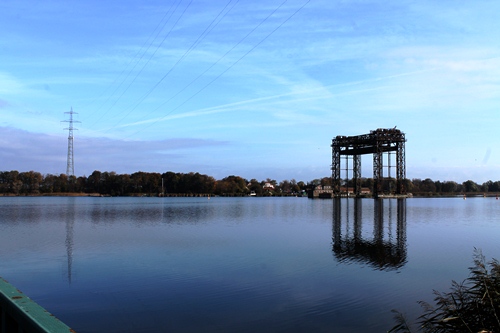
But first, before dealing with natural ruins, we started with some man-made ones. With a white-tailed eagle soaring overhead, we were looking across the water towards Usedom and the remnants of the old railway bridge that once transported the Berlin trains to and from the island, and which helped transform the fishing and farming communities into the seaside resorts I have written about on Under a Grey Sky over the past year. In 1945, with the end of the war approaching, the SS destroyed the bridge to prevent the approaching Red Army from making use of it, and ever since this particular line has been out of action. To get to Usedom now by train requires a more circular route, north and through the harbour town of Wolgast.

The long absence of the trains does have a benefit for the walkers and the birdwatchers who have discovered this strangely beautiful corner of Germany, for the raised embankment is high enough above the reclaimed bog to allow you to walk right through the middle of it without even getting the soles of your shoes wet. And so we walked, stopping to look and identify the wealth of birdlife that call this place home, as well as the traces of otters, dancing butterflies and one of the last remaining elm trees in Germany. Apparently the disease that wiped out the elm in Germany began a few kilometres to the south, and so this one survived… a remarkable story from a remarkable place.

Anklam3

Anklam4

Anklam5

Anklam6

Anklam7

Anklam8

Anklam9

Words: Paul Scraton
Pictures: Katrin Schönig

The Gnitz Peninsula, Usedom

Gnitz1

When most people travel to the Baltic island of Usedom, the attention is taken – understandably – by the sea. Most of the island is in Germany – with only the town of Świnoujście at the eastern end in Poland – and from north to south it is a line of holiday resorts that date back to the nineteenth century, the coming of the railway, and the development of seaside rest cures and vacations for the growing populace of the cities of northern Germany.

But the island is not only built on tourism. Before the first bathers arrived, the main economic activities on Usedom were agriculture and fishing, and that continues to this day. But whilst some of the fish would be and are pulled from the Baltic, a good proportion of the industry is focused on the inland sea that separates the island from the mainland. The communities that face the Achterwasser as it is known still target the tourists, with campsites and signs advertising rooms and apartments for rent, marinas offering boat trips and kayak tours, but it feels less developed than those resorts along the coast, and that these are still places where people live and work, even in the off season.

Continue reading

Autumn leaves

Winter is almost upon us, but it has been a beautiful autumn… here Chris Hughes reflects on the conditions of autumn that so fascinate photographers:

Autumn provides the colour and the clear air that inspires landscape photographers to get up before dawn and also to wait through many chilly dusks hoping to capture dramatic and frequently very beautiful pictures. Given that perfect combination of an indigo sky and a low, searchlight-like sun that follows a sharp autumn shower and many an inspiring photograph can result.

All too often these brilliant conditions occur when you are driving on the motorway, have no chance to stop and probably do not have the camera with you anyway.

So it is that you must seek out opportunities to photograph the colours of autumn even when the sky really is grey and the sun hidden from view with rain close by. You must be cunning and look for the details and the miniature rather than the vast, dramatic vistas and where better to look than on the ground, around your feet and among the most common of autumn features. Let’s look at the leaves.

Image One

There is great beauty in the mass of leaves but sort through the jumble and find the individuals, seek out the colour variations and revel in the variety of shapes and size. Reds, browns, yellows, vivid green all gleaming wet with dew or rain, leaves are landscapes in miniature.

Image Two

Perhaps it’s just me, but I am fascinated by these jewels of autumn and take far too many photographs of them. These tiny autumn landscapes can be found in every street, park, garden, allotment and .. well everywhere there are trees. But, like the autumn light that creates such transient drama, these leaves quickly fade and disappear, turn brown and return to the earth. So you must act quickly and not miss your chance.

Fortunately, come the spring the leaves return, passing through the many shades of green before once again the miracle of autumn comes round one more and the leaves produce their rainbow of colour and I will be looking down to find them once again. I will be taking more photographs of leaves.

But I will also be looking for those brilliant moments when the low sun shines intensely from under a dark sky and lights up the bright yellows and oranges across the dark brown fields.

Image Three

Words & Pictures: Chris Hughes