Category Archives: Memory

Ormeau Park, Belfast 1913-2013

???????????????????????????????

The 1913 women’s walk for suffrage in Britain is well-known. Over 50,000 women arrived in Hyde Park London demanding the vote. The abuse they endured extended to imprisonment and the brutal force-feeding of those on hunger-strike in prison. In Ireland’s nine counties that comprised Ulster suffragettes, Unionist and Nationalist together, held mass rallies in Ormeau Park. A century later their struggle and their bravery was commemorated in Ormeau Park. Dr Margaret Ward, the Director of the Women’s Resource and Development Agency in Belfast and renowned women’s suffrage scholar addressed the meeting and led the commemorative walk for women in the park. This is her address:

Sisters and friends,

We are here today to commemorate the fact that 100 years ago women throughout Ireland were marching, protesting and going to jail because they demanded the vote. Women from Ireland, England, Scotland and Wales were part of a mass, international, movement of women. In Ulster there were around 1,000 members in 20 different suffrage organisations.  Proportionally the Suffrage Movement had as many members in Ireland as they had in England.

Continue reading

The Ghost Bike

OLYMPUS DIGITAL CAMERA

By Phil Scraton

I remember walking to Moreton Cross with my mum to catch the 77 bus to Landican Cemetery on the Wirral. I guess we went once or twice a month. Mum knelt on an old towel clearing weeds and trimming the edges of the flower bed that marked Aunty Mary’s grave. I was off running between the headstones with my invisible friend, Ben – like Calvin and Hobbes. Neither Ben nor I ever stepped on a grave. The souls might have ascended to heaven but the interred bodies had to be respected. Back from my imaginings I’d find mum silently weeping. I hugged her so hard thinking how she loved her older sister. Only recently did I discover that Mary was, in fact, her mother.

Cemeteries house the dead, their neat avenues and walkways are like miniature housing estates. A reverential solitude accommodates remembrance, grief and, on occasion, celebration of a life well lived. Having renewed the flowers on Mary’s grave we would drop by the ice cream shop and take the bus home. As an altar boy in a Catholic family I regularly served requiem mass and stood alongside numerous gravesides. I suppose I accepted memorialisation as part of life. Death was not an end, but a beginning. Not a proposition that endured into my adult life!

Continue reading

The Squire of Ribbeck, Havelland, Germany

IMG_2844

By Anja Ahrens:

Almost thirty years ago, when I was still a child, my Grandfather attempted to teach me Theodor Fontane’s poem Herr von Ribbeck auf Ribbeck in his original tongue – Plattdeutsch, a dialect of German from the north of Germany – as I spent my summer holidays with him in the countryside. I did not understand the poem then, and try as I might I was unable to memorise it. That was the summer before my grandfather died.

Years later I remembered his wish for me to know this particular poem, and knowing that he had died soon after, and having finally come to understanding the story, I always felt as if he had been trying to tell me something… that in some way he wanted to leave something behind in a different way than the Herr von Ribbeck:

Continue reading

Nostalgia, Portishead and the Spandau Citadel

Citadelle

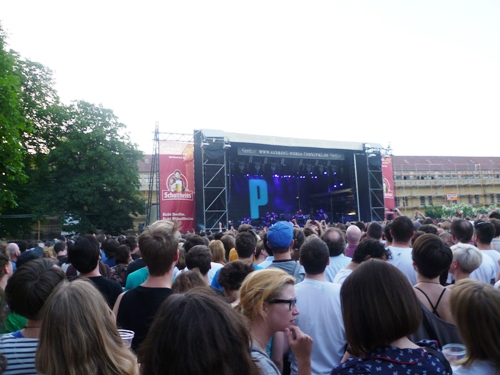
Last week I visited the Citadel in Spandau for the first time. It is an impressive structure, built in the second half of the 1500s, although it is a little surprising to walk along a fairy busy street, past garden centres and car showrooms, and then suddenly come upon a medieval fort standing proudly in the early evening sunshine. We were there to see Portishead, part of a summer concert series that makes up the Citadel Music Festival, and from the moment we crossed the drawbridge and entered the fort through the thick stone walls it was clear that this was going to be a special venue for a special concert.

If I had to place Portishead in my personal music history, it would be in the years I was at Sixth Form College in Leyland, and their first album Dummy was on heavy rotation. There have only been a couple of albums since, and throughout the show I was continually taken back into my memories of hearing some of those songs, the strange music and haunting vocals, and I imagine that in that crowd I was not alone in experiencing the concert as something of an exercise in nostalgia.

Continue reading

The Sportforum Hohenschönhausen, Berlin

forum1

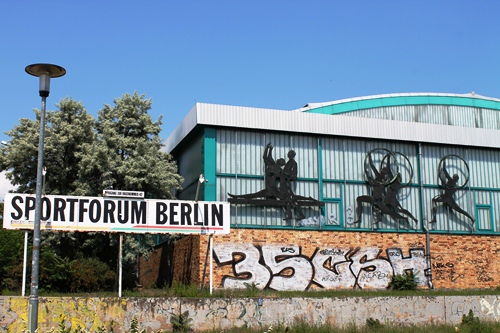
The tram dropped us in front of the Sporthalle, where a couple of people stood at the top of the steps, waiting in the sunshine for a moment longer before heading in to pay admittance to a cheerful women sitting behind a trestle table just inside the front door. From inside we could hear the sound of spectators – cheers and drums and whistles – but there was no clue to what kind of event was taking place. We headed around the side of the hall, where weeds grow through the paving stones and coaches were parked in lines in the sunshine, but it remained a mystery. As we pressed on, deeper into the Sportforum complex, we caught a glimpse of numbered-shirts pressed up against a frosted window. Crossing the car park we heard a sudden outburst of enthusiasm, a “come on lads!” kind of a sound, and then the numbered-shirts were gone, ready to do battle.

The Sportforum complex is one of Berlin’s “Olympic Training Bases” and has facilities for all kinds of different sports. Built in the 1950s, its heyday was during the years of the German Democratic Republic when it was the main training complex for the athletes of the socialist country, whose regime had identified sport as a way of the small nation punching above its weight and who saw its elite athletes as “diplomats in sports gear”. On opening it was the largest such training complex in Europe, and thanks to a system devoted to success – including of course the use of more unhand, chemical techniques – the GDR did indeed win over five hundred medals in the Summer and Winter Olympics combined, a number which has East Germany still standing eighth in the all-time records.

Continue reading

Memories of Liberation Square, Sarajevo

???????????????????????????????

It is over a decade since I was last in Sarajevo. When I look back on it now, that journey in the early winter of 2001 was something I had been building up to ever since I had watched the scenes from the city and elsewhere in the former Yugoslavia unfolding on our teatime television screens during my teenage years. It was to become a major part of my studies, both during by BA and MA at the University of Leeds, and during my university years I made my first trips to some of the countries that were once part of the Federal Republic of Yugoslavia, and which culminated in a bus ride from Zagreb to Sarajevo which will live long on my memory. Here is something from my notebook, written in Berlin after the trip was over:

The two men stand across from each other, separated by the sixty-four squares of their battlefield, their knee-high soldiers awaiting instructions. The game has been progressing for some twenty minutes, and even to untrained eyes it is the older of the two who has the upper hand. He is relaxed, continually joking with the band of spectators gathered around the outdoor chessboard, rejecting advice with a wave of the hand, barely contemplating the situation before making a move. His opponent, younger and dressed in a suit, is quieter, his energies focussed on the game. But it is all to no avail, as age and experience finally triumphs. Checkmate achieved the victor takes the congratulations of the onlookers as he re-sets the pieces, ready for the next opponent.

Continue reading

Botanischer Garten, Berlin

Bot1

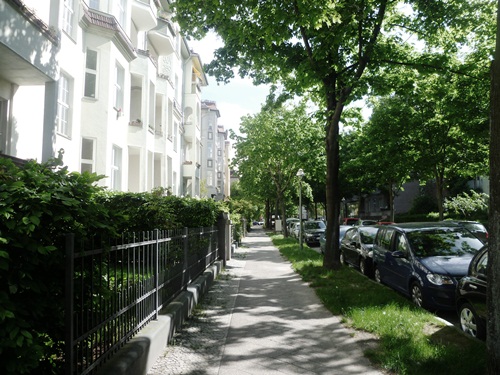
No, this post is not about the Botanic Gardens of Berlin, so wonderfully captured recently on the überlin blog. The reason for this post is somewhat more personal, as I caught the S-Bahn this morning from Bornholmer Straße south to Steglitz and the Botanischer Garten stop. This was my first neighbourhood in Berlin, back in the winter of 2001/2. Having moved to the city without a place to stay, one of my colleagues who was also studying at the Free University offered me a room in his apartment. The flat was on the ground floor, which made it a little dark – and happily cool when it came to the summer – but this was made up for by the fact that we had an overgrown garden out the back door that only Thomas and I had access to.

Altogether I lived down by Botanischer Garten for about nine months, before Thomas returned to Australia and I moved north, to Prenzlauer Berg, Mitte and, eventually, where we are now in Wedding. But I have very strong memories of that time, perhaps because it was my first months in the city. We would travel into the city on the S-Bahn, although if we were caught in town after the last train we would catch a night bus that took us on moonlight ride through deserted streets for over an hour, from Hackerscher Markt through Checkpoint Charlie to Kreuzberg and Schöneberg, before finally stopping in the shadow of the Rathaus tower in Steglitz. Sometimes, when Thomas had worked late and I was on an early shift, we would meet on the platform of the Botanischer Garten station, both of us bleary-eyed at opposite ends of our respective days.

Continue reading

Through the streets of Dresden, Germany

Dresden4

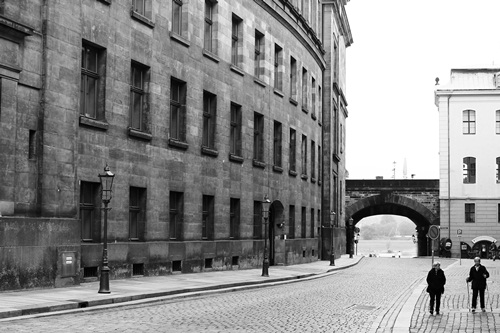
Since I moved to Germany I have made a handful of trips south to Dresden, that grand old city on the Elbe with its beautiful Altstadt and bustling and buzzing Neustadt on opposite banks of the river. The first time we went there we caught the train sometime in January, walking through the snow past some suitably eastern bloc socialist modernist architecture before we reached those buildings that made the city famous and that can, with a squint and a bit of imagination, return us to the city as painted by Bellotto during the 18th Century, a period when Dresden was renowned for its art and architecture, and which inspired Schiller to write his Ode to Joy, his poem celebrating brotherhood and unity of all mankind.

The wide sweep of the river separates the old and the new towns – and the flood meadows that seem to stretch almost as wide as the Elbe itself highlight the sense of distance between either side. On another visit I came south with a friend to play Petanque, tossing those boules along pathways in the manicured gardens of the Japanese Palace on the northern bank, our view back across to the old town distracting in its beauty. It was around about then that they finished the reconstruction of the Frauenkirche, and it is at this point we come to the unavoidable fact about Dresden and one which cannot help but shape your view of the city however many times you visit.

Continue reading

Remembering the Annie Maguire, at Cape Elizabeth, Maine

Annie1

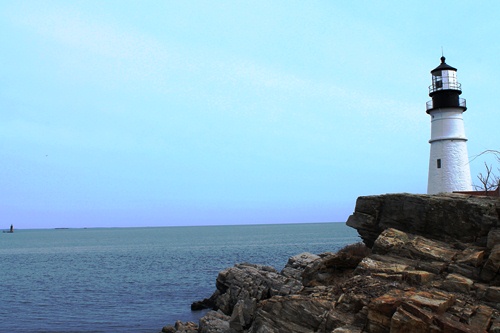
In December 1886 Captain Daniel O’Neil climbed aboard his ship, the “Annie Maguire” for a voyage north from Buenos Aires to Quebec. With him for the voyage were thirteen crew, two mates, his wife and his twelve year old son. Caught in bad weather just off the coast of Maine on Christmas Eve, O’Neil was aiming for Portland Harbour in order to take shelter and ride out the storm. On land, in the Portland Head Lighthouse atop the rocky cliffs of Cape Elizabeth, lighthouse keeper Joshua Strout was keeping watch as the clock approached midnight. It may have been Christmas Eve, but it would not be a quiet shift.

Continue reading

Springtime and memory in the Schönholzer Heide, Berlin

Bike1

Just underneath the S-Bahn tracks, crossing from Wedding into Pankow not far from the Wollankstraße station, there is a collection of cherry trees gifted to the people of Berlin by the people of Japan, and which are currently in blossom. It remains one of my favourite “memorials” in a city that as so many, if only for its fleeting appearance every springtime. And thankfully spring has arrived, even if it is almost three weeks later than the Sunday last year when I captured the pink blossom at this exact point for another entry on Under a Grey Sky.

It was also possible to see the arrival of warmer weather by the coating of pollen on our bikes as we lifted them out from the rack in the courtyard of our apartment block, and in the number of people walking, riding and running along the Panke and Berlin Wall trails, which we followed to reach the Soviet Memorial in the Schönholzer Heide. We had decided to ride up there to capture some pictures of what is the third largest such memorial in Berlin, behind those in Treptower Park and the Tiergarten, and the final resting place for over 13,000 of the 80,000 Red Army soldiers who died during the final battle for Berlin. Unfortunately, we timed our trip during a period when the memorial is being restored, and so Katrin picked her way through the trees to try and get some pictures, but otherwise it was not possible to get any closer than the gates.

Continue reading