Monthly Archives: February 2013

A walk in Brandenburg, Germany

BR1

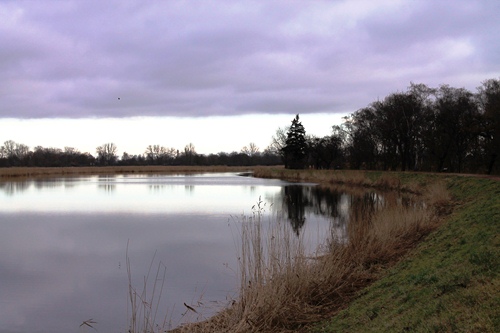
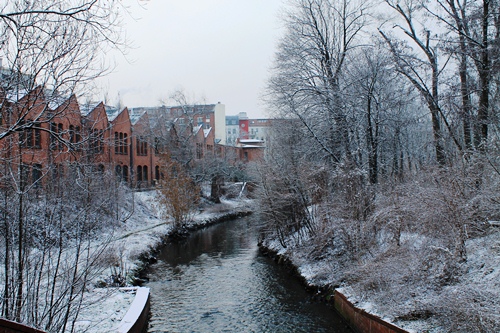
The mist hangs between the tall, gloomy pine trees as we climb down from the train. Only one other passenger stepped off with us, and by the time we have sorted ourselves out on the platform she has disappeared into the haze. At the level crossing, where no cars wait for the train to depart, onwards towards the Polish border, the guesthouse is shuttered and locked. “Closed, for January and February” states a handwritten note in the window. No refreshments here, and we are glad that this is just the beginning, and that we are walking in the other direction.

We pick our way through the village to the river, which is glassy and still like the weather. Which way does the water flow? It is impossible to tell. The path leads us right along the water’s edge, the reeds springy underfoot. We pick our way along the bottom of holiday cottage gardens. Across the river is a field, the ground ploughed and hard into row after row of snow-capped ridges. We have moved away from the main road now, and there is little sound except for the occasional bird call or an airplane coming into land in the distance.

Continue reading

Ghosts of Elephant and Castle, London

Heygate

Last week I was in London for work, and stayed for a night in a new hostel that has opened in Elephant & Castle and occupies the former headquarters of the Labour Party. Indeed, in the reception area – all shiny surfaces and plush carpets – the foundation stone as laid by James Callaghan occupies pride of place. The date too is symbolic, as the building work was begun in the summer of 1979, just after Margaret Thatcher’s election victory and the start of eighteen years of Conservative rule. I was born three days after that election, and would watch Labour’s victory in 1997 five days shy of being able to vote for them myself.

Across the street from the hostel is the southern edge of the Heygate Estate, once home to around three thousand people, and now empty as it awaits demolition and redevelopment as part of a regeneration strategy for the neighbourhood. Hmmm. As we walked the next morning down the road to find something for breakfast, there was a corner shop front filled with images of how the Heygate would look once the development was finished. The artists impressions painted a picture of sunny days and green spaces, of large balconies and evening strolls, but it made me wonder; how many of these shiny new flats and apartments would be occupied by former residents of the estate, and also, where have the three thousand that once called it home gone?

Continue reading

City Strolls with Slow Travel Berlin

ITB Blog

Next week Slow Travel Berlin are launching a couple of new “City Strolls” of neighbourhoods around Berlin as part of the ITB and the related Travel Massive gathering of the travel industry, blogging community and travel media. The idea of these walks is to offer the visitor, or maybe the curious Berliner from a different part of the city, the chance to take part in “informal but well-researched strolls that draw on history, literature, architecture and other cultural phenomena to provide unique, un-clichéd insights into the city’s past and present.”

One of the tours is led by me and will take a small group through my neighbourhood of Wedding, where I have lived for the last couple of years. As you might have seen on Under a Grey Sky over the past year, I have been enjoying exploring the places just beyond my front door as much as more further-flung expeditions, and I think it is going to be really great to have the chance to share the cultural past and present of my home with those who come along on the tours.

As well as my tour, Slow Travel Berlin head honcho Paul Sullivan will be leading a tour through Prenzlauer Berg (as well as hosting a Photography workshop) and German history expert Richard Carter is hosting two tours, one taking a stroll through Berlin’s historic heart, whilst the other explores the architecture of East Berlin. I will be making a page here on Under a Grey Sky about the tours in general, but if you are interested in the tours taking place on the 3rd or 5th March, you can find more information and book one of the extremely limited places, here on Gidsy.

(Photo by Katrin Schönig)

Special places and the joy of the familiar

Headland Shelly Beach Paul

With this post Under a Grey Sky reaches the milestone of two hundred articles, all published in just over a year, and featuring the words and pictures from contributors all over the world. It is the variety that has made this such an inspiring project to work on, as people have used the space here to talk about and document the type of the places that inspire them when they take a step out of the front door.

For the two hundredth post, then, I wanted to dwell a little not only the places that are special to me, but also those that have a meaning beyond perhaps an obvious beauty or an exotic location. They are the places related to personal history, to moments in the memory, that may also be special to others but not necessarily so. In his book, “The Wild Places”, Robert Macfarlane discusses this very issue;

Continue reading

Outside the front door – A walk through Wedding, Berlin

Wedding

Since we moved to the neighbourhood of Wedding* at the end of 2010 we have enjoyed exploring and getting to know a new corner of the city. Not long after we moved, I wrote about my experiences and first impressions for Slow Travel Berlin, and even then I was quite taken by this corner of the city that has a pretty poor reputation in the city and yet has not only a fascinating history, but is also home to a number of really interesting grassroots cultural, artistic and community projects that reflect the diversity and also the “neighbourhood pride” in an area where the population is mixed between those with long-established roots here and those of us who are in the 35% who were born in another country – the highest percentage of foreign-born residents anywhere in Berlin.

Continue reading

A Moment in Time

Moment 1

By Chris Hughes

I have recently digitised my old colour slide collection and the moment came when I was certain all of them had been saved and the large pile of card and film was now completely redundant. It was still some days before I could finally take them to the bin, finally cast them in and know that the step was irreversible. I am now part way through scanning old photographs and while some have gone straight from scanner to shredder many of these are kept as the look and the feel of the old photograph cannot be replaced by the computer image, no matter how much I am able to improve it with the magic of Photoshop. These treasures will carry on until another generation makes the decision to cast them into the wheelie bin.

But…… some images have stuck in my mind as I have gone through this sorting process…

Continue reading

The Joys of Essex

Diana1

(above: Essex Marsh, by Diana Hale)

By Diana Hale:

Jonathan Meades‘ recent BBC4 programme ‘The Joy of Essex‘, replete with characteristic provocations, utopian visions and other little known eccentricities, inspired me to relive some of my own joys of Essex, searching out paintings and photographs and taking advantage of an opportunity for some biogeography, or topography of the self. Not difficult as I was actually born there, or at least in what used to be Essex, as was everything east of the River Lea at one time.

Although my birth certificate says the London borough of Redbridge as that was where the hospital was, in fact my parents were living with my grandparents in Buckhurst Hill, in the Epping Forest district of Essex. Appropriately, as it was where my father’s family had ended up, it is not far from Hale End (on the map between Walthamstow and Chingford).  Incidentally there is now a new Hale village next to Tottenham Hale, not that far away from Hale End and not far from where I now live – a pleasing circularity. ‘Hale’ apparently means ‘a hollow place’ in Old English so I think there are plenty around.

Continue reading

The Road Not Taken, Amherst

By Phil Scraton:

I was 17 when I first heard The Dangling Conversation. The song’s simple beauty contrasted with the complex emotion of its lyrics. The mood, the characters, caught my imagination. Written by Paul Simon, recorded with Art Garfunkel, we are introduced to the lives of two lovers caught in the quiet solitude of a seemingly lost relationship. ‘You read your Emily Dickinson’ and ‘I my Robert Frost’; we ‘note our place with bookmarkers’ that ‘measure what we’ve lost’.

Like a poem poorly written
We are verses out of rhythm,
Couplets out of rhyme,
In syncopated time
Lost in the dangling conversation
And the superficial sighs,
Are the borders of our lives.

In a ‘lost’ relationship, ‘out of rhythm’, ‘out of rhyme’ what was the relevance of the Emily Dickinson/ Robert Frost juxtaposition? I soon discovered that both were fine North American poets, two generations apart. Their personalities and lives had little in common; she a virtual recluse and a home-based correspondent, he an affable teacher with a love of the outdoors. Yet comparisons of their poetry have been endless – books, theses, articles, essays.

Continue reading

The heart of winter

annika_winterA lovely and evocative snapshot of winter, by Annika Ruohonen:

The sound of snow under your feet marks the heart of winter. Prints in the snow hold stories like a bookshelf full of winter tales. There is the one rushing off to work. There is the one coming home from school, kicking an ice block ahead of him, stopping to examine sticks and rocks on his way. There is the one searching for food, ruffling up his feathers in the merciless minus degrees. There is the one who roams free, hunting birds and mice, paying the price of freedom in his search of a place for the night. Smoke rising from the pipes, frost popping in the corners. Time for the blue moment. Only a rare occasion in the course of the year. In the heart of winter.

This first appeared on Annika’s website and we are extremely pleased that she gave us permission to reproduce it here.

A walk by the river

Ryck1

A few weeks ago we were in Greifswald, an old Hanseatic League city in the north of Germany, made famous by its university and the paintings of Casper David Friedrich. Whilst we were there, Katrin and I took a walk along the River Ryck, from our hotel in the fishing village of Wieck to the old town of Greifswald itself, and back again. The short piece that I wrote about the walk for Caught by the River was published yesterday:

Continue reading