The Things Around Me – Malachy Tallack


Wounded Man by Malachy Tallack with Steven Laurenson, from the album from the thorn (buy here)

I discovered the music of Malachy Tallack through another project, The Things Around Me. Last year Malachy moved to a house in the village of Vidlin, on the north east coast of the Shetland mainland. After six months, and still feeling like a stranger, he began to write a series of essays in an attempt to come to some understanding with his surroundings, and these essays are wonderfully evocative of the animals, birds and plants all around him. They are also beautifully illustrated by Will Miles, and artist and ornithologist who lives and works in Fair Isle. Continue reading

Facing the past: From the Wannsee shore to Indian Island

(Photo: Indian Island Tolowot California / Wikimedia Commons / Ellin Beltz)

Tony Platt travels from Berlin back home to California, comparing the ways in which societies deal with past, and the hidden history of the ‘outdoor paradise’ of Humboldt County:

In October I spent a few days in Berlin, not for oompah and pretzels, but to check out memorial culture. I don’t know of another country that assiduously remembers the worst of its history as Germany does. Fortunately, the nation that carries the weight of Nazism did not take Ronald Reagan’s advice when he visited Bitburg cemetery in 1985 – “I don’t think we ought to focus on the past.” That could be the mantra, though, for his home state. Back in northwest California, I’m struck by how scrupulously the region forgets its sorrowful history.

Throughout Germany there are close to two hundred “authentic sites of remembrance” of Hitler’s regime, as well as a lexicon of terms to describe the extraordinary variety of commemoration: memorials of apology, memorials of honor, active museums, memorial cemeteries, memorial plaques, thinking sites, learning places, documentation centers, and so on. In Berlin alone, you can spend a week going from site to site, as I did, and still not see everything. Back home in Humboldt County, a couple of hours once a year is all you need. Continue reading

Goodbye England (Covered In Snow)


When I hear this song it makes me think of a day between Christmas and New Year’s Eve, not only long before Laura Marling ever released it, but probably whilst she was still at school. I had been given a camera for Christmas, my first SLR, and I was staying at my Mum’s house in Menston, near Ilkley, during the university break. It had snowed overnight, and – and here my memory is a little hazy – I was on my own and decided to head out and up towards the moor to try out the camera. Continue reading

Clare Woods at the Hepworth, Wakefield


Tom Salmon checks out the exhibition “The Unquiet Head” from Clare Woods, which is at the Hepworth Gallery in Wakefield until the 29th January 2012. The film above is an introduction to the artist and her work, and concentrates on the current exhibition:

On a typical wintery day in Yorkshire – grey, bleak, misty and great – we headed out to the Hepworth Wakefield, a new gallery that celebrates the area’s unique artistic legacy and exhibits the work of major contemporary artists. We were looking for a bit of culture, but the trip also gave me pause to reflect on how much I love living here and why Yorkshire is known (at least by us locals) as ‘God’s own county.’ Continue reading

By the Weißer See, Berlin

We take a Sunday walk around the Weißer See, at the heart of its near-namesake neighbourhood of Weißensee, to the north east of Berlin and a short tram ride from the popular and supposedly hip neighbourhoods of Prenzlauer Berg and Mitte. The cultural centre on the edge of the park that leads down to the lake looks as if it has seen better days, like the area as a whole, but there is no denying the small but important role this corner of Berlin has played in the city’s cultural history. During the early years of cinema, the Weißensee Film Studios produced a number of legendary films, most famously The Cabinet of Dr. Caligari. The Antonplatz – the central square of Weißensee – once boasted no fewer than eight cinemas, such was the influence of the art form on the neighbourhood. Into the 21st Century, only one remains. Continue reading

Sweetness and Blood: Surfing the World


The film is a trailer for Michael Scott Moore’s Sweetness and Blood: How Surfing Spread from Hawaii and California to the Rest of the World, With Some Unexpected Results. In the book Mike travels the world – Israel, the Gaza Strip, West Africa, Great Britain, Germany, Indonesia, Japan, Cuba, and Morocco  – to explore surfing and surf culture, and since its publication (paperback last year, hardback in 2010) it has recieved some wonderful reviews:

“Moore writes in a spirit closer to Bruce Chatwin’s In Patagonia than the latest issue of Carve. … What he has done, subtly and beguilingly, is write a book about surfing that often is not really about surfing but about simply being alive (and, in some cases, dead).” – Andy Martin, New York Times Book Review

We will be posting an extract from the book here on Under a Grey Sky, probably by the end of next week, so watch this space.

Also check out: Michael Scott Moore’s website and blog.

Scotland’s Thousand Huts campaign

Interesting article from the Guardian about “hutting” in Scotland and the Thousand Huts campaign which is led by Reforesting Scotland and is centred around the idea of the hut as a “place, an experience, an endeavour, an ideal for all to enjoy,” taking their lead from other countries in Northern Europe – such as Norway and Sweden, where hutting is long established. The campaign is also interested in the practical aspect of hutting alongside its social and community benefits, with the belief that “building huts with local timber can revive skills that all rural communities once took for granted and strengthen community resilience.”

From the Guardian (05/01/12):

Gerry Loose calls it “the long view”. Standing a few yards from his moss-carpeted wooden hut in a Stirlingshire forest, Loose gestures towards the hill-line of the Campsie Fells, their peaks and flanks dusted with snow. The air is crisp, sharpened by the winter chill.

The hut is Loose’s retreat from urban Glasgow. Built about 80 years ago, its weathered green paint now peeling, the cabin has three small rooms and an outdoor privy built from salvaged timber. Still lit by prewar gas lamps, it has no electricity, no mains water and a brisk walk takes him to the nearest standpipe, which frequently freezes in winter…

Read the full article on guardian.co.uk

In the Grunewald Forest, Berlin

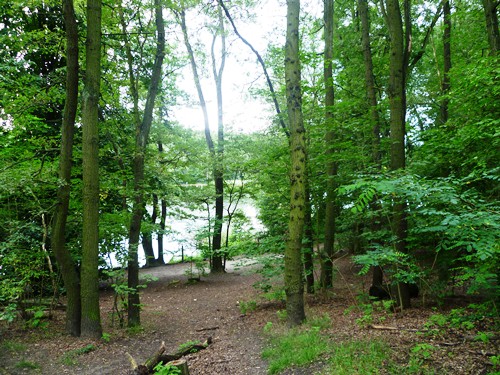
(Photo: View through the trees / Paul Scraton)

From the moment people began to make money in Berlin, they looked for ways to escape the city. The Grunewald, with its forest and lakes, became home to the mansions and villas of the rich at the end of the nineteenth century, and the neighbourhood was incorporated into Berlin in 1920. Not long after Christopher Isherwood was in town, and his impression of the place was less than favourable:

“Most of the richest Berlin families inhabit the Grunewald. It is difficult to understand why. Their villas, in all known styles of expensive ugliness, ranging from the eccentric-rococo folly to the cubist flat-roofed steel-and-glass box, are crowded together in this dank, dreary pinewood.”

A page or so later, on his way to teach the daughter of one of those rich Berlin families, he goes on to describe the place as a “millionaire’s slum”. But the wealthy and the well-to-do continue to be quite happy in their moneyed-sanctuary between the trees. Continue reading

Out from the studio – The art of Helen Mirra

Helen Mirra
Field Recordings, 7 x 5000 Schritte, in Berlin (Steglitz) 31 Juli
Detail / detail
Öl auf Leinwand / Oil on linen, 2010
80 x 170 cm
Courtesy of the artist

An exhibition currently taking place in Berlin is “gehend: Field Recordings 1-3” which is taking place at the KW Institute for Contemporary Art. Helen Mirra made these prints and rubbings on hikes around Berlin, Bonn and Zurich. She explains her philosophy on her website:

“After a number of years making discrete works in various materials, and considering various subjects, Mirra’s present rhythm of working takes the form of a kind of paced printmaking, made through walking. The activities are interdependent; the walking structures the printing, and the printing impels the walking. This rhythm is nestled into a cycle of exhibitions that perpetuates the project.”

For this exhibition she spent a month in each of the three locations, and spent almost every day walking. Every hour she would make a print of the ground before transferring this onto linen, collecting seven such prints a day. The aim of her work, according to the notes that accompany the exhibition, is to “resist idealised notions of nature” as well as to “open up spaces of association, in which the perception of small things is enlivened, and our ethical sense of responsibility regarding our environment and its diversity is addressed.”

Exhibition runs until the 29th January – Homepage

The Joy of Maps

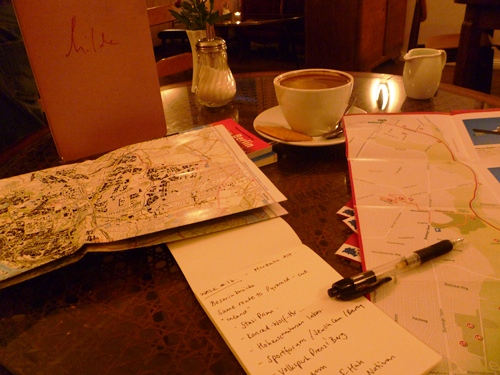
A beautiful morning gives way to a miserable and bitterly cold afternoon, the wind whipping down the avenues of Berlin as drizzle falls in the ever encroaching darkness. It may be nicer in general to be out of doors, but sometimes a refuge is needed, whether it is the bookshop, the pub, a café or the living room. I choose Café Hilde on the corner of Prenzlauer Allee and Metzer Straße, a sanctuary of flickering candles, gentle music and good books to browse on the shelves. Continue reading