For a week I was in Japan – or was it six days? I count back on my fingers to try and piece together the chronology of a trip that even now, only a couple of weeks later, is something of a blur. It is okay, I tell myself. Just try and write it up, and you will find the through line; you will be able to chart a clear path through your notes and make sense of all the sights and sensations of those six days… but it has not worked like that, so we will go this way instead: fragments of a city to which I cannot wait to return…
Ever since I was a small child my mom has been telling me how great Scotland is, the beauty of the landscapes and the friendly people that she met, and how she really wanted to eat haggis… the delicacy that she missed on her first trip over 35 years ago. So in October we made a trip – her return to Scotland – for our annual mother-daughter journey together.
The history of this village at the bottom end of the Scharmützelsee lake about an hour from Berlin is all there in the name. The Wends were West Slavs, who settled in the land between the Elbe and the Oder rivers over a thousand years ago. Divided into a number of different tribes, they were the majority population of the area that now makes up most of the state of Brandenburg until the arrival of German colonists between the 12th and the 14th centuries. By the 18th Century most of the Wends had been assimilated into the German population, except for the Sorbs, who continue to live as Germany’s only indigenous minority in the Spreewald region, not far from Wendisch-Rietz.
It is a holiday in Beeskow, a small town on the river Spree about an hour and a half drive from Berlin. Not long after Christmas and the town feels like it is indulging in a collective hangover; there is barely a soul to be seen, and as we walk through the cobbled streets of the Altstadt the only people we come across are a group of men, a little worse for wear on beer and schnapps, who are making their way to a smoky bar down on the embankment. But before we come across them – filled as they are with alcohol-fuelled bonhomie – we have walked through the picturesque market square, complete with town hall and the odd half-timbered house. Even the buildings that date back to the German Democratic Republic and beyond have been built to fit with the ensemble, and it is easy to imagine it cheerful and bustling on an early summer market day, the outdoor seating of the cafes and restaurants spreading out across the cobblestones.
The Ghost of Tom Joad, as performed by Bruce Springsteen and the E Street Band, with Rage Against the Machine’s Tom Morello joining on lead guitar, also features on Bruce’s new album of covers, rarities and reworkings entitled High Hopes that was released here in Germany a couple of weeks ago. Truth be told, and probably down to the nature of how it came together, the album is something of a mixed bag, but for me at least it is the re-working of The Ghost of Tom Joad that is, as they say, worth the price of admission alone…
The song, with its nods to Steinbeck, Woody Guthrie, the depression-era United States and the travails of contemporary (it was written in the 1990s) worker migration in the south west of the country, was powerful in its simplicity when first recorded for the album of the same name. The version on High Hopes, with Morello taking turns to sing with Springsteen, and featuring his trademark guitar sound, which you can see in the video below, brings a whole new level of anger and, indeed, rage, to the song.
There are plenty out there who find it hard to stomach the likes of Springsteen and Morello – wealthy rock stars both – taking up the cause of the invisible and unheard, the destitute and disenfranchised, but having observed both men bring their political beliefs to their art over the past couple of decades, from that wonderfully uncompromising first Rage Against the Machine album that hit my sixteen year self hard around the ears, to Bruce’s recent offerings on the Wrecking Ball album of 2012, I think it is fair to say that both men appear to be genuine in their commitment, and I admire them all the more for it.
I have taken time out on Under a Grey Sky to write about Bruce Springsteen before, but listening to the new version of The Ghost of Tom Joad I could not help think that there was a wider issue that I wanted to bring to these (virtual) pages. At first glance it might seem that a website about “adventures beyond the front door” would have little to do with politics, let alone the latest release by Mr Springsteen. But I cannot help but think that anyone who is interested in place, in social and cultural history, in (psycho-)geography both physical and human… indeed, anyone who is trying to understand that world beyond the front door, cannot ignore “politics” in all the many and varied meanings of the word.
As I look back through the archive, to articles on walking and access, whether in Berlin in 2013 or on Kinder Scout eighty years earlier, on the post-industrial landscape of Yorkshire or the Saarland, the Llanberis Slate Mines, the Swedish countryside or the Black Mountain over Belfast, and it is clear that to understand these places now is to understand the social, economic and political developments that brought us to this point. As I walk the Berlin Wall Trail for Traces of a Border, I am not only reflecting on the history of the division of Berlin but also contemporary issues of memorialisation, of society in transition, of widening wealth gaps and gentrification. And as I take a small group of interested people through my home neighbourhood of Wedding, as I will do on Saturday morning, there will be much to talk about the social and political developments of the neighbourhood in the present day, as much as we discuss its political past as a focal point of the Social Democratic and Communist movements in Berlin and the Germany beyond the city limits.
A friend of mine once told me about a fellow blogger who, when discussing his Berlin-based website said; “I don’t do politics.” I find it hard to imagine how you write about a city without “doing” politics, but this disengagement seems to fairly common. That is perhaps half the problem… and maybe we could all do with “doing politics” a little bit more. Whatever you might think of Bruce Springsteen or Tom Morello, that is not something that can be levelled at them…
Now Tom said “Mom, wherever there’s a cop beatin’ a guy
Wherever a hungry newborn baby cries
Where there’s a fight ‘gainst the blood and hatred in the air
Look for me Mom I’ll be there
Wherever there’s somebody fightin’ for a place to stand
Or decent job or a helpin’ hand
Wherever somebody’s strugglin’ to be free
Look in their eyes Mom you’ll see me.”
Words: Paul Scraton
Song Lyrics from The Ghost of Tom Joad by Bruce Springsteen
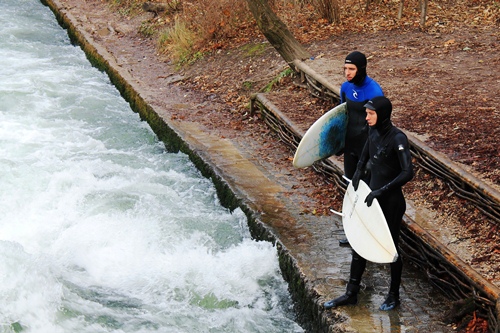
Just before Christmas, as we walked through the Englische Garten in Munich, I realised the water level in the Eisbach – a man-made river that flows through the park – was particularly high.
“I bet the surfers would love this…” I remarked, having seen the young men and women dance atop the man-made wave during an early summer’s visit a few years ago.
“Do you think they will be surfing today?” Katrin asked, but I was doubtful. It was barely above freezing, and that was on the footpath. How it must have been in the water itself I could not imagine. But of course, the failure of imagination was all mine, for as we turned the corner to come within sight of the permanent wave that curls back on the river just after it passes beneath the road at the bottom of the park, there were some black-clad figures, only their eyes and noses exposed to the elements, dropping down onto their surfboards from the brick embankment to the amazement (and bemusement, it has to be said) of the onlookers gathered on the bridge above.
I sort of suspected this would happen… writing this piece yesterday I had a feeling that the weather gods mentioned in the last paragraph might make me look foolish, and as I ran through icy rain this morning it became clear that they were not even going to wait for the piece to go online. It is supposed to snow later on as well… I guess the wait is over.
Something strange has been happening with our weather. Whilst North America freezes, and Great Britain is bashed by storms, northern Germany has been mild to the point of springtime, and along the Berlin Wall Trail not far from our apartment the first cherry blossoms have been sighted, almost four months too early. On the web people joke that we will pay for it sooner rather than later, that the Berlin winter will once more take us in its icy grip, but for the moment we are talking more about the weather than even the British, debating what we should be wearing when on a normal January day in this city there would only be one answer; as much as possible.
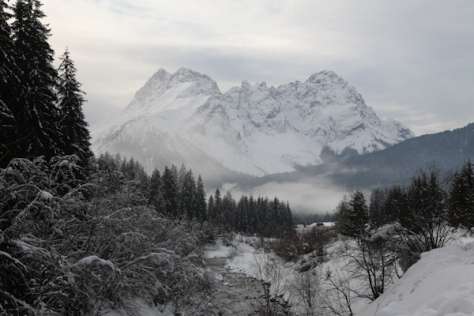
For the past few days I’ve been exploring a remote mountain village called Sappada in Northern Italy. The valley is secluded amongst gorgeous, steep, snow-topped mountains Monte Sierra, The trio of Monte Terza and Monte Ferro. At the bottom of the valley there is the beautiful Fiume Piave, a mountain river that runs all the way down to Mediterranean. We have been following it on our trips back and forth to Venice. At some parts there are fantastic rapids and waterfalls, and sometimes there is just a peaceful little stream in the middle of a huge valley with limestone pebbles.
Walking through the lakeside village of Pieskow in Brandenburg is a lesson in history through architecture. There is the grand manor house, with a garden that sweeps down to the lake, high fences to keep out the riff-raff, and mysterious initials on the doorbell where – in a more humble abode – there would be a surname or even two. There are the classic, single-storey Brandenburg farmhouses arranged around cobble courtyards. There are prefab blocks from the GDR-era, once belonging to a holiday camp, now abandoned in the woods. Further along the shore there is a functioning holiday camp, built after the fall of the Berlin Wall, in the style of Swedish or Danish boathouses… all wooden decks and stoves to keep out the cold. And there is the village church, of uneven brick and a tiled roof, the tower looking out over it all…
A few days into the New Year and we have headed down to Wannsee, the resort on a lake that sits within Berlin’s city limits. In the summer thousands head for the bathing beach, or walk and ride the shoreline path, but in the early days of January it feels as if we have the place to ourselves. As we leave the villas that line the lake behind us and walk through the trees with the water just a few metres away, all we can hear are the birds, the distant hum of a main road, and the occasional airplane. The lake is still, and there is little breeze. It is almost as if the weather has taken a holiday, along with most of the city.
After a walk out to the headland and a long view down the Havel towards the Teufelsberg in the north, we head back to the statue of a lion that stands above the boathouses and marks the beginning of town. There are still remnants of the New Years Eve fireworks standing at the foot of the statue, and the odd discarded beer and sekt bottle. From the balcony where the lion stands it is possible to look out over the lake from a slightly elevated position, but there is little to see, except for a pair of kayakers chasing the slipstream of the BVG ferry that crosses each hour between Wannsee and Kladow on the opposite bank.





 Under a Grey Sky