Cairnsmore of Fleet, Galloway, Scotland, February 2014
By Daniel Greenwood
A wading bird bursts from the bog. I watch its sharp wings cut into the wall of mist and descending treeline. I put my binoculars to my eyes and the bird is lost. The world has been reduced. All terrestrial life but for water, a few lichens, heather and wintry moor grasses has escaped. I have left behind oak woods overcome by rhododendron and cherry laurel, and Cairnsmore Burn choked by the former, its water crashing from the shadows. It was not right. Snowdrops still managed to create small rugs of white flowers and winter green leaves. Bluebells peeked through the leaf litter amongst them. Behold the denizens of Galloway’s oldest woods. Up here those are images in the mind. The life in the lap of the Cree estuary – the buses, postman, trees and gentle flowering plants are mere memory. The cover of Glenure Forest’s regimental spruce is the last notion of protection. It’s now up to willpower, my body and clothing. The path leads clear from 20 metres, visibility coming and going with cloud.
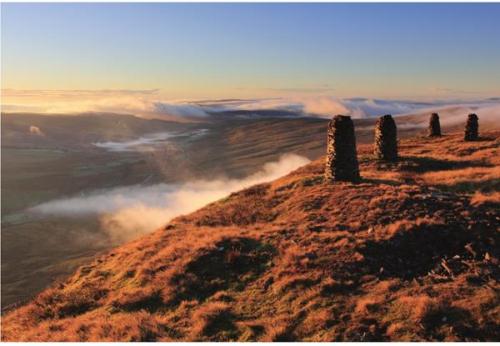
Wild Boar Fell at Dawn, chosen by Matt Neale, Area Ranger, Yorkshire Dales National Park Authority: “This is on one of my local runs. I get the train up to Kirkby Stephen early in the morning, run over Wild Boar Fell and back home, which is about 12 miles.”
Sarah Butler writes…
Working The View (www.workingtheview.co.uk) is a two-year collaboration between my brother (a landscape photographer who lives and works in the Yorkshire Dales ) and myself, exploring the relationship between the Yorkshire Dales landscape and its guardians. Working with 40 participants – from farmers to planners, from archaeologists to experts in peat restoration, water management and forestry – we asked them to choose their favourite view and tell us how and why they feel connected to this unique part of the world.
We’ve brought the results – a collection of gorgeous photos and fascinating insights into the passion and politics involved in maintaining and making a living from this landscape – together into a coffee table book (available from http://www.yorkshiredalesphotography.co.uk/wtv/products-page/) and a series of exhibitions throughout the Yorkshire Dales.
“Here hills with vales, here woods with water vie;
Here art with nature strives to feast the eye;
Here Espec’s tow’ring fabric, clad with green
and monkish grandeur, decorates the scene;
Here architects engrave th’ Ionic scroll,
and fam’d Burnice’s pencil crowns the whole.”
– An anonymous contemporary description of Rievaulx Terrace and its Ionic temple.
It felt like spring had finally arrived as we drove through the North York Moors National Park. The low sun, flickering through the bare trees, gave the woods an almost stroboscopic quality. Daffodils lined the lanes and snowdrops nodded in the March breeze. We were heading to Rievaulx Terrace, a landmark created by a wealthy landowner in 1758 to stroll, entertain and impress his friends. Every landscape tells a story, especially when they cost as much as this must have done to create.
Chris Hughes explores two of his favourite Art Deco buildings to be found on the English seaside, and reflects on both their history and their future. It would be great to hear in the comments of any readers’ favourite buildings, wherever they might be, and especially those which have been adapted to new and different purposes…
The De La Warr Pavillion built in 1935 and the Midland Hotel built in 1933 stand on the seafronts of Bexhill-on-Sea and Morecambe, the first in the South-east and the second the North-west of England.
The De La Warr Pavilion is an International Stylebuilding and considered by many to be in an Art Deco style. Some claim it to be the first major Modernist public building in Britain (the other option being Hornsey Town Hall). The building was the result of an architectural competition initiated by Herbrand Sackville, 9th Earl De La Warr, who was a committed socialist and Mayor of Bexhill, and who persuaded Bexhill council to develop the site as a public building
Subversive Urbanism is a blog by Phil Wood that takes us on an exploration through the urban environment “ready to question the ‘common sense’ or ‘expert’ ideas about the way our cities are and have to be.” According to his bio, Phil has been described as “cultural planner, urban therapist, intercultural innovator, insurgent anthropologist, psychogeographer…” and I have very much enjoyed reading back through his archive of work. Phil has kindly given us permission to re-publish the following piece on Venice – a city that is more subversive than you might think…
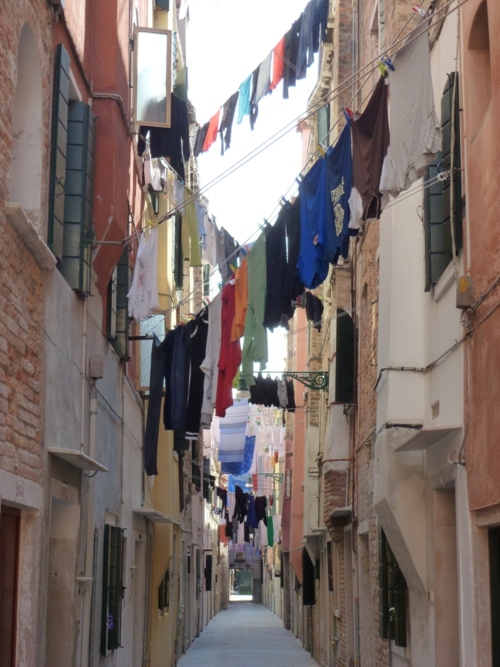
Venice… subversive? When I made a short visit to Venice I wasn’t expecting to be inspired to write anything in this blog about subversive urbanism… but I was wrong.
After all, isn’t Venice the ultimate clichéd example of a city that has lost all point and purpose other than to offer itself up as an open air museum, hawking its illustrious past along with an over-priced cappuchino and a souvenir tea towel? Well that’s certainly one way of looking at Venice and there’s plenty of evidence for the prosecution, even on an off-season Tuesday in March. There’s something dispiriting about those hordes of visitors trekking dutifully across the Rialto and into Piazza San Marco. Judging from many of their faces it seems hardly more pleasurable than the job, in the office or call centre, they’ve had to endure in order to raise the money to pay for the trip to La Serenissima in the first place. Somehow it’s a reciprocal obligation both they and the city must perform but which no-one really enjoys.
The Ghost of Tom Joad, as performed by Bruce Springsteen and the E Street Band, with Rage Against the Machine’s Tom Morello joining on lead guitar, also features on Bruce’s new album of covers, rarities and reworkings entitled High Hopes that was released here in Germany a couple of weeks ago. Truth be told, and probably down to the nature of how it came together, the album is something of a mixed bag, but for me at least it is the re-working of The Ghost of Tom Joad that is, as they say, worth the price of admission alone…
The song, with its nods to Steinbeck, Woody Guthrie, the depression-era United States and the travails of contemporary (it was written in the 1990s) worker migration in the south west of the country, was powerful in its simplicity when first recorded for the album of the same name. The version on High Hopes, with Morello taking turns to sing with Springsteen, and featuring his trademark guitar sound, which you can see in the video below, brings a whole new level of anger and, indeed, rage, to the song.
There are plenty out there who find it hard to stomach the likes of Springsteen and Morello – wealthy rock stars both – taking up the cause of the invisible and unheard, the destitute and disenfranchised, but having observed both men bring their political beliefs to their art over the past couple of decades, from that wonderfully uncompromising first Rage Against the Machine album that hit my sixteen year self hard around the ears, to Bruce’s recent offerings on the Wrecking Ball album of 2012, I think it is fair to say that both men appear to be genuine in their commitment, and I admire them all the more for it.
I have taken time out on Under a Grey Sky to write about Bruce Springsteen before, but listening to the new version of The Ghost of Tom Joad I could not help think that there was a wider issue that I wanted to bring to these (virtual) pages. At first glance it might seem that a website about “adventures beyond the front door” would have little to do with politics, let alone the latest release by Mr Springsteen. But I cannot help but think that anyone who is interested in place, in social and cultural history, in (psycho-)geography both physical and human… indeed, anyone who is trying to understand that world beyond the front door, cannot ignore “politics” in all the many and varied meanings of the word.
As I look back through the archive, to articles on walking and access, whether in Berlin in 2013 or on Kinder Scout eighty years earlier, on the post-industrial landscape of Yorkshire or the Saarland, the Llanberis Slate Mines, the Swedish countryside or the Black Mountain over Belfast, and it is clear that to understand these places now is to understand the social, economic and political developments that brought us to this point. As I walk the Berlin Wall Trail for Traces of a Border, I am not only reflecting on the history of the division of Berlin but also contemporary issues of memorialisation, of society in transition, of widening wealth gaps and gentrification. And as I take a small group of interested people through my home neighbourhood of Wedding, as I will do on Saturday morning, there will be much to talk about the social and political developments of the neighbourhood in the present day, as much as we discuss its political past as a focal point of the Social Democratic and Communist movements in Berlin and the Germany beyond the city limits.
A friend of mine once told me about a fellow blogger who, when discussing his Berlin-based website said; “I don’t do politics.” I find it hard to imagine how you write about a city without “doing” politics, but this disengagement seems to fairly common. That is perhaps half the problem… and maybe we could all do with “doing politics” a little bit more. Whatever you might think of Bruce Springsteen or Tom Morello, that is not something that can be levelled at them…
Now Tom said “Mom, wherever there’s a cop beatin’ a guy
Wherever a hungry newborn baby cries
Where there’s a fight ‘gainst the blood and hatred in the air
Look for me Mom I’ll be there
Wherever there’s somebody fightin’ for a place to stand
Or decent job or a helpin’ hand
Wherever somebody’s strugglin’ to be free
Look in their eyes Mom you’ll see me.”
Words: Paul Scraton
Song Lyrics from The Ghost of Tom Joad by Bruce Springsteen
Walking through the lakeside village of Pieskow in Brandenburg is a lesson in history through architecture. There is the grand manor house, with a garden that sweeps down to the lake, high fences to keep out the riff-raff, and mysterious initials on the doorbell where – in a more humble abode – there would be a surname or even two. There are the classic, single-storey Brandenburg farmhouses arranged around cobble courtyards. There are prefab blocks from the GDR-era, once belonging to a holiday camp, now abandoned in the woods. Further along the shore there is a functioning holiday camp, built after the fall of the Berlin Wall, in the style of Swedish or Danish boathouses… all wooden decks and stoves to keep out the cold. And there is the village church, of uneven brick and a tiled roof, the tower looking out over it all…
A few days into the New Year and we have headed down to Wannsee, the resort on a lake that sits within Berlin’s city limits. In the summer thousands head for the bathing beach, or walk and ride the shoreline path, but in the early days of January it feels as if we have the place to ourselves. As we leave the villas that line the lake behind us and walk through the trees with the water just a few metres away, all we can hear are the birds, the distant hum of a main road, and the occasional airplane. The lake is still, and there is little breeze. It is almost as if the weather has taken a holiday, along with most of the city.
After a walk out to the headland and a long view down the Havel towards the Teufelsberg in the north, we head back to the statue of a lion that stands above the boathouses and marks the beginning of town. There are still remnants of the New Years Eve fireworks standing at the foot of the statue, and the odd discarded beer and sekt bottle. From the balcony where the lion stands it is possible to look out over the lake from a slightly elevated position, but there is little to see, except for a pair of kayakers chasing the slipstream of the BVG ferry that crosses each hour between Wannsee and Kladow on the opposite bank.
Just before Christmas I was invited once again by the lovely folks of Caught by the River to write my “Shadows and Reflections” for 2013 as the year comes to an end. I got down to it on the train back to Berlin from Munich, and my thoughts as the German countryside rushed beside me outside the window turned to this land and its landscape, and feelings of home and belonging:
The German tourists on the bus laugh as the pack of feral dogs crosses the street at the airport roundabout. And why should they not? There are three dirty Jack Russell terriers and one lanky greyish-brown greyhound, an odd-looking combination for a modern day pack of hounds. The tourists do not know that the dogs hunt hares in the bushes and undergrowth around the business parks in Dublin 15, tearing them to pieces. The dogs leave shreds of paws and ears and bits of bone lying around the car parks for unsuspecting call centre workers. Dublin in autumn is a nice and gentle city only upon first glance.
Two days later, I take the local commuter train, the DART, from north Dublin to the city centre. Along the canals that the train passes and on the small squares next to the playgrounds in the estates kids in tracksuits and in grubby-white sneakers erect pyramids of wood; temporary pyramids to burn. They pile old wooden pallets, doors, window frames upon twigs, mouldy floor boards, plastic rubbish and the occasional refrigerator to form large heaps of tinder; offerings to the old Irish harvest gods and their own juvenile lust for destruction. One of the piles I see is crowned with a decapitated doll’s head on a wooden pole, its blue plastic eyes staring into nothingness.






 Under a Grey Sky