Category Archives: Reflections

The Lost Neighbours of Rathenow, Brandenburg


Rathenow1

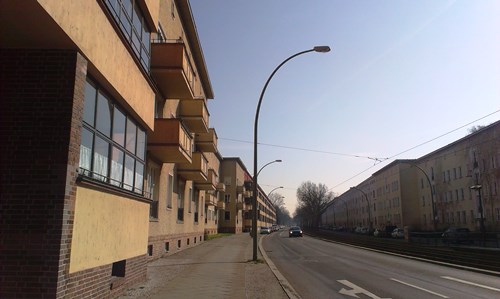
At the harbour in Rathenow on a sunny, summer’s day, the atmosphere is fine. People take pictures of the “lock spitters”, a memorial to the piece workers who used to kill time whilst waiting for the barges to pick them up by holding spitting competitions against the canal. Others queue at the specially-erected wooden info stands for their maps and tickets for the BUGA, Germany’s premier flower show being hosted in 2015 by Rathenow and other communities in the west of Brandenburg. The BUGA has brought many people to the town, and it seems well-scrubbed in anticipation of their visit. The streets are clean and the bicycles lanes smooth, the balconies of the GDR-era Plattenbau filled with flowers, and every shop and cafe seems to be welcoming the flower-peepers to their corner of Westhavelland, proud of their town.

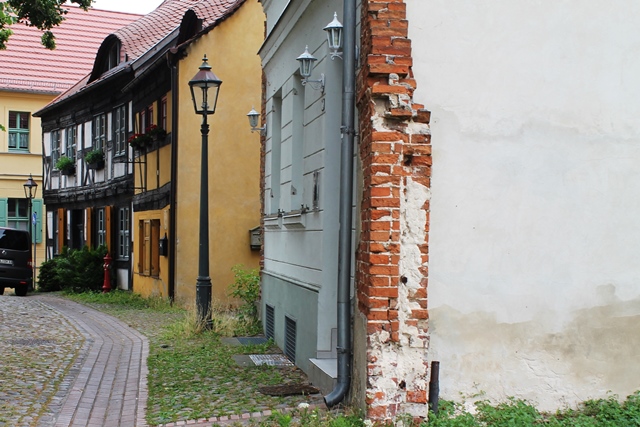
But as we cross the bridge from the harbour and into the old town – a collection of cobbled streets around the church – I get the sense of something missing… the old town itself. For in Rathenow, the Altstadt only contains a handful of pre-war buildings. The red brick church (itself needing massive renovation over recent decades) and some half-timbered houses, but otherwise most of the the old town seems to have been built either during the years when Rathenow was part of the German Democratic Republic, or even since. It is not that it is bad, or it is ugly, but just you cannot help but get a sense of loss as you walk the streets… and you want to find out more.

Continue reading

The Possibility of an Island

Island

The Possibility of an Island is a better title than it is a book. Indeed, although I have read it I cannot for the life of me recall a single scene from Michel Houellebecq’s book, but the title has stayed with me. To me islands always seemed to be filled with possibility; they are an endless source of fascination. Perhaps it is because they are contained, a world in and of itself, that can be explored and mapped. There is an end to an island. A natural border.

A few weeks ago I read about a short journey I have always wanted to take. The writer Richard Carter had climbed into a canoe on Coniston in the Lake District and, slowly but surely, made his way across the lake to Wild Cat Island. No matter that the island’s real name is Peel Island, for any readers of Arthur Ransome’s wonderful Swallows and Amazons will know what it is really called, and thirty five years after reading the book for the first time (about six or seven years before I did), Richard discovered the magic was based on reality:

We drift past a low, rocky promontory and some rocks. This is so right: it’s just like in the book! We’re almost past it before I see it: back to our right—I mean starboard—a steep-sided, narrow channel leads straight into the heart of the island. A few feet to either side of here, and the channel would be invisible, obscured by rocks and headland. This is the place! We’ve found the secret harbour! Continue reading

An update from Elsewhere

Elsewhere_GorgastFestival

Those readers of Under a Grey Sky who have been following the progress of my new project Elsewhere: A Journal of Place will already know most of this, but in case you missed it I wanted to record an update on the journal here on my personal blog as it is has been a challenging but rewarding process so far.

When Julia and I first met to talk about the project at the end of last summer, our aim from the beginning was to provide a platform for writing and visual arts that explores the concept of place in all its various meanings, whilst also committing to print and the desire to create a beautiful object with which to transport those words and pictures. A few days ago, after months of writing, editing, designing, crowdfunding, building an audience, meeting tax consultants, and all the various bits and pieces that we needed to do to get from there to here, we sent the first edition to the printers here in Berlin and now all there is to do is wait for the physical thing to arrive.

Continue reading

Strange light in northern Berlin

Eclipse

The newsreaders on the breakfast radio swung between breathless excitement and dark warnings of incinerated retinas. Television crews headed to our daughter’s school where, an email assured us, all the kids would be supplied with the proper eyewear. Our Hausmeister patrolled the central reservation – normally reserved for doggy toilet runs and the rumbling trams – waiting for the moment. I went for a run.

Continue reading

The Invisible Border, Priwall

PriwallFerryweb

The rain started to fall as I waited for the car ferry to take me from Travemünde across the mouth of the river that gives the town its name to the village of Priwall, on the opposite bank. Priwall sits at the end of a peninsula that belongs to the city of Lübeck. The hinterland to which the peninsula is attached belongs to the state of Mecklenburg-Vorpommern. None of this really matters, except for the need to use the ferry if you want to stay within the limits of the Lübeck transport system. But from the end of the Second World War until early 1990 it did. Priwall was cut off by the inner-German border, surrounded by water and wire, and gazed down upon by watchtowers. The ferry I am waiting for was the only connection to West Germany, of which Priwall was a part. For the best part of half a century, the peninsula was – to all intents and purposes – an island. Continue reading

Seventy years since Auschwitz-Birkenau

???????????????????????????????

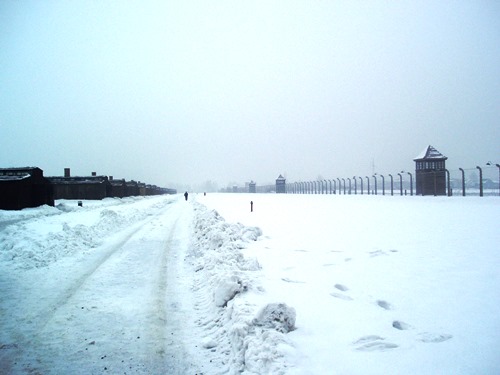
Today is the seventieth anniversary of the liberation of the Auschwitz-Birkenau extermination camp in German-occupied Poland. As events are held across the world to commemorate the anniversary, I dug out an article I wrote based on a visit to Krakow in the early months of 2006. Katrin was pregnant, and we had travelled to the Polish city to scout locations for an international hostel conference she was organising. A few months later, when the conference took place, we had to travel overland as Katrin was no longer allowed to fly, but on the first visit we landed at the airport and were driven into town through socialist-era suburbs that reminded us of Berlin to the beauty of the old city centre:

On a clear winter’s day, with a light mist hanging overhead, weak sunshine bathes the Old Town of Krakow in a gentle, almost dream-like light. It softens the cobbled streets, the towers and spires, the market square – a more beautiful city in Europe is hard to imagine. In the bone-chilling cold people move at a brisk pace. Young women students scurry between university buildings wrapped in heavy scarves and jackets, hats pulled low, their round, pretty faces open to the elements. Only tourists loiter – that’s what tourists do – framing the city through digital lenses. But in January they are few in number. As the city ebbs and flows, people go about their daily business. For them beautiful Krakow is commonplace; while visitors gaze in wonder, local eyes rarely rise above street level.

Continue reading

At the end of the road – the Hans Fallada Haus, Carwitz

Fallada1

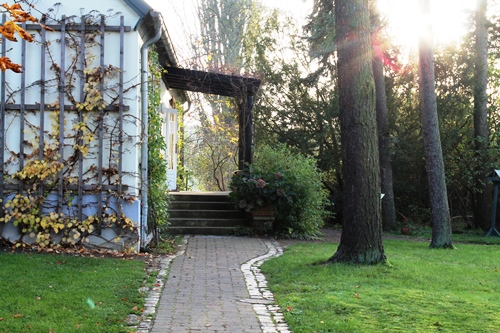
The writer Hans Fallada, perhaps best known in the English speaking world for his 1947 classic Alone in Berlin, was born as Rudolf Ditzen in Greifswald in 1893. He died, fifty three years later in the year Alone in Berlin was published, at the age of 53. The headlines of his biography suggest an extremely eventful, often tragic, half century of a life:

Sustains injuries, kicked by a horse
Contracts typhoid
Kills friend in a duel as part of a suicide pact
Continue reading

Looking back on three years… and forward to elsewhere

UaGS Image

Three years ago the first post on Under a Grey Sky was published, reflecting on a year of travels and explorations that took Katrin and I to familiar corners of north Wales and Spain, as well as new experiences not only on the road but also within our home city of Berlin. Under a Grey Sky was always intended to reflect on the fact that you don’t need to travel long haul to find fascination (although you can), and that there are plenty of adventures to be found just beyond the front door.

Looking back on those three years and the writing and photography we have published here, from friends old and new, and our own explorations both here in Germany and beyond, Under a Grey Sky has been not only a great place to reflect on what we have experienced but has also served as a motivation to get out of the house, even on the gloomiest of February days. It has become such a fundamental part of our life, even if the frequency of new articles has tailed off a little in the past eighteen months, and we are always on the lookout for what to write about or photograph next.

At the same time, the project has also connected me with likeminded people – such as the wonderful community around Caught by the River – as well as making many new friends along the way, many of whom are fantastic and inspiring writers, even if I have never met them face to face. It has also informed the writing and other activities with Slow Travel Berlin, included the creation and launch of our series of guided walks and the publication of a book, Mauerweg, with STB-founder and great friend, Paul Sullivan.

That book was also tied to Traces of a Border, another “spin-off” project from Under a Grey Sky, exploring the 160 kilometre length of the Berlin Wall Trail. With the 25th Anniversary of the Fall of the Wall in November 2014 and the publication of the book, there has been a little break from Traces of a Border, but that project won’t stop because there are still many more stories to tell.

So as Under a Grey Sky moves into its fourth year I am very proud not only of the website, but of the change in my own writing (and indeed approach to life) that the project has very much been central to inspiring. I have walked, talked, written and read more… and it has led, eventually, to another new project that some of you may already know about. In 2015, along with another good friend and incredibly talented designer Julia Stone, we will launch a quarterly print journal of place. Julia and I had long spoken about a project together, and during the course of 2014 we developed the idea that you can read about on the Elsewhere website.

I am really excited and nervous about this step, but my experiences over the past three years since I sat down to write that very first post on Under a Grey Sky convince me that we have a good chance to make it work. I hope some of you will come along for the ride.

See you in 2015,

Paul Scraton

Autumn leaves

Winter is almost upon us, but it has been a beautiful autumn… here Chris Hughes reflects on the conditions of autumn that so fascinate photographers:

Autumn provides the colour and the clear air that inspires landscape photographers to get up before dawn and also to wait through many chilly dusks hoping to capture dramatic and frequently very beautiful pictures. Given that perfect combination of an indigo sky and a low, searchlight-like sun that follows a sharp autumn shower and many an inspiring photograph can result.

All too often these brilliant conditions occur when you are driving on the motorway, have no chance to stop and probably do not have the camera with you anyway.

So it is that you must seek out opportunities to photograph the colours of autumn even when the sky really is grey and the sun hidden from view with rain close by. You must be cunning and look for the details and the miniature rather than the vast, dramatic vistas and where better to look than on the ground, around your feet and among the most common of autumn features. Let’s look at the leaves.

Image One

There is great beauty in the mass of leaves but sort through the jumble and find the individuals, seek out the colour variations and revel in the variety of shapes and size. Reds, browns, yellows, vivid green all gleaming wet with dew or rain, leaves are landscapes in miniature.

Image Two

Perhaps it’s just me, but I am fascinated by these jewels of autumn and take far too many photographs of them. These tiny autumn landscapes can be found in every street, park, garden, allotment and .. well everywhere there are trees. But, like the autumn light that creates such transient drama, these leaves quickly fade and disappear, turn brown and return to the earth. So you must act quickly and not miss your chance.

Fortunately, come the spring the leaves return, passing through the many shades of green before once again the miracle of autumn comes round one more and the leaves produce their rainbow of colour and I will be looking down to find them once again. I will be taking more photographs of leaves.

But I will also be looking for those brilliant moments when the low sun shines intensely from under a dark sky and lights up the bright yellows and oranges across the dark brown fields.

Image Three

Words & Pictures: Chris Hughes

Water and Concrete: Walking Cologne and the Rhine

Cologne

By Marcel Krueger:

I turn away from the plastic people and plastic boutiques of the Belgian Quarter, and cross the Friesenplatz and its puke pancakes from the night before. On my way to the cathedral and the water I pass through Steinfeldergasse, a small lane where every one of the small colourful low-rise buildings on either side is owned by the Catholic Church or a Catholic association. The church is still a dominating presence in this town.

I arrive at the cathedral shortly afterwards, walking past Komödienstrasse and An den Dominikanern, where a cameraman of the US army filmed a tank battle in March 1945. A German Panther tank destroyed a Sherman, killing three of its crew, and was in return blown up by a Pershing tank destroyer in one of the last tank fights in the destroyed city. The dramatic manoeuvres and firefights amidst the rubble around the cathedral could have been scripted by Hollywood, but the dismembered dead were all too real, futures obliterated by high-explosive shells. Now, on the streets where they died, I could buy an ‘original German cuckoo clock’, or pause to eat a döner kebab.

Continue reading