Category Archives: Off Season

Familiar Spaces… New Year Exploration

FRONT

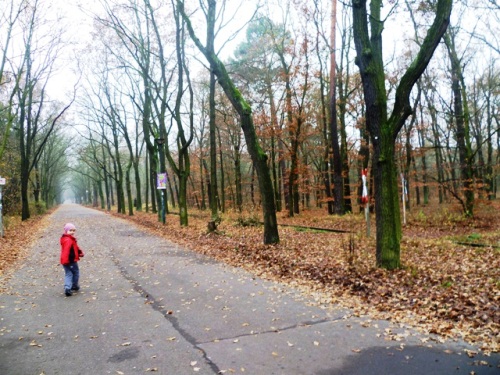
On the first weekend of the year we decided to escape not so much the madness – for that was all reserved for New Year’s Eve and the early hours of the following morning – but the debris and the feeling of the morning after the night before. Outside our apartment on Osloer Straße the street was strewn with firework casings, empty and smashed bottles, piles of grit from the snow flurry earlier in the week, and first of the abandoned Christmas trees, branches drooping and the needles scattered across the pavement.

We caught the S-Bahn from Bornholmer Straße, that famous bridge where the Berlin Wall was first opened and – with its dramatic views south towards the city centre – the venue for one of the larger impromptu firework displays on the 31st December. The half-empty train took us north, through Pankow and towards the suburbs, always close to the Panke river that flows, mostly hidden, by the raised railway tracks. At Karow – still Berlin and yet, with its detached houses and neat village centre, feeling like a place apart – we sought out the river and the route to the Karow ponds.
Continue reading

The Gnitz Peninsula, Usedom

Gnitz1

When most people travel to the Baltic island of Usedom, the attention is taken – understandably – by the sea. Most of the island is in Germany – with only the town of Świnoujście at the eastern end in Poland – and from north to south it is a line of holiday resorts that date back to the nineteenth century, the coming of the railway, and the development of seaside rest cures and vacations for the growing populace of the cities of northern Germany.

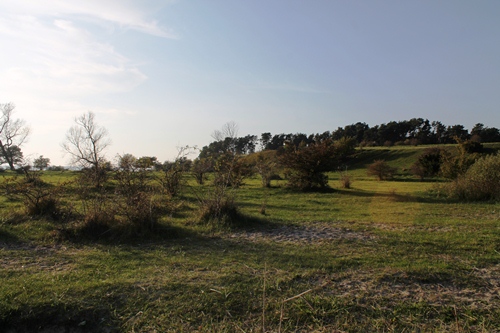
But the island is not only built on tourism. Before the first bathers arrived, the main economic activities on Usedom were agriculture and fishing, and that continues to this day. But whilst some of the fish would be and are pulled from the Baltic, a good proportion of the industry is focused on the inland sea that separates the island from the mainland. The communities that face the Achterwasser as it is known still target the tourists, with campsites and signs advertising rooms and apartments for rent, marinas offering boat trips and kayak tours, but it feels less developed than those resorts along the coast, and that these are still places where people live and work, even in the off season.

Continue reading

A walk in the woods: Wendisch-Rietz, Brandenburg

Wendisch1

The history of this village at the bottom end of the Scharmützelsee lake about an hour from Berlin is all there in the name. The Wends were West Slavs, who settled in the land between the Elbe and the Oder rivers over a thousand years ago. Divided into a number of different tribes, they were the majority population of the area that now makes up most of the state of Brandenburg until the arrival of German colonists between the 12th and the 14th centuries. By the 18th Century most of the Wends had been assimilated into the German population, except for the Sorbs, who continue to live as Germany’s only indigenous minority in the Spreewald region, not far from Wendisch-Rietz.

Continue reading

Early in the New Year at Wannsee, Berlin

wannsee1

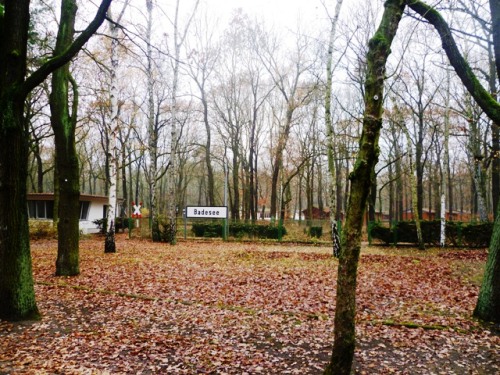
A few days into the New Year and we have headed down to Wannsee, the resort on a lake that sits within Berlin’s city limits. In the summer thousands head for the bathing beach, or walk and ride the shoreline path, but in the early days of January it feels as if we have the place to ourselves. As we leave the villas that line the lake behind us and walk through the trees with the water just a few metres away, all we can hear are the birds, the distant hum of a main road, and the occasional airplane. The lake is still, and there is little breeze. It is almost as if the weather has taken a holiday, along with most of the city.

After a walk out to the headland and a long view down the Havel towards the Teufelsberg in the north, we head back to the statue of a lion that stands above the boathouses and marks the beginning of town. There are still remnants of the New Years Eve fireworks standing at the foot of the statue, and the odd discarded beer and sekt bottle. From the balcony where the lion stands it is possible to look out over the lake from a slightly elevated position, but there is little to see, except for a pair of kayakers chasing the slipstream of the BVG ferry that crosses each hour between Wannsee and Kladow on the opposite bank.

Continue reading

Fog on the Water: Waren and the Müritz

Water1

The captain of the boat is sceptical.

“Are you sure you want to go out?”

There only about eight of us hanging around on the jetty, hands stuffed in pockets against the cold. We nod, perhaps as much in order to get aboard and indoors. He sighs.

“OK then. But you won’t see much…”

And it is true. We arrived in the town of Waren at the north end of the Müritz lake about three hours ago, with fog engulfing the town and visibility at about fifty metres. We hoped that by waiting until later in the afternoon it would have the chance to clear. And it had, a little, but as the boat made its slow progress out from the harbour it was hard to make out the opposite bank.

Continue reading

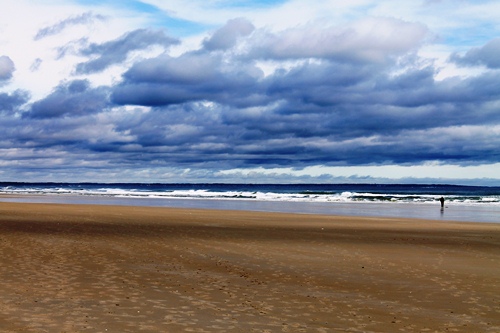
Off season in Ogunquit, Maine

Ogun1

It is the Easter weekend and we have headed for the coast. Despite the fact that lawn signs advertise Egg Drops and oversized bunnies are posing for photographs in shopping malls, the seaside resort of Ogunquit, just north of the New Hampshire border, has a decidedly off-season feel to it. Many of the motels, inns and hotels are not yet open for the season, and the little trolley bus that travels around the town and its neighbouring resorts will not emerge from the garage for another month or so. Still, as we follow the Marginal Way trail along the coast from Ogunquit village to the boutiques, lobster shacks and clapboard houses of the scruffily-posh Perkin’s Cove, there are a good number of people on the trail, enjoying the first real warming sun of the year. Enough, in fact, to image what kind of a traffic jam must occur on these low cliffs during the high season.

Continue reading

Once a park for Pioneers, Wuhlheide – Berlin

Katrin takes Lotte to the FEZ in the Wuhlheide, south-east of Berlin city centre. The park is quiet on this November weekend, although in the main hall kids crowd around the arts and crafts tables or wait, patiently or otherwise, for the play on the stage of the Astrid Lingren Theatre to begin. When Katrin first came here, as a child herself, this was the Ernst Thälmann Pioneers’ Park, inaugurated by the first President of the German Democratic Republic in 1950. It was the location for the 3rd World Festival of Youth and Students one year later, and again for the tenth edition in 1973. By that point it had grown from the original tent village to a facility including an open air stage, a sports stadium and indoor activity rooms… tens of thousands of children who grew up in East Germany came to the Pioneer Park each year. Most of attractions that Katrin enjoyed as a child are still there for her daughter, from the playground and forest trails, swimming pool and stages for different events and shows. The railway still runs – although it is no longer operated by the Pioneers themselves, for they have all grown up now and are bringing their own children to the park, to find their own adventures beneath the trees.

Continue reading

You shouldn’t always walk alone – Buckow, Germany

This piece was inspired by a walk in Brandenburg with Nicky and Greg Gardner. Nicky is the co-editor of Hidden Europe, and you can read her own impressions of the walk by following the link below.

Many writers would argue that if you want to walk for inspiration you need to walk alone. I have some sympathy for this view, and often find that a solitary walk gives me the time and space to get things clear in my head, finding solutions on the pavement or the parkland track to problems that seemed insurmountable sitting in the accusing glare of the anglepoise lamp on my desk. It is for this reason that I rarely leave the house without a small notebook in my pocket, using park benches, stone walls and tram-stops as temporary office space along the way.

But sometimes it is company and conversation that can make a walk inspiring, and so it proved on a wet Friday afternoon at the beginning of October, as I walked with friends around the lake at Buckow, fifty-odd kilometres east of Berlin. “Normally I am known for taking copious amounts of notes when I walk,” Nicky said to me, about halfway around, but her notebook, like mine, stayed firmly in the pocket. Instead, we talked.

Continue reading

Beers under a grey sky at Berlin’s Prater Garten

At Berlin’s oldest beer garden it is the first weekend in May, the flowers are blooming on the trees, but the shutters are most definitely down, behind which are locked beer taps that will not be flowing with Prater Pils. It seemed like the perfect time to head out for the first beer garden afternoon of the year. The skies may have been overcast all morning, and there is a slight chill in the air, but we have sipped beers in the rain here before, sheltering under those generous branches that provide shade on better days, or under the roof where they place the big screens for football tournaments.

Luckily the Prater has a restaurant, and they are more than happy to serve us some drinks to take out into the beer garden which we then have pretty much to ourselves. The kids do not have to wait for the swing in what is often both Berlin’s smallest and busiest “playground”, and we have our pick of the benches and tables. There is no sausages on sale, pretzels or pasta salad, but the burger place across the street is open and for once, there is no-one to object to us bringing in our own food.

Continue reading

Twice around the Schäfersee, Berlin

A weekend morning at the Schäfersee, a small body of water just inside the Reinickendorf border, a few hundred metres from the local chapter of the Hell’s Angels, in the north of Berlin. It is only a few kilometres from our apartment, but apart from perhaps on the bus up to Tegel, this is a corner of the city I have barely touched in the ten years I have been living here. The buildings around a typical for the neighbourhood – old worker’s apartment blocks from before the war, when Wedding and Reinickendorf were centres of industry in the city, plus a few post-war blocks of flats that look more peeling and crumbling than their older neighbours. An then there are the open spaces, perhaps planned or where, maybe, stray bombs fell. During the Second World War a nearby flak tower shot down a Soviet plane which then landed in the lake and, as yet, it has never been recovered from the depths. Continue reading