Monthly Archives: March 2013

To America…

America_Julia

Tomorrow morning we fly to the United States for a two week trip to two very different corners of the country; first to Orlando, Florida, and then on to Amherst, Massachusetts. It will be the first time I have set foot in the United States of America, although I have gazed across at it through the spray and the mist of Niagara Falls, and as with our journey to Paris last year, I am intrigued to see how this country that has played such a massive role in my own cultural life will live up to my expectations. Even more so than for the French capital, I think that it is an impossible task, as no other country lives so strongly in my imagination despite the fact I have never even been there. I cannot be the only one for, if you live in the west especially, American culture has been ever-present in our lives for the best part of a century.

In preparation for our trip I was looking through our bookshelves for something to read on the flight across the Atlantic, and I was struck by the number of books – and not just any books, but those formative books that shape your ideas and expectations – by American authors. However good certain books might be now, if I re-read them, they remain important to me because of the how and the when I first discovered them. Junky and Queer by William Burroughs, two slender volumes discovered on the shelves of Runshaw College library in my first year of Sixth Form. Fear and Loathing in Las Vegas, and  Fear and Loathing on the Campaign Trail, both bought at Manchester Airport on the way to Canada at the age of eighteen. Another Country, Giovanni’s Room and Notes of a Native Son, all part of a James Baldwin collection given to me by my dad during the first year of university and opened in the vast, cavernous hall of the Parkinson Building at Leeds.

Continue reading

Misty mornings in the Lake District, Cumbria

OLYMPUS DIGITAL CAMERA

By Matt Lancashire:

We recklessly chose to spend the end of February in the Lake District – statistically the wettest part of England – but were blessed with blue skies and t-shirt weather while the rest of the country got the cloud cover we were expecting. There was still snow on the mountains and broken ice washing down them into the lakes, but it was ideal weather for us, with misty mornings and red sunsets.

I’d not been before and my initial reaction was amazement at how the mountains appeared to have been upholstered with tweed, and how many beautiful shades of dusty brown there were. I kept stopping the car every ten minutes to get out and look at the view; partly because it kept surpassing the last view, and partly because the constant blind bends and bumps on the road made it too dangerous to gawp as I drove, even without the high-season crowds. Every mountain differed from the last and barren, rounded hills sit next to craggy, tree-covered slopes.

Continue reading

The hills of Volkspark Prenzlauer Berg, Berlin

PB1

We went for a walk in the park, the snowfall of March calling us to the hills – or at least, such hills as we have here in Berlin. We decided to go to another one of those places in the city that I had never been to before. But unlike Hermsdorf, a week or so ago, this time it was somewhere that I may have never been to but I had seen many times, looking up at the tree-lined hills through trams windows on the journey between Mitte and Hohenschönhausen.

The Volkspark Prenzlauer Berg, as it is laid out today, was created by the tons and tons of rubble created by the bombing raids of World War II, the Red Army’s battle for the city, and the clearances of the area around Alexanderplatz to make way for the new socialist city centre that was to emerge from the wreckage in the heart of East Berlin. Berlin has a number of such rubble “mountains”, and I was surprised by the steepness and the height of the first that we climbed, trudging through the snow to a plateau at the top, where Katrin came with friends and a few bottles of wine to celebrate their Abitur (A Levels) around about the same time I was doing similar at a pub by the canal in Lathom.

Continue reading

A Saturday stroll through Hermsdorf, Berlin

Hermsdorf1

The choice of title of this piece has been chosen in homage to the inspiration for our explorations in the north of Berlin last weekend; the wonderful Strollology Berlin website that is devoted to “strolling through Berlin, collecting impressions of the city while moving around from A to B, as well as ‘strolling’ the internet in search of historical curiosities and images.” In a post last autumn, there was featured a slideshow of images from their “home neighbourhood” of Hermsdorf. The post intrigued me because, not only did their neighbourhood look leafy and green and well worth an explore, but also because up to that point I never even knew that Hermsdorf existed, and I was surprised to discover it was only about fifteen minutes away by S-Bahn.

It turns out that Hermsdorf is tucked up against the very edge of the city and the border with Brandenburg. Which means that, as Hermsdorf was part of West Berlin, the northern boundary of the neighbourhood was blocked off by the Berlin Wall. We did not make it that far on Saturday, instead climbing down from the S-Bahn and walking through quiet streets towards the old centre of the village (the “dorf” in Hermsdorf), stopping to explore the foundations of the former village church before following a narrow path down to the Tegeler Fließ, a stream that runs for 30km from outside Berlin (close to Wandlitz) to the lake at Tegel – hence the name. The stream itself was threatening to flow into some of the gardens as it appeared to have already broken its banks at various points, but the ducks seemed happy enough as they paddled in the shallows. By the time we reached the section where it opens out into the Hermsdorf lake the surface was frozen, contrasting nicely with the spring-time sunshine we were enjoying from above.

Continue reading

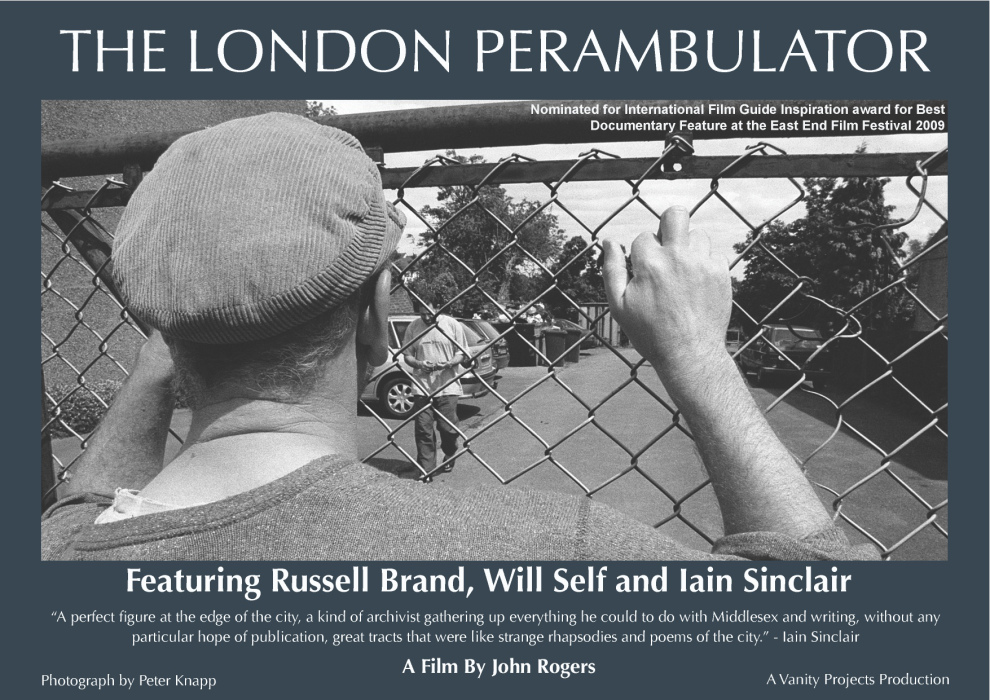
The London Perambulator and Deep Topography

London perambulator

The interest in “adventures beyond the front door” that eventually led to the creation of Under a Grey Sky, and the idea that you need not be in a National Park to enjoy the outdoors, has been developed not only by the getting out there and doing it, but by flicking through the pages of books – such as Rebecca Solnit’s wonderful Wanderlust or Edgelands by Paul Farley and Michael Symmons Roberts– as well as reading essays online, listening to podcasts, and even watching the occasional film.

These virtual adventures beyond someone else’s front door led me to the Ventures and Adventures radio show presented by John Rogers and Nick Papadimitriou – also available to download as a podcast – as they explored the outer reaches of London using old walking guides, or simply the interests of the two presenters, whether it was the Brent Cross shopping centre or the North Middlesex/South Hertfordshire Escarpment, otherwise known as Scarp and the title and subject (or starting point) of Papadimitriou’s book which currently sits in my to-read pile.

Continue reading

Walking and the imagination in London

London1

On our last day in London we left the hostel in Knightsbridge, not far from the Natural History Museum, and walked across Kensington Gardens and Hyde Park before making our way past Buckingham Palace, the Houses of Parliament, through to Whitehall and eventually up to Leicester Square, Chinatown, and Covent Garden. I realised as I walked that although I have been to London a number of times in the past fifteen or so years, I don’t think I have walked those particular streets, and past those particular sights, since a primary school trip to the capital in what must have been 1989 or 1990. I had sudden flashbacks, such as walking past Baden Powell House, or Westminster Abbey, that took me right back to that school trip, and memories that I would have presumed were long forgotten.

The other thing about walking through these most famous of London cityscapes, along with all my fellow tourists from around the world, was how familiar it all was. How many times have I seen the Houses of Parliament, on the news credits or on a bottle of brown sauce? So many time that it was only standing there looking at it in the flesh that I considered how preposterous the architecture of the place actually is, whilst trying to imagine how it was in the days of the plague and the Great Fire when the river was so polluted and foul that they had to hang chlorine-soaked sheets in the windows of the Parliament to try and alleviate the smell. I heard that story on one of the archive editions of In Our Time that I had downloaded to listen to before the trip, trying to get a crash course in London history as I waited on the S-Bahn platform at 5 in the morning for the train to the airport.

Continue reading

The Chimney and the Grindstone

???????????????????????????????

By Phil Scraton:

Certain moments capture the imagination, stop us in our tracks, and are the stuff of coincidence. And so it happened on a cold, calm afternoon before the snow storm arrived. The previous evening I’d been reading an anthology of Robert Frost’s poems compiled and reviewed by Louis Untermeyer. Frost identified the ‘complete poem’ as ‘one where an emotion has found its thought, and the thought has found the words’. His poems often celebrate the great outdoors, sharply observed, laced with metaphor and emotionally stirring. He commits to place and to the detail he finds there: ‘And the dry pump flung up an awkward arm/ And the fence post carried a strand of wire’.

In his poem The Need of Being Versed in Country Things from which the above lines are taken, Frost invites the reader to reflect on the remnants of a house lost to fire. It stands alongside ‘The barn across the way/ That would have joined the house in flame/ Had it been for the will of the wind, was left/ To bear forsaken the place’s name’. While the poem celebrates the continuing life offered by the dilapidated barn as birds, flying to and fro, ‘rejoiced in the nest they kept’, Frost suggests they ‘wept’ its neglect and decline. For:

The house had gone to bring again
To the midnight sky a sunset glow.
Now the chimney was all of the house that stood,
Like a pistil after the petals go.

Continue reading