Monthly Archives: September 2012

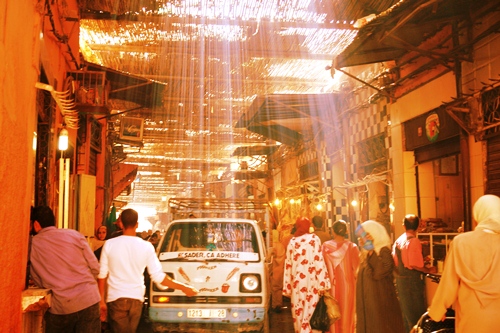
Through the Marrakech Medina, Morocco

It is easy to get lost in the Marrakech Medina – a cliché, but it’s true, and also half of the fun. The buildings are squeezed together, to use all available space, and limit the penetration of the hot sun to the heads of those walking within. Through these narrow alleyways people throng day and night, between stalls that sell everything imaginable, dodging the vans, taxis, carts and bikes that compete for space with a sound of the horn and relentless momentum.

The business of the Medina is trade, transactions completed on the street or in wardrobe-sized shops piled high with products for sale. The cries follow you everywhere… “My friend…” the shopkeepers say, with a smile on their face. “Look in my shop…just a look…no need to buy…” And if you want to, it seems as if there is nothing you can’t take home with you. Carpets, scarves, pottery, leather, tables, door frames, candle-holders, all produced in backstreet workshops and sold on the main tourist routes. No money, no problem. A friend two shops down has a machine for AmEx, Visa or Mastercard.
Continue reading

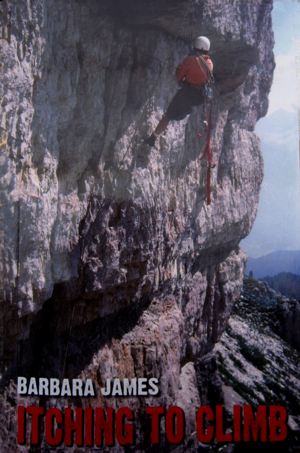
Itching to Climb by Barbara James

Review by Sheila Scraton:

“By now I’d led two classic climbs, graded hard severe plus, in the Llanberis pass. They were on a dramatic lump of rock, Dinas y Gromlech, usually abbreviated to The Cromlech that stood, like a vertically opened book, above a steep scree slope. The well- protected ‘Cenotaph Corner’, in the ‘spine’ of the book was a mixture of bridge and balance moves but ‘Cemetry gates’, a climb on the vertical right-hand wall was harder. I needed strong arms because hanging from the fingers of one hand, I needed the other to reach upwards and insert a protecting runner. I used my powerful thigh muscles as much as possible to move upwards”

This book, about the life of the climber Barbara James, stirred many personal memories for me as I read about her many exploits both on and off the rock.  ‘Itching to Climb’ is a very personal account of Barbara’s life, particularly her traumatic struggles with eczema and other serious allergies. The book is the story of a determined, capable woman that not only provides an interesting read but is also focused on encouraging others to follow their dreams and pursue their goals.

Continue reading

Morning on the Alexanderplatz, Berlin

 “Alexanderplatz is both the GDR capital’s architectural centre and the city’s central point of attraction and a favourite meeting place where thousands of Berliners and people visiting the city meet every day at the World Time Clock for a walk in the new socialist city centre.”

(From the 1980 guidebook, Berlin: Capital of the GDR)

Twenty-three years after the fall of the Berlin Wall, people still use the clock as a meeting point. The House of the Teachers is still adorned with a suitably inspiring, socialist mural, and the television tower still gazes down upon the whole scene. But much else has changed on the Alexanderplatz. The old Centrum Department Store is now the Galeria Kaufhof and got a facelift eight years ago, the Pressecafe is now a steak house, and the old Interhotel Stadt Berlin has had a couple of new names even in the time I have been in the city. Even some post-Wall changes, such as the text from Döblin’s Berlin Alexanderplatz that once graced the facades of the buildings on Karl-Marx-Allee have now faded, although if you look closely you can still see the outline of some of the letters washed away by time and the elements.

In the past ten years the re-development of Alexanderplatz and the surrounding area has accelerated, with the opening of the enormous Alexa shopping mall and the new Saturn building on the edge of the square. The tram lines have been re-laid and all the major international shops and fast-food outlets can be found somewhere around the square. But if the area is no longer a “new socialist city centre”, the echoes of the German Democratic Republic and the brave new heart of (one half) of the city that was built out of the ruins of the Second World War in the 1960s can still be heard.

Continue reading

Snapshots of Stockholm

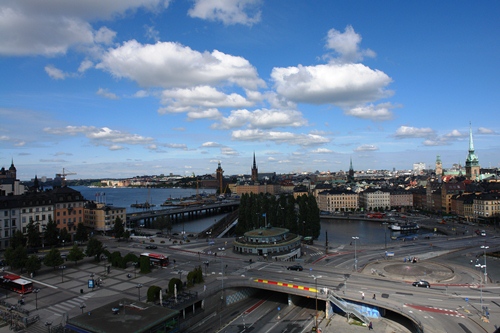
What to say about Stockholm? It was the one place in Sweden where I already had certain preconceived ideas about what to expect; from the islands and the parklands to the particular style of houses of the old town quayside that I had seen on pictures before we left. We stayed at a campsite in the woods and right on the water, but only ten minutes walk from the T-bana metro line into the city, and it was an interesting way to experience a “city break”, returning each evening to our tent beneath the trees and late night walks down to the water’s edge.

The one downside/advantage of camping – depending on how you see it – is the early morning starts, and we arrived into Stockholm’s central metro station on a Sunday morning where it felt like the majority of the population were sleeping off the after-effects of the night before, whilst council-workers hosed down the mess that they had left behind. The walk down the pedestrianised Drottninggatan shopping street towards the Gamla stan (old town) was relaxed, aside from the whirring brushes of the street-cleaning vehicles, as the owners of souvenir shops stood on the steps of their businesses and looked hopefully up and down for custom.

Continue reading

Family memories and the art of Rob Piercy

In preparing this post I thought a lot about a picture of the Welsh mountains that used to hang over the fireplace of our family home in West Lancashire, that would remind me each morning as I got ready for school or in the evening stretched out on the rug underneath it of those places we would get to through the Mersey Tunnel, the traffic jams on the coast road, and the views across to Anglesey, squat and lazy, and seemingly floating in the Irish Sea.

Continue reading

Public art on the Linienstraße, Berlin

(above: the Video Box at Linienstraße 142, and sculptures from Tobias Sternberg)

Walk down Linienstraße in central Berlin at some point after 5pm over the next few months and you will come face to face with a shipping container transformed into a video box, as part of the re:MMX public art project from the folks at Co-Verlag here in Berlin. The original MMX project was in the same location – Linienstraße 142 – and was a year-long project in an old abandoned building that by its end had featured over two hundred artists from Berlin and around the world.

As one of the few remaining unrenovated buildings in this part of town, it was no surprise that it was bought by developers and plans were put in place to renovate the old buildings and re-build the front house that was presumably destroyed during the Second World War. But the developers, conscious of the passionate debates around gentrification in Berlin, and perhaps even that the iconic squatted Tacheles arthouse around the corner finally closed this month, invited the Co-Verlag team to return to the space to run a series of public art exhibitions during the renovation process.

Continue reading

Postcard from Wyk, Germany


(One from the personal archives that seemed apt as the summer comes to an end. Back in the summer of 2006 we took our new-born baby to a holiday island in the north sea… the World Cup had just taken place, which might explain the number of flags flying from the beach chairs)

Early morning and the town is waking up slowly. A few early risers stroll along the pavement towards the bakery. Dog walkers meander along the promenade, the North Sea glassy and still at the end of the sands. Council workers, their orange overalls bright in the early morning sunshine, pick litter and rake the beach between the uniform rows of wicker beach chairs waiting patiently to be rented.

As the morning progresses waiters appear from behind the shuttered interiors of cafes and ice cream parlours, to wipe down tables, unfurl sun umbrellas and distribute ashtrays and menus. The beach begins to fill up as holidaymakers erect windbreaks and washing lines between the beach chairs, flags fluttering in the slight breeze that has picked up as the morning moves lazily along. Children and pensioners take to the water with enthusiasm that is only differentiated by volume, whilst up on the viewed platform a lifeguard surveys the scene, scanning the beach with his binoculars or looking out onto the water, towards the German mainland and Denmark beyond.

Continue reading

Hiking at Lake Kukuljärvi, Finland

By Annika Ruohonen

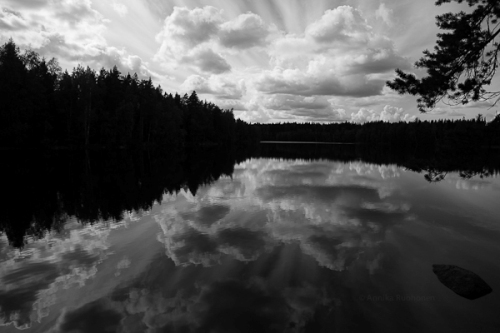
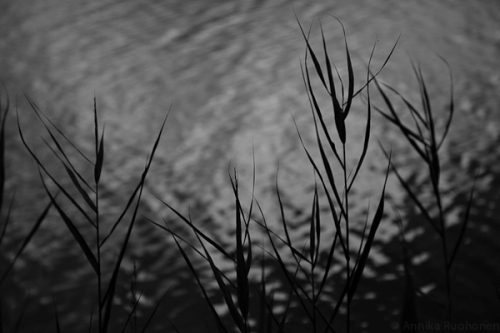
Finns who live by the sea like to celebrate the last weekend in August as the last weekend of summer. We call it Venetsialaiset, the Venetians and to celebrate it most people like to go boating or spend time in their summer cottages. It is a celebration of water, fire and light. Due to the midnight sun, most summer nights aren’t dark here at all, and that is why August nights are special for us – dark and warm nights with the sound of crickets and the mirror like reflections of fireworks and bonfires on waters.

Continue reading

Why do we visit these places?

(above: inside the District Six museum, Cape Town)

An article I wrote for Slow Travel Berlin on the Olympic Village just outside Berlin was picked up by the Guardian as part of their Travel Network, in which they select certain blogs or articles from different travel websites to feature on the travel pages of Guardian.co.uk. One commentator wondered why anyone would want to visit somewhere like the semi-ruined Olympic Village in Elstal when there were more interesting places to go to in the city, and it got me thinking about how we chose to explore places – and which places we choose to explore – whether during our travels or closer to home. As regular readers of Under a Grey Sky will know, I am fascinated by places that can tell a story – whether in the middle of Berlin or a remote Scottish island – and I am certainly of the opinion that there is value to setting foot in these places, even if there is very little to see.

Why is that? Can I understand better the lives of workers in Wales, Germany or Sweden by walking through the relics of their industry? What do I learn about apartheid wandering the cleared streets of District Six in Cape Town? How do I further my understanding of the Holocaust by riding a bus from Krakow to Auschwitz to stand before a snowy field and try to comprehend what took place there? Some of us are simply interested in historical sites, whatever their state of disrepair, but there is also the more important issue about how or why we would maintain such sites, and what role they have in our understanding of historical events.

Continue reading

Beer and Waterproof Clothing at the Berlin Festival

Yes, the pun in the title has been done in one way or another a thousand times before, but then again I am not sure how often I will write about a music festival on these (virtual) pages so I will do it now. And it is somehow kind of apt. After all, it was my cagoule that kept me warm and dry whilst the kids got soggy as the sun went down behind the rain clouds, even if as an item of clothing it is about as cool as its 1930s fascist-leaning namesakes.

We arrived at Tempelhof early enough to wander around the half-empty Berlin Festival site and marvel at the fact that it was being hosted in and alongside one of the most iconic buildings in Berlin. Tempelhof stopped receiving flights in 2008, and it is one of my lasting Berlin regrets that I never took a flight to or from there, but it remains a symbolic location for – amongst other things –  its role in the Berlin Airlift following Stalin’s blockade of the western sectors of the city.

Continue reading