Under Trees – The Germans and the Forest

I wrote about the connection between the forest and the German imagination in my post on the Grunewald not that long ago, and for those of you in Berlin – or if you will coming here before the end of March – the German Historical Museum has a special exhibition on that very topic. From the website:

In Germany the forest is more than just the sum of the trees. When trees are threatened, Germans go on the warpath. For in our country the forest is not only a cultural landscape formed through forestry and the result of modern recreational activities ranging from GPS-guided hikes to treetop trails. At the same time, the woods and trees possess great symbolic, spiritual and fairytale-like charismatic powers and have always been celebrated in German poetry, art and music. In this way the forest is deeply rooted in the German consciousness – not only when we are meandering under trees.

The exhibition will visualize this special relationship of the Germans to the forest, focusing first on the Romantic Age around 1800, when the forest and the trees first became a matter of scientifically based forest management and at the same time enriched literature, music and the graphic arts as subject and theme. It was above all painting – the core of the exhibition – that shaped patterns of perception that have marked our view of the forest up to the present day.

Under Trees: The Germans and the forest is running until 4th March 2012. Here’s the link.
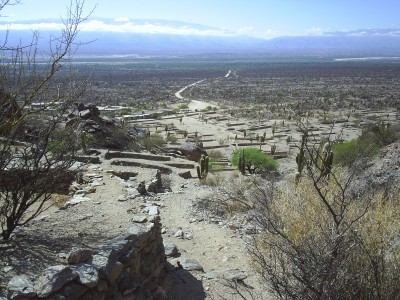
Memories of Quilmes, Argentina

Tom Salmon on a journey through Argentina to the ruins of a fortress city and the history of the Diaguitan people that once called it home:

It’s amazing, and pretty primeval, how your senses can take you back to a place. I got home last night to find frost already settling on the ground, it was a clear and crisp January night in Yorkshire. After putting the kids to bed it was time to eat. Steak, thin chips, salad and malbec wine had been planned in homage to Argentina.

But it was the Quilmes beer that we drank after the meal that really brought the memories flooding back from our six week trip around Argentina in 2006. My highlight from that adventure was the region around the colonial Andean city of Salta, spending the days exploring high altitude deserts and the nights eating tamales, humitas and locro in piazzas around the city. Salta, founded in 1582, was once the most important administrative centre in Argentina and the region was extremely wealthy in the time before Buenos Aires became the capital. Continue reading

Ghost towns of California, Keeler and Darwin


A photo diary from Julia Stone:

A handful of people still live in the old mining towns just beyond Death Valley, although in Keeler we only saw crazy cars – apparently still in use – as there were no people around. This was not surprising, due to the time of day and the temperatures, but in Darwin we met Jay. Jay either moved in a few years before or moved into the trailer that is now his home after his house burned down a few years back. It was hard to follow his story. Jay talked a lot… Continue reading

He got game, and the Spanish hills


A song for Friday.

You see, it doesn’t matter what a song is about or what they put in a video. A song ties itself up in your head with memories because of when you first hear it, or a particular concert, or a certain trip when it was on heavy rotation. And boy, for three weeks in the summer of 2001 did we hear this song a lot. I travelled to Spain will fellow members of the Grey Sky Appreciation Society Tom and Jasmine Salmon, and our navigator supreme Nev. We had rented a car in Barcelona and were going to aim it north, for the Pyrenees, west, for the Basque coast and the Picos de Europa, and then south, across the dusty plain to Madrid. We had brought piles of CDs , confident that with the new millennium all rental vehicles would be supplied with something to play them on. Unfortunately there was some kind of misunderstanding at the rental agency, and they had to dig a battered and bruised old jalopy out from a garage down a side-alley. It was nice and spacious but only had a tape player.

And we only had one tape. Continue reading

The last big freeze, Lake Constance

Three countries share Lake Constance, the communities of Switzerland, Germany and Austria facing each other across the water. Nowadays you can cross the border without formality – don’t tell anyone, but I spent an afternoon in Austrian Bregenz without a single piece of identification having left it behind in Germany – and there are plenty of boats that criss-cross the lake. The owner of our apartment lived in one country, worked in another, and no doubt went on Sunday bike rides in the third. There is another way to make these international journeys, although on average the opportunity strikes only a couple of times a century, if that, and that is when Lake Constance freezes over. Continue reading

Winter in Rocquetas, Spain

A Journal Entry from December 2008:

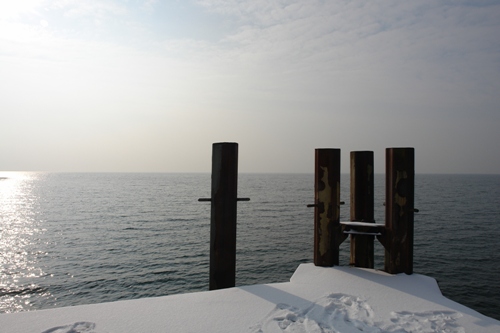
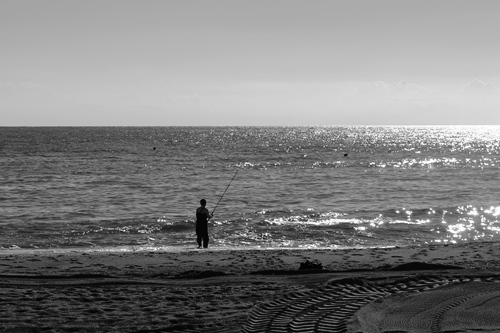
Ten at night in Roquetas. Waves crash against an empty beach, a cold wind chilling the few hardy late-night promenaders. From the sands the town is dark, with only a few buildings showing signs of life. The hotels, if they are not closed entirely for the winter season clearly have rooms to spare. It feels lonely on the beach, the wrong time of day in the wrong time of the year. But under the warming winter sun the following morning, it becomes clear that even in December there is life in the town. Continue reading

Letter from (Hidden) Europe

Yesterday the new Letter from Europe from Nicky and Susanne of Hidden Europe landed in my inbox, titled “Frisian waves”. As well as their wonderful magazine that explores the nooks and crannies of our fascinating continent, they send out these letters three times a month and they are always a treat. Subscribe to the magazine and sign up for the newsletter. You won’t regret it…

Dear fellow travellers

We map our way around Europe using antique guidebooks, just as we map our way through the year using long-obsolete ecclesiastical calendars. So we are in a small minority of Europeans who happen to know that today, 16 January, was long observed as the Feast of St Marcellus. Quite what happened to St Marcellus we don’t know, but it seems he was ousted from his January perch by this or that papal reform sometime in the last century.

We have been staying for a spell on the North Frisian Islands, a part of Europe where locals have good cause to remember St Marcellus Day. For it was on this day in 1362 that North Sea coastal geography was reshaped by the most terrible flooding. A fierce Atlantic storm caused inundations in the Low Countries, throughout the Frisian Islands and north along the coast of Jutland.

Read the rest of “Frisian waves” at Hidden Europe

Sunday by the seaside, Whitby

Jasmine Salmon on an off-season jaunt to the North Sea coast:

Whitby.  Wintery, wild and windy.  Doesn’t sound too promising, but when you’ve got two children under the age of four with cabin fever – and possibly harbouring chicken pox – a two hour drive to the coast seems an attractive prospect.

And in fact many would argue that Whitby is at its best in January.  Devoid of tourists, the weak winter light and grey skies add to the dramatic atmosphere of the North Sea coast and fossil-rich cliffs, with the headland topped by the gothic architecture of the ruined Abbey and surrounded by the bleakly beautiful moorland of the North York Moors National Park. Continue reading

A walk in Neukölln, Berlin

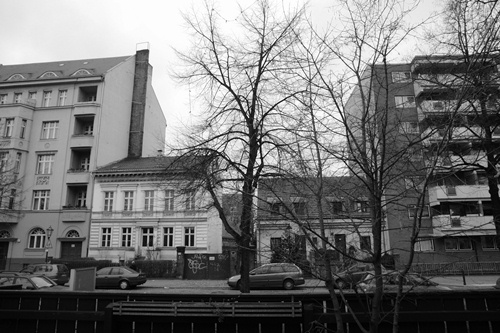
Photo diary from Thursday 12th January 2012, taken very much under grey skies. Julia showed me around her kiez – along busy roads crammed with second hand electronics stores, internet cafes and takeaways – through the old Rixdorf village long subsumed by the city, and across some patches of green, either sculpted on the whim of industrialists or built upon the rubble of Second World War bombing raids. More photographs after the jump, and keep an eye out for a more detailed report on Slow Travel Berlin at some point in the future… Continue reading

Surfing in Cuba: A different revolution

(Photo: Calle 70, Havana, 2009 / Michael Scott Moore)

The following extract is taken from Sweetness and Blood, by Michael Scott Moore, in which he explores how surfing spread from Hawaii to the rest of the world and the impact the sport has had in some extremely unlikely places:

In a beachside neighbourhood I flagged down a powder blue Cadillac with fins.

“¿A Habana Vieja?”

“Sí, sí.”

No room in back, so I sat in front. The dashboard had cheap wooden panels and backlighting provided by old pale bulbs. A Cadillac eagle logo rendered in steel reached its wings over my knees. Most of Havana’s máquinas, or gypsy cabs, are old American iron. They’re run by Cubans for other Cubans, and visitors aren’t supposed to ride them. But there was almost no way to move in Cuba without breaking the law.

“American?” the driver said when the car was almost empty.

“Yes.”

“What brought you to Cuba?” Continue reading