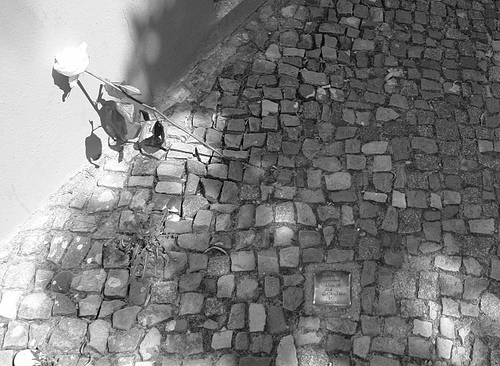
Public art on the Linienstraße, Berlin

(above: the Video Box at Linienstraße 142, and sculptures from Tobias Sternberg)

Walk down Linienstraße in central Berlin at some point after 5pm over the next few months and you will come face to face with a shipping container transformed into a video box, as part of the re:MMX public art project from the folks at Co-Verlag here in Berlin. The original MMX project was in the same location – Linienstraße 142 – and was a year-long project in an old abandoned building that by its end had featured over two hundred artists from Berlin and around the world.

As one of the few remaining unrenovated buildings in this part of town, it was no surprise that it was bought by developers and plans were put in place to renovate the old buildings and re-build the front house that was presumably destroyed during the Second World War. But the developers, conscious of the passionate debates around gentrification in Berlin, and perhaps even that the iconic squatted Tacheles arthouse around the corner finally closed this month, invited the Co-Verlag team to return to the space to run a series of public art exhibitions during the renovation process.

Continue reading

Postcard from Wyk, Germany


(One from the personal archives that seemed apt as the summer comes to an end. Back in the summer of 2006 we took our new-born baby to a holiday island in the north sea… the World Cup had just taken place, which might explain the number of flags flying from the beach chairs)

Early morning and the town is waking up slowly. A few early risers stroll along the pavement towards the bakery. Dog walkers meander along the promenade, the North Sea glassy and still at the end of the sands. Council workers, their orange overalls bright in the early morning sunshine, pick litter and rake the beach between the uniform rows of wicker beach chairs waiting patiently to be rented.

As the morning progresses waiters appear from behind the shuttered interiors of cafes and ice cream parlours, to wipe down tables, unfurl sun umbrellas and distribute ashtrays and menus. The beach begins to fill up as holidaymakers erect windbreaks and washing lines between the beach chairs, flags fluttering in the slight breeze that has picked up as the morning moves lazily along. Children and pensioners take to the water with enthusiasm that is only differentiated by volume, whilst up on the viewed platform a lifeguard surveys the scene, scanning the beach with his binoculars or looking out onto the water, towards the German mainland and Denmark beyond.

Continue reading

Hiking at Lake Kukuljärvi, Finland

By Annika Ruohonen

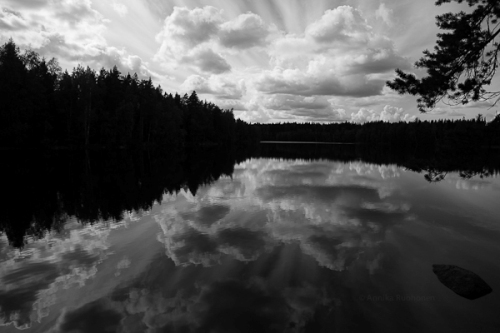
Finns who live by the sea like to celebrate the last weekend in August as the last weekend of summer. We call it Venetsialaiset, the Venetians and to celebrate it most people like to go boating or spend time in their summer cottages. It is a celebration of water, fire and light. Due to the midnight sun, most summer nights aren’t dark here at all, and that is why August nights are special for us – dark and warm nights with the sound of crickets and the mirror like reflections of fireworks and bonfires on waters.

Continue reading

Why do we visit these places?

(above: inside the District Six museum, Cape Town)

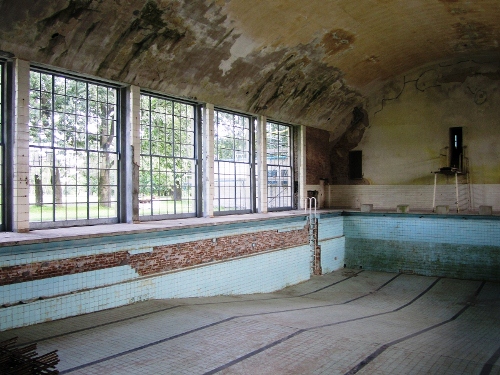
An article I wrote for Slow Travel Berlin on the Olympic Village just outside Berlin was picked up by the Guardian as part of their Travel Network, in which they select certain blogs or articles from different travel websites to feature on the travel pages of Guardian.co.uk. One commentator wondered why anyone would want to visit somewhere like the semi-ruined Olympic Village in Elstal when there were more interesting places to go to in the city, and it got me thinking about how we chose to explore places – and which places we choose to explore – whether during our travels or closer to home. As regular readers of Under a Grey Sky will know, I am fascinated by places that can tell a story – whether in the middle of Berlin or a remote Scottish island – and I am certainly of the opinion that there is value to setting foot in these places, even if there is very little to see.

Why is that? Can I understand better the lives of workers in Wales, Germany or Sweden by walking through the relics of their industry? What do I learn about apartheid wandering the cleared streets of District Six in Cape Town? How do I further my understanding of the Holocaust by riding a bus from Krakow to Auschwitz to stand before a snowy field and try to comprehend what took place there? Some of us are simply interested in historical sites, whatever their state of disrepair, but there is also the more important issue about how or why we would maintain such sites, and what role they have in our understanding of historical events.

Continue reading

Beer and Waterproof Clothing at the Berlin Festival

Yes, the pun in the title has been done in one way or another a thousand times before, but then again I am not sure how often I will write about a music festival on these (virtual) pages so I will do it now. And it is somehow kind of apt. After all, it was my cagoule that kept me warm and dry whilst the kids got soggy as the sun went down behind the rain clouds, even if as an item of clothing it is about as cool as its 1930s fascist-leaning namesakes.

We arrived at Tempelhof early enough to wander around the half-empty Berlin Festival site and marvel at the fact that it was being hosted in and alongside one of the most iconic buildings in Berlin. Tempelhof stopped receiving flights in 2008, and it is one of my lasting Berlin regrets that I never took a flight to or from there, but it remains a symbolic location for – amongst other things –  its role in the Berlin Airlift following Stalin’s blockade of the western sectors of the city.

Continue reading

Jesse Owens and the Olympic Village

The following article is written by Paul Scraton with pictures from Julia Stone (including the one above) for the wonderful Slow Travel Berlin website. Here’s a short extract:

What do you do with a building when it symbolises some of the darkest days of your country’s history? It’s a common question in Berlin and elsewhere in Germany, and one which was certainly asked of the various venues built for the 1936 Olympics.

Of course, Germany was awarded the Olympics before Hitler and his National Socialist cronies took power, and indeed many of the designs were already in place, but the Olympic Stadium and its surroundings still symbolise a games where Hitler was determined to show to the world the power and the glory of his three-year-old Thousand Year Reich.

Read the rest on Slow Travel Berlin

Where the wall was the water, Berlin

Yesterday I headed south to walk a stretch of the Berlin Wall Trail, between Griebnitzsee station and Wannsee. Heading south first by U-Bahn and then by S-Bahn we rocked along through the city in full train carriages, as people made their way to school, university or work. I was amazed at how many people disembarked at Griebnitzsee, but at the bottom of the steps down from the platform they turned right towards the University of Potsdam buildings, and within a matter of seconds I was standing virtually alone down by the water’s edge.

This footpath was once patrolled by East German border guards, and where a hotel now stands a watchtower gazed out across the water towards the thick trees of West Berlin on the opposite bank. Like along so many stretches of the Berlin Wall Trail, a cluster of cherry trees – a gift from the people of Japan to the people of Berlin – cast some shade across the footpath.

“You should see them in blossom,” a gardener said, who had followed me down the steps. “Beautiful. It makes a mess, but it is beautiful.”

Continue reading

With their backs to each other – Nora and Gyttorp, Sweden

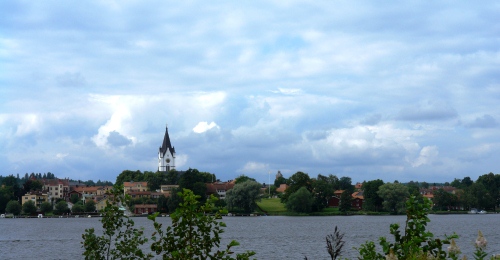
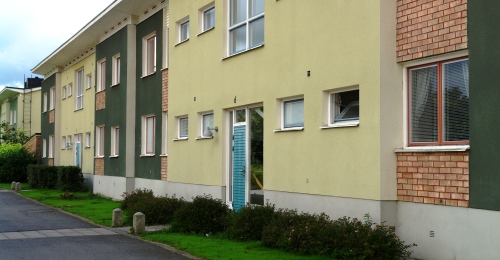
The towns of Nora and Gyttorp are separated by a short stretch of road through the woods, and each look out onto a different lake; stand on the shore in Nora and you are staring West across the Norasjön, from Gyttorp you gaze to the east across the wind-ripples of the Vikern. You can easily visit the two in a single morning, walking amongst the picturesque wooden houses of Nora before exploring the functional terraced townhouses of Gyttorp. These two neighbouring towns couldn’t look more different, and it is this contrast that makes them together a fascinating look at how we imagine a town or community should be designed and organised.

Continue reading

In Leiden, the Netherlands

By Barry Sheppard

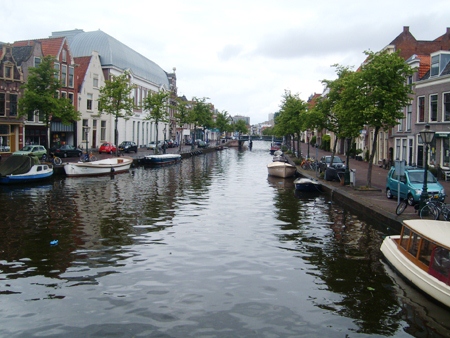
Approximately 35km southwest of the hustle, bustle and mind-altering tourist attractions of the city of Amsterdam lies the much smaller and quieter university city of Leiden.  And for me it is a homecoming of sorts, for it was twelve years to the day that I, along with approximately twenty other fine upstanding young men and women from the four corners of Ireland, made picturesque and historic stretch of land our home for those hot summer months.  Today though, I’m part of a much smaller yet equally fine and upstanding party getting ready to take in the familiar sites of the place I called home for a short time.

Although I have been back in the Netherlands on several occasions since the glorious summer of 2000 it is the first time I have decided to venture back to this location, and departing through the train station front doors the first thing to grab my attention is the pristine four story building to my left where formerly stood a large bricks and mortar brightly covered canvas for a commune of artistic punk types who called it home.  As the vast majority of buildings throughout the centre of Leiden are of that unmistakable tall and thin Dutch style the gang of punk’s squat should really have looked out of place.  But now that it appears to be no more, this monument to modernity which has taken its place looks decidedly out of step.   However, I am not prepared to let the demise of a building I never set foot into spoil this walk down memory lane.

Continue reading