Finding joy under a grey sky

By Miles Richardson, author of Needwood, a search for deep nature in the local landscape and a celebration of the joy that can be extracted from ordinary things in the natural world:

My book Needwood was written on foot. It takes a simple journey into an ordinary rural English landscape with no obvious grandeur, wilderness or drama. So the ordinary things are enjoyed: the oak, the rook, the river; the solace of the risings, the calm of the water meadows and the lifeless hedgerows of winter under a leaden sky. In this ordinary landscape, searching for ordinary things, I found a universal story about our connection to nature. Some of the most compelling moments took place under grey skies and below are two days from my year long journey; the first from February, the second from November.

Continue reading

Waiting for the ferry

The following piece was inspired by the above photograph, taken at Rostock in northern Germany:

At the ferry port the vehicles line up in rows beneath the enormous floodlights that will make the scene as bright as daytime as soon as darkness falls. Families pile out of overloaded cars – playing cards and pillows, crumbled magazines and half-eaten biscuits, fall onto the tarmac as doors open – whilst lorry drivers lean patiently against open windows or watch films on laptops balanced on the dashboard. A coach driver bows to pressure from the back rows and releases the smokers with a pneumatic hiss of the doors, and the foot passengers and bike riders sit on wooden picnic tables lined up by the raised footbridge, next to a row of brilliant blue portaloos.

If travel is as much about the journey as the destination, and anticipation of what is to come heightens the experience when we finally get there, then waiting is part of the deal. Train stations, airports, ferry terminals and even service stations become the moments where the journey must pause, and we find ourselves killing time before we can get on the move again. Sometimes you hear these places – especially airports and service stations – described as neutral, or nowhere zones, because they are designed with a certain uniformity, or they do not necessarily reflect their surroundings. But ask any frequent flier about airports and they will tell you their favourites, the places they are happy to transit through and those which they avoid if they can possibly help it.

Continue reading

Swallows and Amazons, Red Devils, and Alntorps Island

When I was younger I loved the Swallows and Amazons series of books. It was not so much the “adventure” aspect, but the fact that the things the kids got up to, and the dangers they faced along the way, were so completely believable. Of course, even my younger self got recognise that this was another world that Arthur Ransome was writing about – from the freedom granted to the children to the gender politics expressed in the stories – but I think that the books and the stories told therein were massively influential in the games that we would play each summer in Rhoscolyn.

We were from a few different families and we called ourselves the Red Devils. We mapped the headland and (with Capt’n Rob) took to the high seas, went exploring and made a magazine… it is amazing to think back now about the range of ages in the group, and somehow we all managed to play together as we created our own world in and around Cerrig-yr-adar and the Outdoor Alternative campsite.

Continue reading

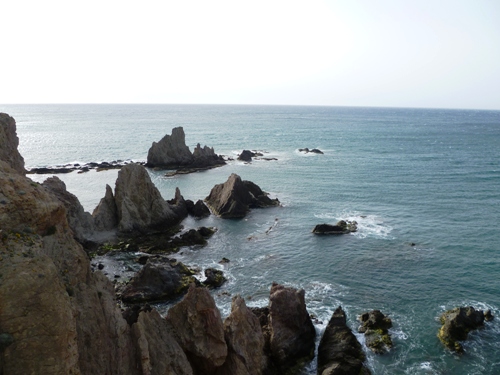
Along the cliffs – Cabo de Gata, Spain

Our route took us out from San Jose, along a dusty, windswept valley until we began a steep climb up a crumbling track to a lookout point just below an old tower, where once they would light fires to pass messages and warning signals along the coastline. We paused for a moment, to catch our breath and to look back towards the town. The night before we had eaten fish down by the harbour and walked through the quiet streets towards our hotel. It was spring, and there was not much happening in the town, as everyone took to their local bars or their living rooms to watch Madrid in the Champions League.

The coastal path took us north, above jagged and dramatic cliffs, finding its way between the water and the dormant volcanos that give this corner of the national park such a distinctive look. The track had once been a mine road, and we came across abandoned buildings and old quarries that were a reminder of an industrial past in this corner of Andalucia. But all was quiet now, and in the ten kilometres we walked between San Jose and the Castillo San Felipe, where waves crashed against salt-eroded stone walls, we did not meet a single soul.

Continue reading

Platform 17 at the Grunewald Station, Berlin

As the S-Bahn swings south at Charlottenburg and heads for Potsdam, the cityscape shifts from six-storey buildings and balconies upon which satellite dishes are precariously balanced to one of detached houses with the occasional, modest apartment block here and there, and the wide expanse of the forest, through which it is possible to glimpse the odd dwelling, tucked away between the trunks and beneath the branches like a fairy-tale cabin.

The S-Bahn drops us on the platform of the Grunewald Station, and we take the steps down to a long brick tunnel that runs beneath the tracks. We emerge into the daylight. At a kiosk cyclists sit lyric clad and lightly sweating, drinking bottles of water and licking ice creams. In front of the station entrance is a cobble-stoned turning circle, a drop off point for the trains into town. You can picture the early days of the railway, when the city still felt separate from this community, as the merchants and bankers caught the Berlin train for another day amassing the wealth upon which these tree-shaded villas were built. But more than that you can picture a very different train, and a memory of this suburban station that is altogether darker.

Continue reading

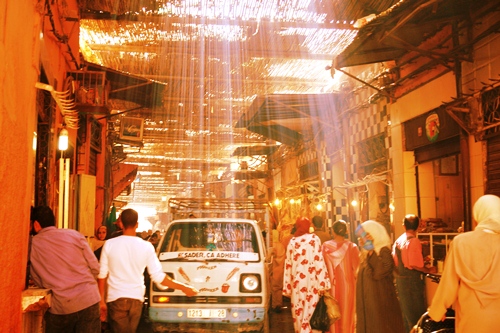
Through the Marrakech Medina, Morocco

It is easy to get lost in the Marrakech Medina – a cliché, but it’s true, and also half of the fun. The buildings are squeezed together, to use all available space, and limit the penetration of the hot sun to the heads of those walking within. Through these narrow alleyways people throng day and night, between stalls that sell everything imaginable, dodging the vans, taxis, carts and bikes that compete for space with a sound of the horn and relentless momentum.

The business of the Medina is trade, transactions completed on the street or in wardrobe-sized shops piled high with products for sale. The cries follow you everywhere… “My friend…” the shopkeepers say, with a smile on their face. “Look in my shop…just a look…no need to buy…” And if you want to, it seems as if there is nothing you can’t take home with you. Carpets, scarves, pottery, leather, tables, door frames, candle-holders, all produced in backstreet workshops and sold on the main tourist routes. No money, no problem. A friend two shops down has a machine for AmEx, Visa or Mastercard.

Continue reading

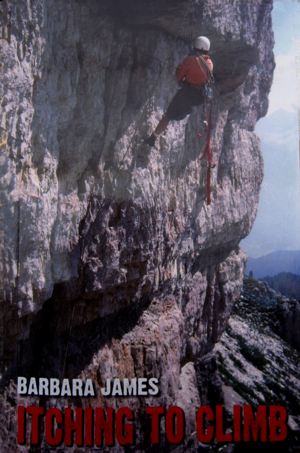
Itching to Climb by Barbara James

Review by Sheila Scraton:

“By now I’d led two classic climbs, graded hard severe plus, in the Llanberis pass. They were on a dramatic lump of rock, Dinas y Gromlech, usually abbreviated to The Cromlech that stood, like a vertically opened book, above a steep scree slope. The well- protected ‘Cenotaph Corner’, in the ‘spine’ of the book was a mixture of bridge and balance moves but ‘Cemetry gates’, a climb on the vertical right-hand wall was harder. I needed strong arms because hanging from the fingers of one hand, I needed the other to reach upwards and insert a protecting runner. I used my powerful thigh muscles as much as possible to move upwards”

This book, about the life of the climber Barbara James, stirred many personal memories for me as I read about her many exploits both on and off the rock.  ‘Itching to Climb’ is a very personal account of Barbara’s life, particularly her traumatic struggles with eczema and other serious allergies. The book is the story of a determined, capable woman that not only provides an interesting read but is also focused on encouraging others to follow their dreams and pursue their goals.

Continue reading

Morning on the Alexanderplatz, Berlin

 “Alexanderplatz is both the GDR capital’s architectural centre and the city’s central point of attraction and a favourite meeting place where thousands of Berliners and people visiting the city meet every day at the World Time Clock for a walk in the new socialist city centre.”

(From the 1980 guidebook, Berlin: Capital of the GDR)

Twenty-three years after the fall of the Berlin Wall, people still use the clock as a meeting point. The House of the Teachers is still adorned with a suitably inspiring, socialist mural, and the television tower still gazes down upon the whole scene. But much else has changed on the Alexanderplatz. The old Centrum Department Store is now the Galeria Kaufhof and got a facelift eight years ago, the Pressecafe is now a steak house, and the old Interhotel Stadt Berlin has had a couple of new names even in the time I have been in the city. Even some post-Wall changes, such as the text from Döblin’s Berlin Alexanderplatz that once graced the facades of the buildings on Karl-Marx-Allee have now faded, although if you look closely you can still see the outline of some of the letters washed away by time and the elements.

In the past ten years the re-development of Alexanderplatz and the surrounding area has accelerated, with the opening of the enormous Alexa shopping mall and the new Saturn building on the edge of the square. The tram lines have been re-laid and all the major international shops and fast-food outlets can be found somewhere around the square. But if the area is no longer a “new socialist city centre”, the echoes of the German Democratic Republic and the brave new heart of (one half) of the city that was built out of the ruins of the Second World War in the 1960s can still be heard.

Continue reading

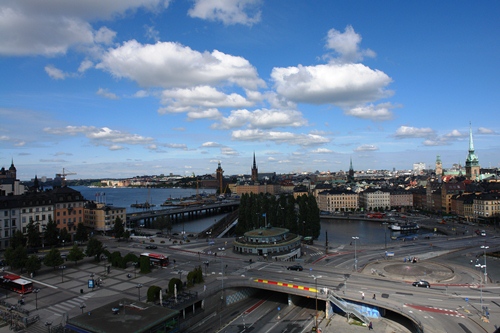
Snapshots of Stockholm

What to say about Stockholm? It was the one place in Sweden where I already had certain preconceived ideas about what to expect; from the islands and the parklands to the particular style of houses of the old town quayside that I had seen on pictures before we left. We stayed at a campsite in the woods and right on the water, but only ten minutes walk from the T-bana metro line into the city, and it was an interesting way to experience a “city break”, returning each evening to our tent beneath the trees and late night walks down to the water’s edge.

The one downside/advantage of camping – depending on how you see it – is the early morning starts, and we arrived into Stockholm’s central metro station on a Sunday morning where it felt like the majority of the population were sleeping off the after-effects of the night before, whilst council-workers hosed down the mess that they had left behind. The walk down the pedestrianised Drottninggatan shopping street towards the Gamla stan (old town) was relaxed, aside from the whirring brushes of the street-cleaning vehicles, as the owners of souvenir shops stood on the steps of their businesses and looked hopefully up and down for custom.

Continue reading

Family memories and the art of Rob Piercy

In preparing this post I thought a lot about a picture of the Welsh mountains that used to hang over the fireplace of our family home in West Lancashire, that would remind me each morning as I got ready for school or in the evening stretched out on the rug underneath it of those places we would get to through the Mersey Tunnel, the traffic jams on the coast road, and the views across to Anglesey, squat and lazy, and seemingly floating in the Irish Sea.

Continue reading