You might remember that a few weeks ago I was invited to take part in a tour, which included the Karl-Marx-Allee in the eastern half of Berlin. The title of that tour was the Divided City, and it covered the differing approaches to architecture and post-war reconstruction either side of the Berlin divide (there was no wall at that point). From Karl-Marx-Allee we jumped on the U- and S-Bahn to cross over to the west and the Hansaviertel, a residential quarter tucked away in a bend in the river at the northern boundary of the Tiergarten Park.
Forgotten Land, by Max Egremont
Due to Germany’s role in World War II and the crimes of the Nazi regime, the expulsion of millions of Germans from territories in the east of Europe received little sympathy at the time, and little recognition later. But the Germans of East Prussia – territory that would become part of the Soviet Union and Poland in the re-ordered post-war Europe – left behind lands in which the German culture had flourished for centuries, a land of forest, lakes and legends of the Teutonic Knights, birthplace of Immanuel Kant and Käthe Kollwitz, and a place that of course still exists and yet has been changed so dramatically over the past half a century that it can truly be described as the “Forgotten Land” of the title of Max Egremont’s book.
Then and Now: On the Potsdamer Platz
“The announcements of music halls, movies, the promotion of cigarettes, the fervor of business advertising – their nightly blaze above the roofs of Potsdamer Platz – drown, suffocate, and obliterate any of the political battle cries in an inferno of light and noise and color.” – Joseph Roth
In between the World Wars Potsdamer Platz was the busiest intersection in Europe. Berlin’s population had grown to 4.4 million – larger than it is today – and the neighbourhood immediately around the square was the ultimate symbol of this modernity, of the Metropolis on the Spree… a relentless intersection celebrating commerce, modernism and a glittering future. This was a place of crowds and noise, of lights and buildings that towered above the individual standing on the street. A hundred thousand such individuals passed through the Potsdamer PLatz each day, alongside 20,000 cars, as well as numerous bicycles and other vehicles such as horse drawn carts.
Sonic Iceland: The end is the beginning is the end
Sonic Iceland is the story of a journey by Marcel Krüger and Kai Müller to discover the music of a country. They collected interviews, pictures and notebooks filled with texts, which became the basis for a website and what will be a book. Here is Chapter 0 – the short introduction for how the idea for Sonic Iceland was conceived.
It’s a cold and miserable winter morning in Cologne, and I am grumpy. It is the day after Boxing Day 2009, and in recent years Christmas has not been a good time for me, so I don’t feel very motivated as I walk up the stairs of the subway station in Ehrenfeld and towards the Weltempfänger-Café. I’m supposed to meet my friend and former housemate Kai, who is planning to visit Iceland. He wants to create some kind of documentary about Icelandic music, and has asked me to join his project. I have no idea of what this whole thing is going to look like, but besides my holiday-grumpiness I’m stoked about the idea of combining a visit to one of my favourite travel destinations with good music. I enter the café, and as I see Kai, beaming and sitting beneath a large map of the world, my mood lifts even higher. After a short shake-hands and catch-up (he lives in Cologne and I in Ireland), we set to work.
Kai and I have been fascinated by Icelandic music for a long time. It was always surprising how many different sounds and styles such a tiny nation produces, compared to Germany, for example. Plus we have watched the “Heima”-movie of Sigur Rós once too often. So the idea for Sonic Iceland was born: to go and talk to the Icelandic musicians in their natural habitat, record the interviews and document this with pictures and text. We set up a blog and started talking to people to help us get to Iceland.
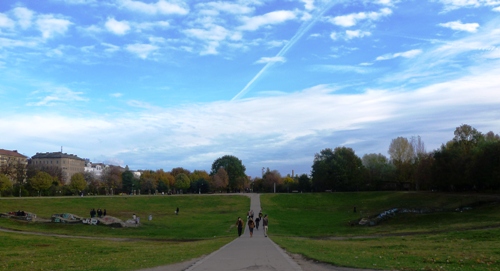
Görlitzer Park, Berlin
It is a November Sunday in Görlitzer Park, Kreuzberg. One of those days when it never gets properly light, not really, and without much wind it feels as if weather itself has taken a day off. We drop off Lotte at a friend’s birthday party, and then walk back towards the U-Bahn through the park. It is not summer, so there are less people around, but nevertheless there is still some action. This is Kreuzberg, so there is the usual mix of punks, students, hipsters and Turkish kids. The drug dealers as well, still open for business whatever the weather.
About the Balance of Things
By Annika Ruohonen:
I’ve been away. Living, like a friend so accurately put it. First east, then west. Exploring places, meeting people, embracing all that is new and precious, but also facing challenges, overcoming obstacles and testing my boundaries. I’ve learned so much and I’m grateful for all that makes me bigger and wiser. I have so much to tell you, as soon as I find the spot where to start. You know how things happen in a certain sequence, but then they eventually find a way to regroup when your experiences eventually get new meanings. Once there is a missed opportunity, then there is an unexpected opening. One soul dies, another one is born. When time passes, it does not seem important at all in which order everything took place. All you see is how it all interconnects.
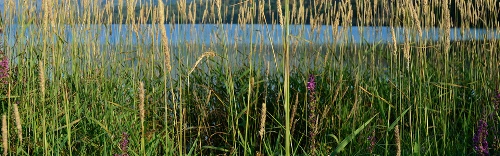
Loving our Lake, Lyn Padarn
We were sent details of a project initiated by our friends at Snowdonia Active, based in the Llanberis area of North Wales, which is inviting residents and businesses to join in to help improve the water quality of Lyn Padarn. The project will last a year, and will include numerous different activities to help identify and promote ways in which the community can take small steps to make big differences to help the lake and its wildlife.
The hills above Belfast
When I began this website back in December of last year, I knew only that I wanted to create a place that would be an interesting diversion for those who subscribed or stumbled across its pages, giving people the chance to explore not only places but also books, music and anything else, and hopefully inspire others to get out and search for what is there to be discovered beyond the front door. Many of the pieces have come from my own experiences, but one of the most gratifying things about Under a Grey Sky is the number of people who have contributed their own words, pictures and experiences to these pages, helping to create this virtual flea market of stories and images through which visitors to the archive can rummage.
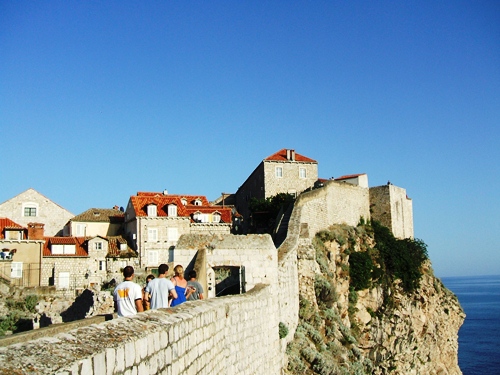
A Chance Encounter, Dubrovnik
He was standing by the side of the road, leaning against the roof of a white Fiat, talking into his mobile phone. We had slowed to a walking pace, confident that we had out-run the polyester-clad gaggle of old ladies that had descended upon us as we climbed down from the bus. As we approached the man he switched off his phone and crossed the road towards us.
“Hi, do you need any help?”
Kevin looked at me, suspicious. I shrugged.
“We’re looking for this hotel,” I said, holding out a piece of paper. The man looked at it, whistled through his teeth and shook his head.
“No good. Let me show you somewhere better.”
“Your place?”
“How did you guess?” The man smiled, a twinkle in his eye. I decided to trust him and looked at Kevin. His expression said why not. We climbed into the Fiat. Inside the car he turned to us and offered his hand.
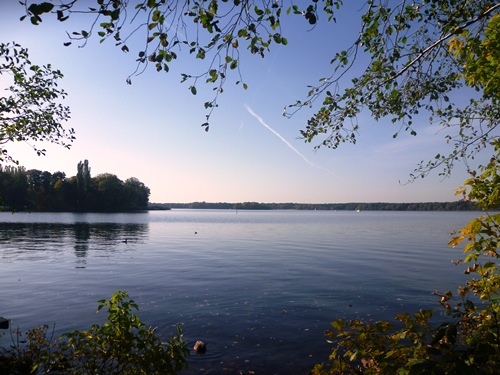
Through the forest to the lake: Tegel, Berlin
We climb down from the U-Bahn and onto leaf-strewn streets of a distinctly French flavour. Here, where the French military were based during the years of occupation, the roads are marked “Rue” and the avenues, well, “Avenue” in a small cluster of a community on the northern fringe of the Tegel airfield. Most of the French community is gone now, and the doorbells and postboxes are labelled with suspiciously German names, but the site of neatly laid-out petanque courts of the “Boulodrome” remind us that we are in one of those places in Berlin shaped by the unique history of the city.