The Highest Mountain and the Deepest Lake, Berlin

TF1

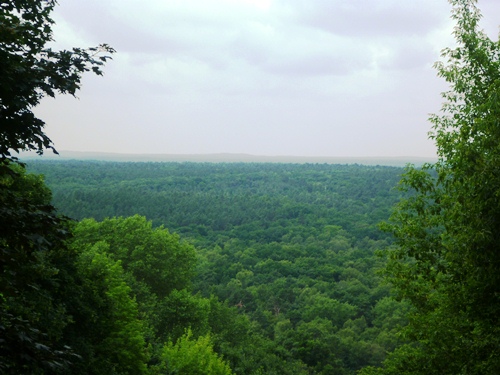
Of course, if you live in Berlin this is all relative. After all, we live in a city where the local Alpine association uses the northern wall of a Second World War flak tower as one if their main training spots, as the nearest actual, real mountains are at least a couple of hours drive away. The Teufelsberg, complete with an abandoned US Listening Station on top, is not even a “real” hill, let alone a mountain… built as it is from the rubble of 15,000 destroyed  buildings that fell victim to the American and British bombing raids of the Second World War.

Still, Lotte and I enjoyed the walk up through the northern Grunewald woods, past the bald Drachenberg hill popular with kite-flyers and mobile airplane pilots, until we reached the double barbed wire fence, recently strengthened to prevent urban explorers accessing the listening station without paying the €7 “tour fee”, advertised at the (locked) main entrance scrawled with a marker on a piece of cardboard. Still, every so often, as we traversed around the hill alongside the fence, the trees moved away every so often to allow us a view out across the western districts of Berlin or east, across the treetops of Brandenburg.

Continue reading

Nostalgia, Portishead and the Spandau Citadel

Citadelle

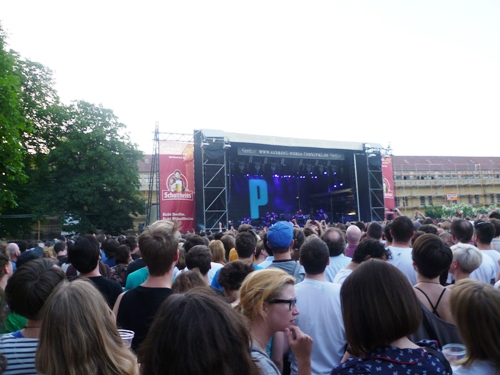
Last week I visited the Citadel in Spandau for the first time. It is an impressive structure, built in the second half of the 1500s, although it is a little surprising to walk along a fairy busy street, past garden centres and car showrooms, and then suddenly come upon a medieval fort standing proudly in the early evening sunshine. We were there to see Portishead, part of a summer concert series that makes up the Citadel Music Festival, and from the moment we crossed the drawbridge and entered the fort through the thick stone walls it was clear that this was going to be a special venue for a special concert.

If I had to place Portishead in my personal music history, it would be in the years I was at Sixth Form College in Leyland, and their first album Dummy was on heavy rotation. There have only been a couple of albums since, and throughout the show I was continually taken back into my memories of hearing some of those songs, the strange music and haunting vocals, and I imagine that in that crowd I was not alone in experiencing the concert as something of an exercise in nostalgia.

Continue reading

The best view in North Wales?

View_1

We have been here on Under a Grey Sky before, but we make no apology… for a good number of the contributors, the Rhoscolyn headland is a very special place, and one of our number who wants to take us back there, asking a question of our readers as he does so whilst leaving those of us a long way from North Wales feeling distinctly homesick, is Chris Hughes:

Is this the best view in North Wales? If it’s not, it must be one of the best and certainly one of the most extensive. I have thought hard about posing this question and putting it out into a  ‘public arena’ but in doing so I am really asking all those of you who visit North Wales to walk, climb, canoe, paint, photograph or picnic by the side of your car to express an opinion and, preferably, post you own contender for the title of “Best View in North Wales”.

For those of you who are not familiar with this magnificent view the photograph is taken from the headland at Rhoscolyn a short walk from Outdoor Alternative. The scene shows the full range of the Snowdonia mountains starting on the left with the Carnedds, Glyders, the Snowdon range, the Nantle ridge and then out to the mountains along the Lleyn Peninsula and eventually as far as the island of Bardsey.

Continue reading

Soapbox Derby on the Badstraße, Berlin

Bad1

Wedding, oh Wedding. Sometimes when I think my neighbourhood has no more surprises for me, another one pops up in a place where you least expect it. The Badstraße, the street that is the extension of Brunnenstraße and runs down from Humboldthain and the Gesundbrunnen station towards Pankstraße and the river where the original spa once stood, was once the main drag in an entertainment and shopping district whose cinemas, theatres, beergardens and restaurants attracted custom from across the north of Berlin. Then the Berlin Wall was built, cutting off this corner of the Wedding district on three sides.

Continue reading

Giants of the Landscape in the North East of England

Angel of the North

By Barry Sheppard:

As far as I’m aware, one region which has not been covered in Under a Grey Sky as of yet, is the North-East of England.  In truth, it is a place I haven’t thought about in quite a while myself, until recently.  So this edition of Under a Grey Sky will be more of a walk down memory lane than a walk of a physical nature.

The North-East of England is a place that I know quite well, having spent a couple of years living in the region in the late 90s.  I have a lot of good memories, and many more fuzzy ones, of a place which I haven’t visited in quite a while yet still occupies a special place in what passes for my heart.  One of my enduring memories of that period was when a group of us decided to go, and (unsuccessfully) explore the famous Hadrian’s Wall.  Our primary failure being that we couldn’t find it!  I still don’t know how we managed to miss a structure that goes on for 73 miles and is ten foot high in places, but safe to say the feats of Shackleton or Livingstone were in no danger of being surpassed by our hardy band of intrepid misfits.

Continue reading

The Sportforum Hohenschönhausen, Berlin

forum1

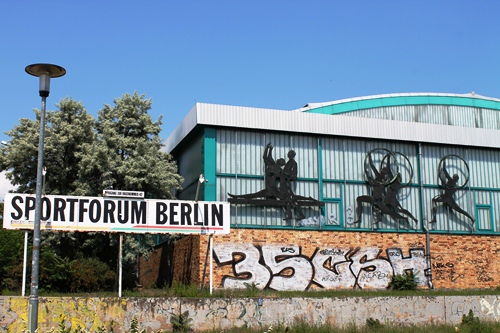
The tram dropped us in front of the Sporthalle, where a couple of people stood at the top of the steps, waiting in the sunshine for a moment longer before heading in to pay admittance to a cheerful women sitting behind a trestle table just inside the front door. From inside we could hear the sound of spectators – cheers and drums and whistles – but there was no clue to what kind of event was taking place. We headed around the side of the hall, where weeds grow through the paving stones and coaches were parked in lines in the sunshine, but it remained a mystery. As we pressed on, deeper into the Sportforum complex, we caught a glimpse of numbered-shirts pressed up against a frosted window. Crossing the car park we heard a sudden outburst of enthusiasm, a “come on lads!” kind of a sound, and then the numbered-shirts were gone, ready to do battle.

The Sportforum complex is one of Berlin’s “Olympic Training Bases” and has facilities for all kinds of different sports. Built in the 1950s, its heyday was during the years of the German Democratic Republic when it was the main training complex for the athletes of the socialist country, whose regime had identified sport as a way of the small nation punching above its weight and who saw its elite athletes as “diplomats in sports gear”. On opening it was the largest such training complex in Europe, and thanks to a system devoted to success – including of course the use of more unhand, chemical techniques – the GDR did indeed win over five hundred medals in the Summer and Winter Olympics combined, a number which has East Germany still standing eighth in the all-time records.

Continue reading

Memories of Liberation Square, Sarajevo

???????????????????????????????

It is over a decade since I was last in Sarajevo. When I look back on it now, that journey in the early winter of 2001 was something I had been building up to ever since I had watched the scenes from the city and elsewhere in the former Yugoslavia unfolding on our teatime television screens during my teenage years. It was to become a major part of my studies, both during by BA and MA at the University of Leeds, and during my university years I made my first trips to some of the countries that were once part of the Federal Republic of Yugoslavia, and which culminated in a bus ride from Zagreb to Sarajevo which will live long on my memory. Here is something from my notebook, written in Berlin after the trip was over:

The two men stand across from each other, separated by the sixty-four squares of their battlefield, their knee-high soldiers awaiting instructions. The game has been progressing for some twenty minutes, and even to untrained eyes it is the older of the two who has the upper hand. He is relaxed, continually joking with the band of spectators gathered around the outdoor chessboard, rejecting advice with a wave of the hand, barely contemplating the situation before making a move. His opponent, younger and dressed in a suit, is quieter, his energies focussed on the game. But it is all to no avail, as age and experience finally triumphs. Checkmate achieved the victor takes the congratulations of the onlookers as he re-sets the pieces, ready for the next opponent.

Continue reading

Death and Life on the Strand

???????????????????????????????

By Phil Scraton: 

Throughout my childhood the coast had special meaning. The River Mersey did not offer its ports, Liverpool and Birkenhead, easy access. Shallow channels were dredged of their silt and sand to allow access to the Irish Sea and to the world. Ports built on the backs of slaves traded through the Atlantic triangle, on the last hopes of Irish migrants as they escaped the Great Hunger and on the wool, cotton and coal industries of Yorkshire and Lancashire whose labour was exploited in pursuit of Empire.

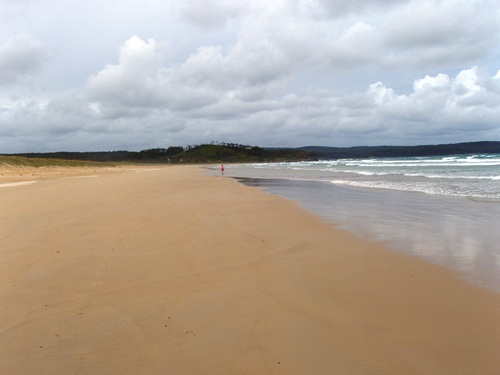
Where I lived they called it the ‘shore’, holiday-makers preferred ‘the beach’. I can’t remember the first time I heard the word ‘strand’ but wrongly assumed, as my German friends know so well, it had a Celtic connection. I can’t explain why, but for me ‘the strand’ has always evoked expansiveness; the power and vastness of the ocean, the constant movement of the tide – incoming, outgoing, only calm for fleeting moments each day, each night.

Continue reading

Physicality and Art by Mark Tweedie

mark_steps

(above: Steps by Mark Tweedie)

The pinhole photography of Mark Tweedie is stunning… I cannot be the only person that finds the images of places, and indeed the series of self portraits, atmospheric and haunting. I have never been to Dartmoor, but I have an imagination of the landscape shaped by things that I have read or perhaps even seen. The photographs in this series are fairly close to what I see in my own imagination.

On Mark’s website he also has a blog, and the articles are well worth a read. It was the most recent piece that drew me there in the first place, and one which – when I think about my own feelings about walking and the creative process – resonates in such a way that I really wanted to share it here…

A good day’s walk makes you feel like your heart has overflowed, that it cannot be contained by the physical confines of the body. It spills out into the trees and hills, it is carried in the wind, winds its way through the air-blown grass like a serpent, runs at your heels like a happy dog. Joy is impossible to describe, for what lifts me may not have any kind of effect on you. But when I walk I feel a part of the world and not apart from it. This sense mixes with everything, I mix with it and, quite literally, en-joy.

Walking, when done in the right spirit, is creative, or at least fills me with the same ineffable sense that something essential, something visceral is happening. It is a feeling that anyone who has created something satisfying will recognise. Moving across the world slowly – from a distance little appears to change, just as an artist’s pencil second by second alters the paper insignificantly – it feels like the landscape and the walker have at the day’s end become a manifestation of more than the sum of themselves.

Travelling on foot gives so much time for mental release thanks to its basic slowness. It creates a psychic momentum which carries one’s thoughts and emotions onward long after the stepping out is finished. It gives a mental space, an openness, which is ripe for fledging ideas and firming up reflections. There is so much in its inherent, rhythmical slowness which is essential to the emotive understanding of all kinds of issues, problems and inspirations. Much of this is also down to the being there, wind on face, earth under foot, straining, feeling muscle and sinew as they negotiate a passage through the elements. The physical engagement transforms everything, makes our sometimes leaden lives golden once more – the philosopher’s stone for those of us who by necessity live our modern lives once removed from the elemental.

Read the rest of Physicality and Art on Mark’s website here

At the Prater Beer Garden, Berlin

prater1

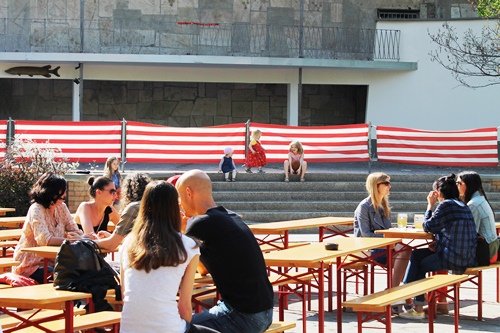
It does not matter how long I have lived in Berlin, how many new experiences I collect or new places open which grab my attention for a night or an afternoon or more, we always return to the Prater. The beer garden is at the top of the hill, I tell our guests who are usually staying at The Circus on Rosenthaler Platz, down at the bottom. We can walk there, after work or school, for a beer and a sausage under the chestnut trees, and although we no longer walk home it is not far, by tram or bike, to Wedding and so it has remained a fixture of our spring and summer months even after we moved out and away from the neighbourhood.

The Prater – restaurant, theatre and beer garden – is not only a fixture of my Berlin, but of the city in general. People began drinking here in 1837, back when the city limits were down at Rosenthaler Platz and the Prater was a day trip into the countryside, a place of escape and refuge from the city. Berlin would break out over the next seventy years, swallowing the beer garden and surrounding it with streets and buildings, but it would remain not only a place of leisure and Sundays free from cares and worries but also, reflecting its position in the heart of the new working class districts providing the labour for Berlin’s rapid industrialisation, a place of political gatherings and agitation as well.

Continue reading