Guided Walk along the Berlin Wall Trail – 8th September 2013

trail1

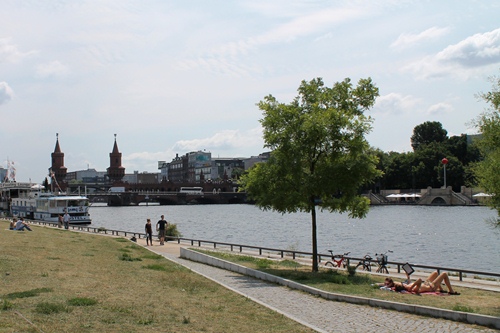
Autumn appears to have arrived in Berlin with the start of September, although the weather is supposed to turn fine again for the coming weekend, which is good because I happen to be leading a “Hike the Berlin Wall” tour for Slow Travel Berlin on Sunday and it would be nice to do it in pleasant sunshine rather than in a blustery shower. I first made this walk – alone – almost exactly a year ago, and although I had long planned to turn it into a guided walk for Slow Travel Berlin circumstances (and the elements) conspired against the inaugural walk until August of this year.

Five people joined me for the walk from Griebnitzsee to Wannsee and I believe we all had a good time. It is a walk that combines some of the most beautiful corners of Berlin and Potsdam with some fascinating stories from the history of both cities… and at around 15 kilometres in length, you certainly feel as if you earned the beer that is waiting at the end of it.

There are still some places available for the guided walk on Sunday 8th September, and it costs €15 per person. If you would like more information, or even to book, then head over to the tour page on Slow Travel Berlin and all will be revealed.

Continue reading

Ormeau Park, Belfast 1913-2013

???????????????????????????????

The 1913 women’s walk for suffrage in Britain is well-known. Over 50,000 women arrived in Hyde Park London demanding the vote. The abuse they endured extended to imprisonment and the brutal force-feeding of those on hunger-strike in prison. In Ireland’s nine counties that comprised Ulster suffragettes, Unionist and Nationalist together, held mass rallies in Ormeau Park. A century later their struggle and their bravery was commemorated in Ormeau Park. Dr Margaret Ward, the Director of the Women’s Resource and Development Agency in Belfast and renowned women’s suffrage scholar addressed the meeting and led the commemorative walk for women in the park. This is her address:

Sisters and friends,

We are here today to commemorate the fact that 100 years ago women throughout Ireland were marching, protesting and going to jail because they demanded the vote. Women from Ireland, England, Scotland and Wales were part of a mass, international, movement of women. In Ulster there were around 1,000 members in 20 different suffrage organisations.  Proportionally the Suffrage Movement had as many members in Ireland as they had in England.

Continue reading

Heavy weather, Nebraska, and a run to the Polish border

Stolpe1

They declared me unfit to live said into that great void my soul’d be hurled
They wanted to know why I did what I did
Well sir I guess there’s just a meanness in this world

These words took me through the deserted streets of Stolpe, a village on the banks of the Lower Oder Valley in eastern Germany, as I made good on a promise to myself that I was going to wake up early on the first day of our trip and run to Poland. At the edge of the village I crossed the bridge over the canal that led me onto the Stolpe Polder, part of the national park and the flat valley floor protected from the canal and the river by high dykes topped with pathways for hikers, bikers and birdwatchers drawn to this strange landscape.

It was early – around seven – but already the air was hot and heavy, the sky overcast and in the distance, to the east above Poland or perhaps even the Baltic, coloured a deep and disturbing red. I ran along the dyke, aware that apart from a couple of tiny figures working a field a couple of kilometres away, I had the entire polder to myself, sharing this flat and lonely landscape with the storks, the housemartins, the starlings and a startled golden oriole, flashing across the path in a burst of green and yellow.

Continue reading

Tales from a fractured summer

Sky over Brandenburg

There was no big trip this year… no epic road trip north, or month-long absence from which to return. Instead we were here and there, more than half of the time in Berlin and yet it did not feel like that. We made our escapes, to a village on the Oder river, in sight of Poland. To a cabin on the edge of the forest an hour or so north of Berlin, where were picked our way cautiously through the woods so as not to meet a grumpy mother wild boar protecting her young. To the very edge of the city, for a day walking the Berlin Wall Trail on the banks of the Havel. And to England, to an old stomping ground and a new corner of my home country never before explored.

We have some more plans, some weekends out of Berlin before the weather turns, but school starts again next week and yesterday I took a small group of people around Wedding on cultural-historical tour through my neighbourhood, and it was a homecoming of sorts. It not only reminded me about the interesting places within a stone’s throw of my front door, but helped to connect me in to the city again and why it is such as fascinating and interesting place to live. The idea of this website has never been to be a personal blog, or one focused on Berlin, but as the principal contributor to Under a Grey Sky, and as I happen to live in the city, then it is only natural that a good number of the pieces found here will be based on the different discoveries I have made in the German capital.

On Friday, on a walk that took me past both the Brandenburg Gate and the Reichstag – the most well-trodden tourist path through the city – I stumbled across a couple of places that I had never visited before and which confounded the expectations I had about what I was about to see when I set out from home a few hours before. That is one of the wonderful things about living in a city such as Berlin, even after a decade of living here, that there remains places to discover. They will feature on the website in the coming weeks, as well as the various tales of our fractured summer in Germany and beyond.

It’s good to be back.

Words: Paul Scraton
Picture: Katrin Schönig

Summer in the city and beyond

Summertime

This time last year we were about to hit the road north, towards Rostock and the Baltic and a ferry that would take us across the water to Sweden. During those four weeks, we put Under a Grey Sky on a break so that we could spend all our time relaxing, enjoying our experiences in Sweden, and to re-charge the batteries for the start of term feeling that always comes with the end of the summer. This year we have decided to do the same, although our journeys this year are slightly more fragmented, to the Lower Oder Valley on the German-Polish border, and then across to England, to Yorkshire and Northumbria, giving us the chance to discover a couple of new places both here and there.

Once again we would like to take the opportunity to thank everyone who has written for, subscribed to, followed and read Under a Grey Sky. And if any of you out there have some particular adventures beyond the front door that you would like to share on these pages, then please do not hesitate to get in contact at paulscraton (at) gmail (dot) com.

Have a great summer.

Paul

The Ghost Bike

OLYMPUS DIGITAL CAMERA

By Phil Scraton

I remember walking to Moreton Cross with my mum to catch the 77 bus to Landican Cemetery on the Wirral. I guess we went once or twice a month. Mum knelt on an old towel clearing weeds and trimming the edges of the flower bed that marked Aunty Mary’s grave. I was off running between the headstones with my invisible friend, Ben – like Calvin and Hobbes. Neither Ben nor I ever stepped on a grave. The souls might have ascended to heaven but the interred bodies had to be respected. Back from my imaginings I’d find mum silently weeping. I hugged her so hard thinking how she loved her older sister. Only recently did I discover that Mary was, in fact, her mother.

Cemeteries house the dead, their neat avenues and walkways are like miniature housing estates. A reverential solitude accommodates remembrance, grief and, on occasion, celebration of a life well lived. Having renewed the flowers on Mary’s grave we would drop by the ice cream shop and take the bus home. As an altar boy in a Catholic family I regularly served requiem mass and stood alongside numerous gravesides. I suppose I accepted memorialisation as part of life. Death was not an end, but a beginning. Not a proposition that endured into my adult life!

Continue reading

The Squire of Ribbeck, Havelland, Germany

IMG_2844

By Anja Ahrens:

Almost thirty years ago, when I was still a child, my Grandfather attempted to teach me Theodor Fontane’s poem Herr von Ribbeck auf Ribbeck in his original tongue – Plattdeutsch, a dialect of German from the north of Germany – as I spent my summer holidays with him in the countryside. I did not understand the poem then, and try as I might I was unable to memorise it. That was the summer before my grandfather died.

Years later I remembered his wish for me to know this particular poem, and knowing that he had died soon after, and having finally come to understanding the story, I always felt as if he had been trying to tell me something… that in some way he wanted to leave something behind in a different way than the Herr von Ribbeck:

Continue reading

Saturday afternoon in Volkspark Friedrichshain, Berlin

FH1

It is early afternoon on Saturday and we follow a cobbled road into the Volkspark Friedrichshain. It is a driveway to the hospital, twisting one way and then the other, flanked by ornate lamps. The park was laid out in 1848 and the hospital, the first of its kind in the city, was opened twenty years later, and it is not hard to imagine a rudimentary ambulance pulled by horses, rolling clackety-clack across the cobblestones towards the brick entrance gate and the hope of the hospital beyond.

So many of Berlin’s most interesting sights are tied up in that period of rapid growth in the second half of the nineteenth century, and walking along with the park on one side and the high walls of the hospital on the other, it is very easy to picture how it might have been, the city growing rapidly, swallowing the fields and villages surrounding it through rapid growth… until the spell is broken by a gang of orange-shirted “stags”, who turn the corner pushing a stolen shopping trolley laden with beer bottles and dripping from melting ice. We will see them again, in the beer garden, and then later, a few of their number AWOL, hanging out in a bus stop and singing German football songs at the cars passing by in the street.

Continue reading

Farewell to the Thomas Cook European Rail Timetable

Timetable

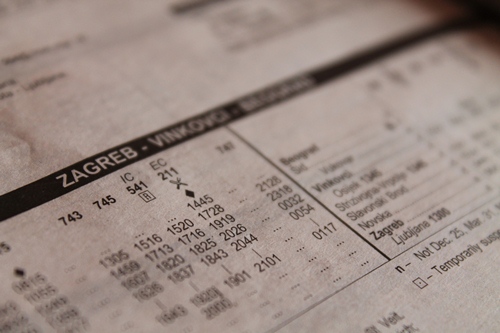
It was with some sadness that I read the news earlier this week that Thomas Cook are closing the publishing branch of their business, which means the end of the legendary European Rail Timetable, which only this year had celebrated its 140th anniversary. Having worked on the last couple of editions of the Europe by Rail guidebook – which is also a victim of the closure – I had cause in recent years to reacquaint myself with the timetable in all its glory. It seems hard to imagine now in this era of extensive internet access and smartphones – in itself a reason why travel publishers have been having a hard time of it – but when I first when interrailing at the end of the 1990s, the printed timetable was the most important part of our luggage. Checking down the columns for the next train from Budapest to Ljubljana, or Florence to Milan, and making sure that it was not subject to any exceptions, or perhaps even a supplement on our rail pass, was an essential part of the routine as we crisscrossed Europe.

Continue reading