Category Archives: Walks

Walking the old customs wall, Berlin

Wall1

The idea for the walk came from Patrick, who had sent me a copy of his map. It showed the route of the old customs wall of Berlin, a fifteen kilometre circle that until 1861 was the limit of the city. There is nearly nothing remaining of the old wall today – just a set of foundations not far from Anhalter Bahnhof and – of course – the Brandenburg Gate, but it lives on in other ways. The route of the U-Bahn line through Kreuzberg for instance and the stations along the way; Kottbusser Tor, Hallesches Tor, Schlesisches Tor… the gates are no more but they live on in these names.

Patrick had walked the route of the old customs wall before and invited me to join him as he did it again. Along the way we would see, as our footsteps followed the path of the invisible wall, how it shaped the development of the city and how you can still see its influence more than 150 years after the city broke through its limitations to become the Weltstadt of the early twentieth century, its population swelling to a number that the old wall could never have contained.
Continue reading

Hey ho, let’s go

Tom1

By Tom Salmon:

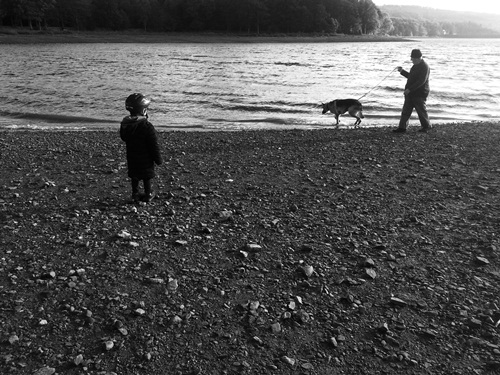
I don’t know when or why the opening lines of the punk classic Blitzkrieg Bop became the rallying cry for a day out with the kids. But the Ramones’ most famous lines are now a part of a soundtrack of the weekend for our three under-fives. ‘Hey ho, let’s go’ they chant as we put our boots on.

We leave home with the kids packed up with their bikes and wrapped up for the chill in the autumnal Yorkshire air. As they clamber over each other’s car seats into the back of the car they play to another Blitzkrieg Bop lyric, “They’re forming in straight line, they’re going through a tight one, the kids are losing their minds, Blitzkrieg Bop”.

Continue reading

Walking the City

Postboxes in Wedding

“I love to read about the city, to live the city, to walk the city.”

This quote comes from a fascinating New Yorker article about William Helmreich, a sixty-seven year old sociology professor who has just spent four years walking every block of New York, some six thousand miles, and whose new book about his walks looks like it is going to be an absolutely fascinating addition to the literature of exploring our urban environment on two feet. As readers of Under a Grey Sky will know, this is something close to my own heart, as walking the city has become something of a passion of mine, not only through corners of Berlin or elsewhere that are new to me, but also by stepping out the front door and taking the time to explore my immediate surroundings.

During the summer I was walking to Pankstraße U-Bahn station. I do this probably five or more times a week, usually along a short stretch of the Panke river, peaceful and secluded, before emerging through a covered walkway onto the Badstraße – a bustling city street filled with kebab takeaways, call shops and travel agents… the tell-tale signs of a neighbourhood with a large immigrant population. These signals – the type of shops, the people on the pavement, the adverts in the kiosks – help us read neighbourhoods and districts, in the same way the buildings can give clues to the history of a particular quarter, and even the proliferation of election posters and how they are targeted in one part of the city compared to the next can help us make an educated guess as to which way one constituency might swing compared to another across the invisible administrative boundary.

Continue reading

The Highest Mountain and the Deepest Lake, Berlin

TF1

Of course, if you live in Berlin this is all relative. After all, we live in a city where the local Alpine association uses the northern wall of a Second World War flak tower as one if their main training spots, as the nearest actual, real mountains are at least a couple of hours drive away. The Teufelsberg, complete with an abandoned US Listening Station on top, is not even a “real” hill, let alone a mountain… built as it is from the rubble of 15,000 destroyed  buildings that fell victim to the American and British bombing raids of the Second World War.

Still, Lotte and I enjoyed the walk up through the northern Grunewald woods, past the bald Drachenberg hill popular with kite-flyers and mobile airplane pilots, until we reached the double barbed wire fence, recently strengthened to prevent urban explorers accessing the listening station without paying the €7 “tour fee”, advertised at the (locked) main entrance scrawled with a marker on a piece of cardboard. Still, every so often, as we traversed around the hill alongside the fence, the trees moved away every so often to allow us a view out across the western districts of Berlin or east, across the treetops of Brandenburg.

Continue reading

Tour along the Berlin Wall Trail

spy bridge

The tours that we have started running over at Slow Travel Berlin seem to be taking off in a big way, and if you go to this page you will see many different fascinating tours coming up in the next few weeks. I have another cultural-historical neighbourhood tour of Wedding next Sunday (19th May) which I am really looking forward to, and a week later on Sunday 26th May I will be heading south with a small group to walk a 12 kilometre stretch of the Berlin Wall Trail, between Griebnitzsee and Wannsee.

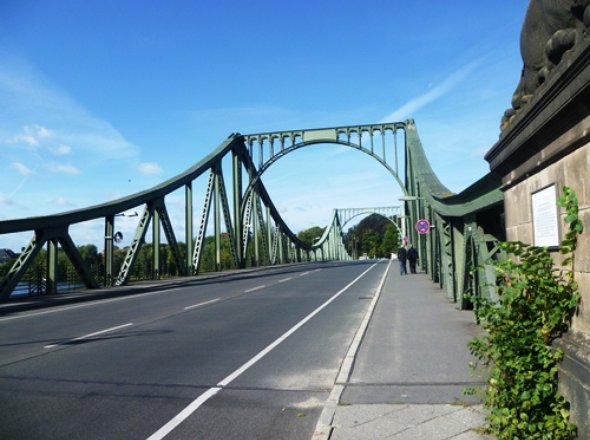
Last summer I did a test walk of this route, which I wrote about here, and it is one of those walks that proves that the very edge of the city can be as interesting as the centre. The walk begins with the villas that housed Churchill, Truman and Stalin during the 1945 Potsdam Conference, takes us past enclaves completely surrounded by the Berlin Wall, old royal palaces and a bridge where spies were exchanged during the Cold War, before a beautiful walk along the banks of the Havel towards Wannsee – West Berlin’s “beach resort” where, in a shady villa at the end of a leafy street, leading members of the Nazi government met to discuss plans for the “final solution” and the murder of six million Jews in Europe.

The walk will take around four to five hours, and there are still a few spaces left. The best place to book is on the tour page at Slow Travel Berlin. And please take the time to look at some of the other tours that are happening over the next couple of weekends… a great way to explore some different corners of the city, and to hear some stories you might otherwise have missed.

From Hermsdorf to Rosenthal – a walk across the top of Berlin

Hermsdorf1

The first section of our walk took us along the busy road from Waidmannslust S-Bahn station and into Hermsdorf, past garden centres and discounter supermarkets, a couple of rough and ready corner pubs and an organic grocers, before we ducked through the railings where the Tegeler Fließ passes beneath the main road and within a handful of footsteps we had left the traffic behind and were left only with the sound of birds singing in the trees. We had been here before, a few months ago in fact, when it looked as if spring was upon us as we explored the old village of Hermsdorf before picking up the trail down by the river, but this time we really had moved beyond winter, and our walk would take us further as well.

We made our way alongside the Hermsdorfer See before the path became a wooden walkway along the bottom of pleasant gardens, raised on stilts above the soggy bog of the wetlands that spread out from the river bank in either direction. Here the Tegeler Fließ is two things… it is incredibly bendy, twisting this way and that, and it also happens to be the border between Berlin and Brandenburg. From the division of Germany after the Second World War until the events of 1989 and the reunification of 1990 this was an international border, although the planners building the Berlin Wall obviously did not fancy doing battle with the swamp and so set their fortifications further to the north, which left one bank of the river and its wetlands technically part of the German Democratic Republic, but sitting on the West Berlin side of the concrete and barbed wire barrier.

Continue reading

A cultural historical stroll through Neukölln, Berlin

neukölln

Attentive readers will know that over the past few months I have been involved with Slow Travel Berlin in organising a series of walks and strolls through different corners of Berlin. Only this week I took a small group through my home neighbourhood of Wedding and it was once again a really brilliant experience to share my much-maligned corner of the city with others, as well as the different stories that make up its history. If you go here you can get an overview of the other tours that are offered, but I wanted to give a heads up for the newest tour that is being launched this weekend, with a second date on Tuesday 30th April. This tour is through the neighbourhood of Neukölln, and is being led by Anna Sprang of the absolutely fascinating Strollology Berlin website. I would urge anyone with an interest in Berlin to take a browse through those pages, and if you at all have the chance, join Anna on her tour which promises to be excellent:

Rixdorf & Rollberge – a cultural-historical stroll through Neukölln

Berlin‘s gritty, working-class Neukölln district is widely known as a problem-gone-hip, now home to a colourful mix of people from all around the world. On this tour through the northern part of the borough, we‘ll uncover many different layers of its changing and often surprising history, some of which are still visible, with others  concealed in old photos, literature, eye witness reports and personal memories.

Continue reading

A walk through Springfield, MA

Springfield

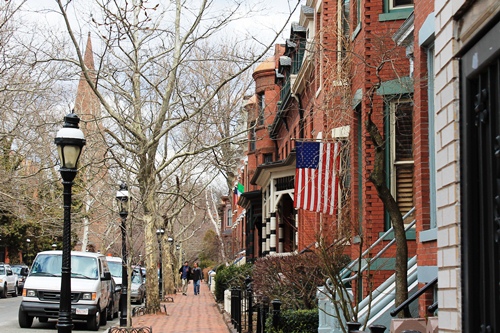
The interstate runs right through the heart of the city, dividing the high, gleaming towers of the downtown with the wide, sedate Connecticut River. We wait for our junction and then roll off, the ramp taking us down and into the concrete canyons of the city centre. Not that Springfield is a large place – 150,000 people live within the city limits, just over a half a million in the metropolitan area – but it is the only true city that we will spend any time in, and the contrast with the university towns, sleepy seaside resorts, and hillside villages that make up most of our two week trip to the United States is quite marked.

The creators of The Simpsons, when deciding on a name for the town where Homer, Marge and the rest of the gang would live, chose “Springfield” as Anytown, USA – and indeed it is the fourth most popular place name in the nation – but Springfield, Massachusetts can lay claim to being one of the oldest, founded as it was in 1636. The history of the city has been one dominated by manufacturing, from the first American musket factory, the discovery of vulcanized rubber, and the Indian motorcycle company. Other claims to fame are as the birthplace of the first American-English dictionary (Merriam Webster), the sport of basketball – created in the local YMCA – and the children’s writer and illustrator Theodor Seuss Geisel, better known as Dr Seuss.

Continue reading

The Chimney and the Grindstone

???????????????????????????????

By Phil Scraton:

Certain moments capture the imagination, stop us in our tracks, and are the stuff of coincidence. And so it happened on a cold, calm afternoon before the snow storm arrived. The previous evening I’d been reading an anthology of Robert Frost’s poems compiled and reviewed by Louis Untermeyer. Frost identified the ‘complete poem’ as ‘one where an emotion has found its thought, and the thought has found the words’. His poems often celebrate the great outdoors, sharply observed, laced with metaphor and emotionally stirring. He commits to place and to the detail he finds there: ‘And the dry pump flung up an awkward arm/ And the fence post carried a strand of wire’.

In his poem The Need of Being Versed in Country Things from which the above lines are taken, Frost invites the reader to reflect on the remnants of a house lost to fire. It stands alongside ‘The barn across the way/ That would have joined the house in flame/ Had it been for the will of the wind, was left/ To bear forsaken the place’s name’. While the poem celebrates the continuing life offered by the dilapidated barn as birds, flying to and fro, ‘rejoiced in the nest they kept’, Frost suggests they ‘wept’ its neglect and decline. For:

The house had gone to bring again
To the midnight sky a sunset glow.
Now the chimney was all of the house that stood,
Like a pistil after the petals go.

Continue reading

A walk in Brandenburg, Germany

BR1

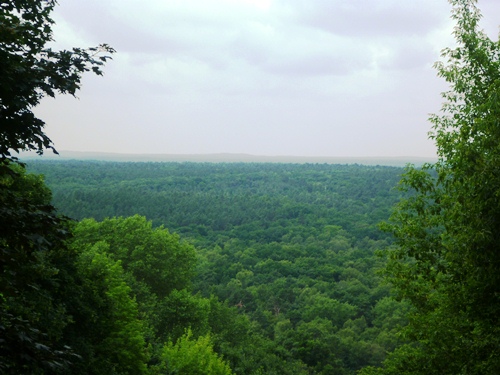
The mist hangs between the tall, gloomy pine trees as we climb down from the train. Only one other passenger stepped off with us, and by the time we have sorted ourselves out on the platform she has disappeared into the haze. At the level crossing, where no cars wait for the train to depart, onwards towards the Polish border, the guesthouse is shuttered and locked. “Closed, for January and February” states a handwritten note in the window. No refreshments here, and we are glad that this is just the beginning, and that we are walking in the other direction.

We pick our way through the village to the river, which is glassy and still like the weather. Which way does the water flow? It is impossible to tell. The path leads us right along the water’s edge, the reeds springy underfoot. We pick our way along the bottom of holiday cottage gardens. Across the river is a field, the ground ploughed and hard into row after row of snow-capped ridges. We have moved away from the main road now, and there is little sound except for the occasional bird call or an airplane coming into land in the distance.

Continue reading