Category Archives: Walks

Across the fields, through the woods, and over the moors

walk1

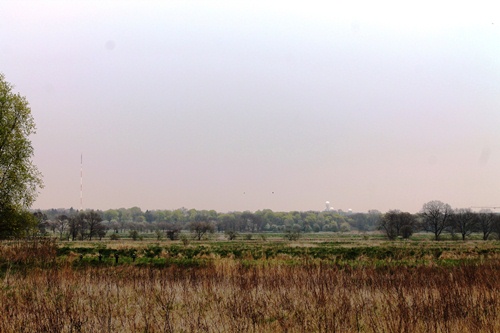
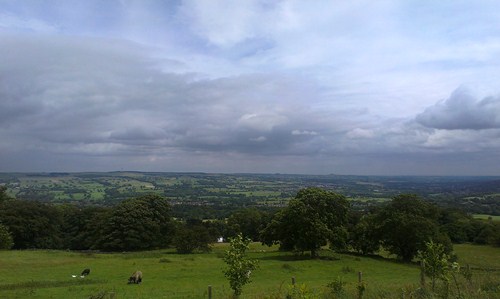
From the house Derry Hill rises steeply out of the village of Menston, a narrow lane along which drivers race just a little too fast and unsuspecting walkers have to keep their wits about them. So it is something of a relief, about halfway up, to follow a footpath sign over a style and to head out across the fields. From this point on, during our seven mile loop that will take us south and then back round to the village, we will only ever encounter roads as we cross them… apart from a couple of farm tracks along the way, the walk will very much be across the fields, through the woods, and over the moors.

So far… so Yorkshire. This part of the world has all the things you would hope to find on a walk such as this, from the dry stone walls to picturesque villages, lonely pubs on the edge of wild moorland, and amazing views across the rolling landscape. But beyond these clichés there is something else that makes walking in West Yorkshire so fascinating, and that is the opportunity – especially once you get up high and the countryside unfolds before you – to understand not only the natural beauty of the region, but also the social history of this landscape, and the human interaction that has shaped it.
Continue reading

From the river to the canal, Berlin

Panke1

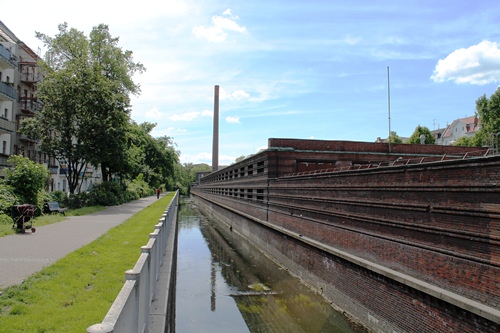
At the site of old mineral spring – the Gesundbrunnen that gives our district it’s the name – the Panke river flows between the red-bricked halls of a former vault-factory and the clumpy grass of an underappreciated park, complete with a football court that local legend has it started the careers of at least one of the three Boeteng brothers. Their faces look down upon the nearby Badstraße from a Nike-sponsored mural. The sports company also dressed up the football court and invited the brothers along to launch an advertising campaign in the gritty urban decay that is our ‘hood. The sign that hung over the gate to the concrete pitch was stolen within days.

Continue reading

A Gift from the Road: Walking the Woods and the Water

walking the woodsA review of Walking the Woods and the Water by Nick Hunt

Review by Paul Scraton:

In 1933 Patrick Leigh Fermor began a walk from the Hook of Holland that would take him across Europe, a journey he would later immortalise in three books – A Time of Gifts, Between the Woods and the Water, and (published posthumously) The Broken Road. The first two have, since publication, been long regarded as classics of travel literature. Reading them today you are struck with the sense that these are books written about a time when Europe was at a tipping point – much of A Time of Gifts for instance is set in a Germany where the Nazis are in the ascendant – but also and especially later in Fermor’s journey, in the lands to the East, where the books are filled with tales of aristocrats and peasants it is a world that became decidedly less “modern” the more he walked.

Continue reading

The Landscapes of Berlin

Cover

What do we think of when we hear the word “landscape”? The first thought might involve hills and mountains or endless prairie fields and wide, wide rivers. It might involve sea cliffs and beaches, bleak moors or a Postman-Pat patchwork of land divided into neat parcels by high hedges. Landscape feels like it should be somehow “natural”, and it is tempting to idealise it as such, even though there are very few places – especially in Europe – that can truly claim to have been untouched by the influence of humankind. After all, we introduced the sheep that tore away the natural vegetation of the Welsh hills and we planted the corn that waves back and forth across the Mid-West. But still, more often than not the word is used to describe something different to the built-environment of the city, which is why I remain amazed when I find those corners of Berlin where it feels as if no other word will do.

Continue reading

The flickering of panic

cairnsmore-of-fleet-1

Cairnsmore of Fleet, Galloway, Scotland, February 2014

By Daniel Greenwood

A wading bird bursts from the bog. I watch its sharp wings cut into the wall of mist and descending treeline. I put my binoculars to my eyes and the bird is lost. The world has been reduced. All terrestrial life but for water, a few lichens, heather and wintry moor grasses has escaped. I have left behind oak woods overcome by rhododendron and cherry laurel, and Cairnsmore Burn choked by the former, its water crashing from the shadows. It was not right. Snowdrops still managed to create small rugs of white flowers and winter green leaves. Bluebells peeked through the leaf litter amongst them. Behold the denizens of Galloway’s oldest woods. Up here those are images in the mind. The life in the lap of the Cree estuary – the buses, postman, trees and gentle flowering plants are mere memory. The cover of Glenure Forest’s regimental spruce is the last notion of protection. It’s now up to willpower, my body and clothing. The path leads clear from 20 metres, visibility coming and going with cloud.

Continue reading

And the river rushes through it… the Strid, Yorkshire

Strid1

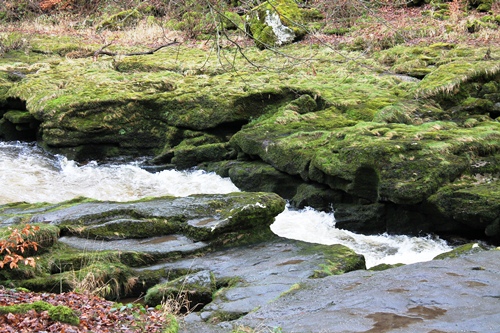
We had entered the grounds of Bolton Abbey just beyond the ruined walls of the old Priory, and parked the car down by the River Wharfe close to the Cavendish tea room. It was one of those mixed days, windy and overcast with the odd spot of rain, but the trees alongside the path above the river gave us good cover as we walked upstream in the direction of the narrows of the river known as the Strid. Our first view of the famous stretch of the came from above, the path a little way up the hillside, and it was hard to make out quite the force of the water as it rushed through. In fact, it even looked a little tame, which is apparently half of the problem.

Continue reading

A walk in the woods: Wendisch-Rietz, Brandenburg

Wendisch1

The history of this village at the bottom end of the Scharmützelsee lake about an hour from Berlin is all there in the name. The Wends were West Slavs, who settled in the land between the Elbe and the Oder rivers over a thousand years ago. Divided into a number of different tribes, they were the majority population of the area that now makes up most of the state of Brandenburg until the arrival of German colonists between the 12th and the 14th centuries. By the 18th Century most of the Wends had been assimilated into the German population, except for the Sorbs, who continue to live as Germany’s only indigenous minority in the Spreewald region, not far from Wendisch-Rietz.

Continue reading

The Bavarian English Garden, Munich

Munich1

We step out of the hustle and bustle of Münchner Freiheit and make our way down sleepy side streets until we reach the edge of the Englischer Garten, central Munich’s large park that runs alongside the river north of the city centre. We are at the very edge of winter, wrapped up warm against the cold, the joggers blowing steam along the pathways as dogs chase each other over the frosted grass. As we make our way to the lake at the heart of the park we are frozen in our tracks at the sight of a flock of geese, taking to flight from the grass about half a kilometre away and now flying low in our direction. Instinctively we duck as they pass on the way to the water, the air filled with squawks and squeals and the beating of wings.

Continue reading

Little Langdale

chris1

By Chris Hughes:

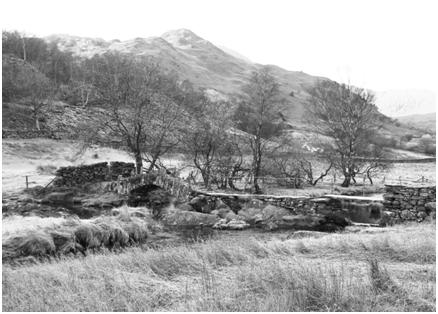
I have driven along the small valley of Little Langdale many times. En route for the Wrynose Pass and Hard Knott and then on to Wasdale in the 1960s, over the Blea Tarn road and down into Great Langdale for the climbing on Gimmer, Raven Crag, White Ghyll and Pavey Ark and visiting the hugely impressive Big Hole slate quarry containing the vast and wonderful cathedral hole, but rarely stopping very much back then – just the occasional pint in the tiny back bar of The Three Shires Inn. With our children we often visited the ford on the track to Tilberthwaite to play in the clear waters of the River Brathay but it is many years since we had actually stopped in the valley and spent some time there. So when visit to Grange-over-Sands was necessary it gave us the excuse – unnecessary really – to have a short stay at The Three Shires Inn and revisit the little gem of the south Lakes, Little Langdale. The hotel was excellent and to be recommended – especially their winter offers – but it was the day, a Monday in late November, which made a little gem into a real, and hugely valued jewel of a place.

Continue reading

As darkness falls: a walk through Berlin

Darkness1

On Thursday afternoon I took a walk through Berlin. I had decided to follow the Berlin Wall Trail from Potsdamer Platz to Ostbahnhof for my project Traces of Border, a walk of five kilometres through the south of the city centre along the boundary between the districts of Mitte and Kreuzberg. As always with these walks it was a combination of the familiar and new discoveries, but for the first time I was walking as darkness encroached on the city which gave it a very different feel.

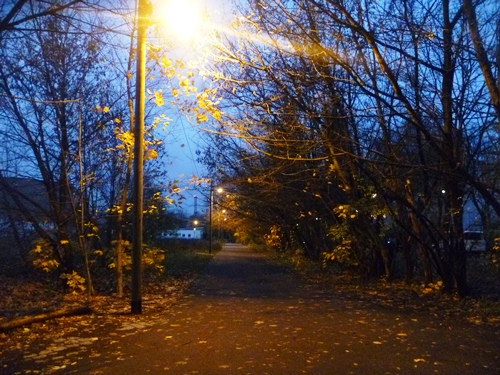
It was my own fault, only starting to walk at about half past three, and at this time of year the streetlights have already flickered into action and the main roads are a stream of white lights approaching and red lights retreating by the middle of the afternoon. Through the half-light I followed the line of cobblestones that marks the route of the wall past the Topography of Terror and through Checkpoint Charlie and its collection of memorials, exhibitions, souvenir shops and fast food joints, and then the site where Peter Fechter died and the enormous Axel-Springer building that houses publishing company of the same name.

Continue reading