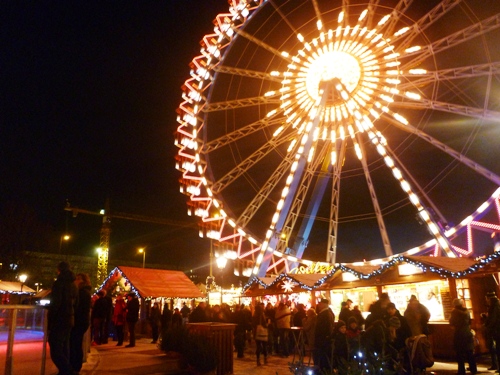
I am an unashamed fan of the Christmas Market, whether it is a small collection of wooden stalls in an cobblestoned square of some small town, or one of the countless versions that we can enjoy here in Berlin, and the four weeks of advent during which they operate is one of the highlights of my year. There is one particular market in Berlin, in the shadow of the opera house, that is called the “Nostalgie Markt” or nostalgia market, which got me thinking the other day as I strolled through the wooden huts, past the glühwein stands and intricate little wooden handicrafts, the smell of roasting chestnuts mingling with the meat on the grill as the big wheel turned against the backdrop of a Plattenbau, that in the end, aren’t all Christmas Markets “Nostalgia Markets” in a certain way?
Category Archives: Reflections
The Lorry-boat Shrimpers of Southport
By Chris Hughes:
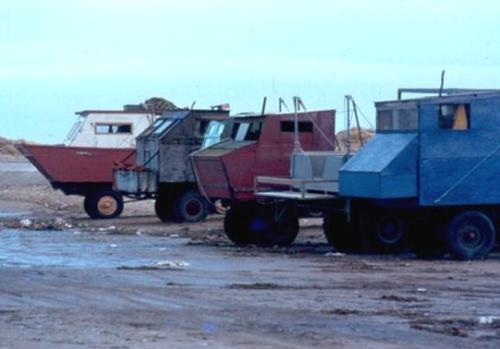
Driving along the coastal road into Southport from my home in Ainsdale I pass a motley collection of vehicles parked up on the beach. Half lorry, half boat these are, or rather were, the shrimpers of Birkdale. The photographs in this article were taken 10 to 15 years ago and there are fewer and less interesting vehicles left now. Although shrimping is still carried on it appears to be largely tractors employed in the process today and far less people are engaged in the activity.
About the Balance of Things
By Annika Ruohonen:
I’ve been away. Living, like a friend so accurately put it. First east, then west. Exploring places, meeting people, embracing all that is new and precious, but also facing challenges, overcoming obstacles and testing my boundaries. I’ve learned so much and I’m grateful for all that makes me bigger and wiser. I have so much to tell you, as soon as I find the spot where to start. You know how things happen in a certain sequence, but then they eventually find a way to regroup when your experiences eventually get new meanings. Once there is a missed opportunity, then there is an unexpected opening. One soul dies, another one is born. When time passes, it does not seem important at all in which order everything took place. All you see is how it all interconnects.
The hills above Belfast
When I began this website back in December of last year, I knew only that I wanted to create a place that would be an interesting diversion for those who subscribed or stumbled across its pages, giving people the chance to explore not only places but also books, music and anything else, and hopefully inspire others to get out and search for what is there to be discovered beyond the front door. Many of the pieces have come from my own experiences, but one of the most gratifying things about Under a Grey Sky is the number of people who have contributed their own words, pictures and experiences to these pages, helping to create this virtual flea market of stories and images through which visitors to the archive can rummage.
The White Mountain National Forest, New Hampshire, USA
By Matt Lancashire:
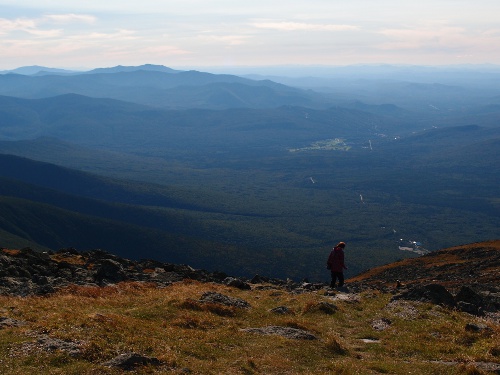
In many ways, New Hampshire was the most libertarian place I have ever visited. The hints started as soon as you drive over the state line, past the sign saying “Welcome Bienvenue / New Hampshire / Live Free or Die”. The confrontational choice of slogan certainly reflects the seriousness of the sentiment for the state. Before long, there was another sign: “N.H. LAW / BUCKLE UP UNDER AGE 18”. The inverse implication that you don’t have to wear a seatbelt if you’ve survived your first 18 years took a moment to settle in. Before long, another official road sign appears, advertising that the next service station doubles up as a “state liquor store”, which a more meddlesome local government might consider a poor combination.
Finding joy under a grey sky
By Miles Richardson, author of Needwood, a search for deep nature in the local landscape and a celebration of the joy that can be extracted from ordinary things in the natural world:
My book Needwood was written on foot. It takes a simple journey into an ordinary rural English landscape with no obvious grandeur, wilderness or drama. So the ordinary things are enjoyed: the oak, the rook, the river; the solace of the risings, the calm of the water meadows and the lifeless hedgerows of winter under a leaden sky. In this ordinary landscape, searching for ordinary things, I found a universal story about our connection to nature. Some of the most compelling moments took place under grey skies and below are two days from my year long journey; the first from February, the second from November.
Waiting for the ferry
The following piece was inspired by the above photograph, taken at Rostock in northern Germany:
At the ferry port the vehicles line up in rows beneath the enormous floodlights that will make the scene as bright as daytime as soon as darkness falls. Families pile out of overloaded cars – playing cards and pillows, crumbled magazines and half-eaten biscuits, fall onto the tarmac as doors open – whilst lorry drivers lean patiently against open windows or watch films on laptops balanced on the dashboard. A coach driver bows to pressure from the back rows and releases the smokers with a pneumatic hiss of the doors, and the foot passengers and bike riders sit on wooden picnic tables lined up by the raised footbridge, next to a row of brilliant blue portaloos.
If travel is as much about the journey as the destination, and anticipation of what is to come heightens the experience when we finally get there, then waiting is part of the deal. Train stations, airports, ferry terminals and even service stations become the moments where the journey must pause, and we find ourselves killing time before we can get on the move again. Sometimes you hear these places – especially airports and service stations – described as neutral, or nowhere zones, because they are designed with a certain uniformity, or they do not necessarily reflect their surroundings. But ask any frequent flier about airports and they will tell you their favourites, the places they are happy to transit through and those which they avoid if they can possibly help it.
Why do we visit these places?
(above: inside the District Six museum, Cape Town)
An article I wrote for Slow Travel Berlin on the Olympic Village just outside Berlin was picked up by the Guardian as part of their Travel Network, in which they select certain blogs or articles from different travel websites to feature on the travel pages of Guardian.co.uk. One commentator wondered why anyone would want to visit somewhere like the semi-ruined Olympic Village in Elstal when there were more interesting places to go to in the city, and it got me thinking about how we chose to explore places – and which places we choose to explore – whether during our travels or closer to home. As regular readers of Under a Grey Sky will know, I am fascinated by places that can tell a story – whether in the middle of Berlin or a remote Scottish island – and I am certainly of the opinion that there is value to setting foot in these places, even if there is very little to see.
Why is that? Can I understand better the lives of workers in Wales, Germany or Sweden by walking through the relics of their industry? What do I learn about apartheid wandering the cleared streets of District Six in Cape Town? How do I further my understanding of the Holocaust by riding a bus from Krakow to Auschwitz to stand before a snowy field and try to comprehend what took place there? Some of us are simply interested in historical sites, whatever their state of disrepair, but there is also the more important issue about how or why we would maintain such sites, and what role they have in our understanding of historical events.
With their backs to each other – Nora and Gyttorp, Sweden
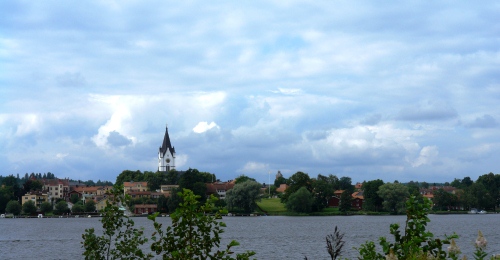
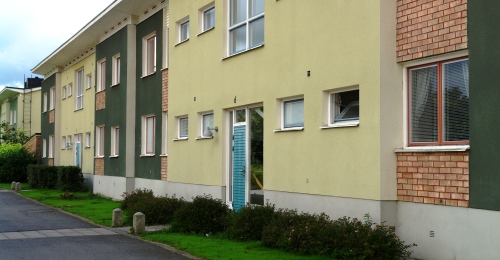
The towns of Nora and Gyttorp are separated by a short stretch of road through the woods, and each look out onto a different lake; stand on the shore in Nora and you are staring West across the Norasjön, from Gyttorp you gaze to the east across the wind-ripples of the Vikern. You can easily visit the two in a single morning, walking amongst the picturesque wooden houses of Nora before exploring the functional terraced townhouses of Gyttorp. These two neighbouring towns couldn’t look more different, and it is this contrast that makes them together a fascinating look at how we imagine a town or community should be designed and organised.
Revitalising remote communities: the idea of ‘sustainable tourism’
The following article is by Sharon Blackie originally appeared on the Earthlines Magazine blog and is a very interesting read for anyone interested in the challenges of balancing tourism, access and sustainability in some of our most beautiful areas. Many thanks to Sharon for allowing us permission to re-post it here:
When we moved to this most remote south-western corner of the Outer Hebridean island of Lewis in 2010, we did so precisely because of its remoteness. We were looking for a quiet place, as far as it is possible to get in this too-cluttered country from the consumption-driven madness of the ‘civilised’ world. One of the many reasons we loved this region called Uig was that it was still unspoilt by an excess of tourism. Because, to us, the words ‘spoilt’ and ‘tourism’ have generally gone together. Tourism can be a very different thing from travelling. It can imply enormous camper vans that are too big for small single-track roads (too big even for their passing places) and that empty their chemical loos all over grazing land (yes, I know: not all camper van owners are so inconsiderate, but sadly many are); too-fast too-impatient cars driving at breakneck never-enough-time city speed, mowing down lambs as they go. It can imply too much inappropriate development – development that exploits a place rather than teaching people to respect and treasure it. It can imply curious people stopping and staring through your fence at you when you’re working on the croft as if you were some kind of museum piece or in a petting zoo. It can imply coachloads of tourists buying up mugs and teatowels that are mass-produced by children in China. It can imply stepping out of the car for a moment and ‘looking at the view’ – or photgraphing it – rather than truly putting yourself into a wild place and going with the flow. In short, it can imply damaging – to the environment, to the culture of a place, and to the inhabitants of that place getting on with doing their work.
I understand that I’ve focused on just one type of tourist experience in the previous paragraph. I understand that by no means all tourists are like this, and that walkers and many other travellers certainly are not. But I’ve lived in a couple of other remote and beautiful places where tourists have a tendency to take over for a good 50% of the year, and if your livelihood doesn’t depend on tourists and yet you’re still trying to manage animals and run a business, the all-too-frequent thoughtlessness can be immensely frustrating and so colours your perception.