Category Archives: Places

Brocken Diary: The Mountain Never Climbed

???????????????????????????????

I don’t tend to make New Year resolutions – perhaps because of football seasons and growing up surrounded by people who work in Higher Education, autumn always feels much more like a “new beginning” that the 1st January – but I have decided to hatch a plan for some point over the next twelve months: to climb what was the highest mountain in East Germany…

On December 25th 2006 our daughter Lotte was six months old. We were celebrating her first Christmas with some friends in a small town on the edge of the Harz Mountains, and decided on the day itself to drive into the National Park and go for a walk. The Harz straddle the border between the German states of Lower Saxony and Saxony-Anhalt, which means that during the years of division the inner-German border. We were staying in the old West. We went for a walk in the old East.

Continue reading

On Ilkley Moor…

Ilkley

This weekend we were back in Yorkshire for just a couple of days, celebrating a very special birthday with close friends and family, including quite a few Under a Grey Sky contributors! The images and text below were actually put together during a trip a month or so ago… this time around there were no views from the airplane as Leeds Bradford was shrouded in mist. In fact, we were unable to land and we were diverted to Doncaster…

Coming in to land at Leeds Bradford airport I look out of the window and can see Ilkley Moor, squat and smooth, not so much towering over the surrounding towns and villages as hulking in its presence. Perhaps it is because we don’t have much in the way of moorland in Germany that the sight of it always makes me feel as if I have returned home, even if the wheels have yet to touch down on the runway tarmac.

Continue reading

How I Ruined Hackney (& the Mystery of “The Hackney Slap”)

Marsh-Hackney-Slap

Gareth Rees, aka The Hackney Marshman, has been chronicling his explorations of the Lea Valley Nature Reserve and the secret life of the Hackney and Walthamstow Marshes since early 2011. With his book about to come out, he has kindly given us permission to re-publish this piece that explains how he has ruined his home neighbourhood and is single-handedly responsible for the gentrification of the area, and all before the book even hits the shelves…

On a bright afternoon I was on Walthamstow marsh with my dog Hendrix, walking beneath the brow of the old aqueduct path where the brambles grow. He was coming the other way, a stocky man, late 40s, with a collie.

“Watch out for her!” he said, pointing at his dog, “She’s on heat.”

“Oh, don’t worry,” I said, “he’s been done.”

The man’s head began swinging angrily from side to side. He held onto his thoughts for a few paces then blurted: “Why the hell would you want to do that? Why? Why? Why would anyone do that to a dog? You’ve ruined his life! Why take away his manhood? YOU ARE IN THE POCKET OF THE VET!”

Hendrix, poor sod, was castrated because he was born with a serious eye-defect. It was unethical to allow him to pass on his genes. But really it was none of this man’s business.

“It’s none of your business,” I said, as we crossed paths.

The man’s face darkened. By now he was walking backwards away from me, and I walking backwards away from him.

Continue reading

On the southern shore of the Müritz

Muritz

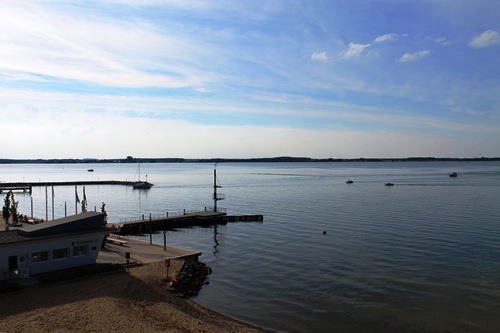
On Saturday morning I walk out of the house and follow the paved path alongside the harbour to where it opens out into the lake. Behind me the resort village is quiet… houses empty or the occupants sleeping. The cleaning crew move amongst the houses on a cart that is so silent it can only be electric, and their voices carry clearly over to where I stand, a conversation full of Friday night gossip and small town exploits. I look out onto the lake – the Müritz – the largest such body of water to be completely contained within the German borders. Lake Constance is bigger, but the Germans must share it with the Swiss and the Austrians, and anyway right now it does not matter whether the Müritz is the biggest, or the second biggest, because there is a mist swirling all around us and visibility is down to about thirty metres. The electric cart moves off and is soon swallowed, but the voices continue to carry across the empty resort plaza to the water’s edge.

Continue reading

Special places: Coniston

Coniston1

By Chris Hughes:

The English Lake District is well known to contain some of the most popular and celebrated landscapes in the UK. There will be as many people who disagree with that statement as do actually agree and no doubt arguments and debates have ranged for many hours over the remains of meals and empty beer glasses as to which landscape is the finest – the Snowdon Horseshoe, The Cuillin Ridge, the Cornish coastline, The Sussex Downs. The choice of the finest landscape is both personal and frequently changes dependent on mood, company and even the weather! But no doubt favourites are places that people will return to time and time again, will enjoy over and over without tiring of seeing and will rejoice in whatever the weather, time of day or company.

Continue reading

A visit to the Karow Ponds, Berlin

karow1

Earlier in the summer Lotte and I headed to the Karow Ponds in the north of Berlin. It resulted in an article that I wrote for Caught by the River, some nice pictures and some great adventures. On the walk to the ponds, Lotte told me: “Quiet Papa, I want to hear the nature…” and so we did, walking in silence towards the ponds set amongst the trees:

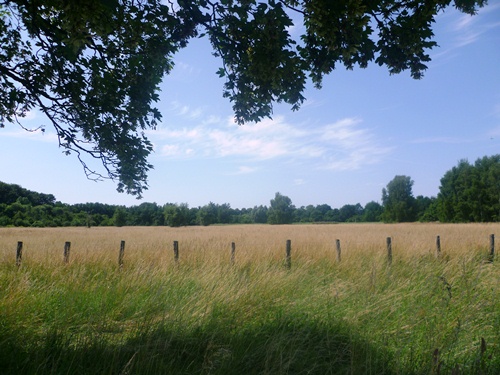
On a sunny Sunday we decide to escape the heat of Berlin by catching the S-Bahn north to the very edge of the city, where the Panke River runs alongside a small patch of marshland and meadows, pasture and ponds. We walk through suburban streets until a path takes us along the river bank and then in towards the Karow Ponds, a peaceful spot popular with strollers, runners and birdwatchers, where we can see bulls lounging in the fields and gaze across the ponds from viewing platforms to see cormorants, grebes, and a grey heron sunning itself on the far bank. Butterflies and dragonflies dart above the reeds, and an otter pulls itself ashore with a shake of its back. Berlin is a city filled with green spaces, but at moments like this I still marvel at the access we have to such places within a handful of minutes of our apartment, and how they managed to escape the rapid growth of the city that swallowed not only fields and forests, but entire villages, during the second half of the nineteenth century.

Read the rest of Caught by the River

Continue reading

Lindisfarne, Northumbria

Lindisfarne1

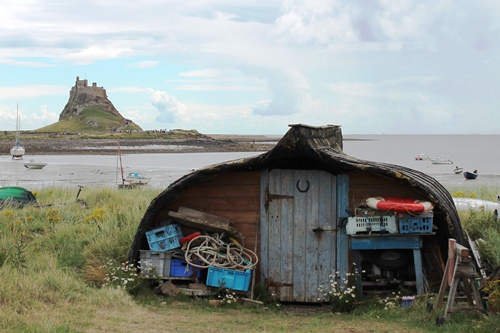
Just outside the Priory museum on Lindisfarne, there is a plaque dedicated to the lifeboat teams of the island and their rescues. The first recorded was in 1867, by the lifeboat Grace Darling – a name we will hear time and again during our trip to Northumbria – and the rescue of four lives from the fishing coble of Holy Island on April 29th. The final rescue, before the lifeboats of Holy Island were withdrawn from service, was in 1954 by the Gertrude, with 11 lives saved. On the day we visited in August it was drizzly but the seas were calm… however, looking out across the North Sea from the lookout tower along the coast south to Bamburgh, and the Farne Island lying low offshore, it was not difficult to imagine the sea violent and transformed, crashing boats against the rocks and then the bravery of those lifeboat teams as they pushed themselves out into the squall.

Continue reading

Ormeau Park, Belfast 1913-2013

???????????????????????????????

The 1913 women’s walk for suffrage in Britain is well-known. Over 50,000 women arrived in Hyde Park London demanding the vote. The abuse they endured extended to imprisonment and the brutal force-feeding of those on hunger-strike in prison. In Ireland’s nine counties that comprised Ulster suffragettes, Unionist and Nationalist together, held mass rallies in Ormeau Park. A century later their struggle and their bravery was commemorated in Ormeau Park. Dr Margaret Ward, the Director of the Women’s Resource and Development Agency in Belfast and renowned women’s suffrage scholar addressed the meeting and led the commemorative walk for women in the park. This is her address:

Sisters and friends,

We are here today to commemorate the fact that 100 years ago women throughout Ireland were marching, protesting and going to jail because they demanded the vote. Women from Ireland, England, Scotland and Wales were part of a mass, international, movement of women. In Ulster there were around 1,000 members in 20 different suffrage organisations.  Proportionally the Suffrage Movement had as many members in Ireland as they had in England.

Continue reading

Heavy weather, Nebraska, and a run to the Polish border

Stolpe1

They declared me unfit to live said into that great void my soul’d be hurled
They wanted to know why I did what I did
Well sir I guess there’s just a meanness in this world

These words took me through the deserted streets of Stolpe, a village on the banks of the Lower Oder Valley in eastern Germany, as I made good on a promise to myself that I was going to wake up early on the first day of our trip and run to Poland. At the edge of the village I crossed the bridge over the canal that led me onto the Stolpe Polder, part of the national park and the flat valley floor protected from the canal and the river by high dykes topped with pathways for hikers, bikers and birdwatchers drawn to this strange landscape.

It was early – around seven – but already the air was hot and heavy, the sky overcast and in the distance, to the east above Poland or perhaps even the Baltic, coloured a deep and disturbing red. I ran along the dyke, aware that apart from a couple of tiny figures working a field a couple of kilometres away, I had the entire polder to myself, sharing this flat and lonely landscape with the storks, the housemartins, the starlings and a startled golden oriole, flashing across the path in a burst of green and yellow.

Continue reading

The Squire of Ribbeck, Havelland, Germany

IMG_2844

By Anja Ahrens:

Almost thirty years ago, when I was still a child, my Grandfather attempted to teach me Theodor Fontane’s poem Herr von Ribbeck auf Ribbeck in his original tongue – Plattdeutsch, a dialect of German from the north of Germany – as I spent my summer holidays with him in the countryside. I did not understand the poem then, and try as I might I was unable to memorise it. That was the summer before my grandfather died.

Years later I remembered his wish for me to know this particular poem, and knowing that he had died soon after, and having finally come to understanding the story, I always felt as if he had been trying to tell me something… that in some way he wanted to leave something behind in a different way than the Herr von Ribbeck:

Continue reading