Category Archives: Places

A view of Rievaulx, North Yorkshire

?????????????????????????????

By Tom Salmon:

“Here hills with vales, here woods with water vie;
Here art with nature strives to feast the eye;
Here Espec’s tow’ring fabric, clad with green
and monkish grandeur, decorates the scene;
Here architects engrave th’ Ionic scroll,
and fam’d Burnice’s pencil crowns the whole.”

– An anonymous contemporary description of Rievaulx Terrace and its Ionic temple.

It felt like spring had finally arrived as we drove through the North York Moors National Park. The low sun, flickering through the bare trees, gave the woods an almost stroboscopic quality. Daffodils lined the lanes and snowdrops nodded in the March breeze. We were heading to Rievaulx Terrace, a landmark created by a wealthy landowner in 1758 to stroll, entertain and impress his friends. Every landscape tells a story, especially when they cost as much as this must have done to create.

Continue reading

Vietnam in Berlin: The Dong Xuan Center

blog1

The district of Lichtenberg in the east of Berlin is certainly an interesting place. It has something of a troubled reputation, mainly due to the social and economic problems that the neighbourhood has had to deal with the in the two decades since the fall of the Berlin Wall. It is also home to a cemetery where the heroes of the socialist revolution, such as Karl Liebknecht and Rosa Luxemburg are honoured each January with the waving of red flags and a pile of red carnations. And it is home to, in an old industrial complex, to an ever growing corner of Vietnam in the German capital.

Continue reading

Two Art Deco gems of the English seaside

1a   1b

Chris Hughes explores two of his favourite Art Deco buildings to be found on the English seaside, and reflects on both their history and their future. It would be great to hear in the comments of any readers’ favourite buildings, wherever they might be, and especially those which have been adapted to new and different purposes…

The De La Warr Pavillion built in 1935 and the Midland Hotel built in 1933 stand on the seafronts of Bexhill-on-Sea and Morecambe, the first in the South-east and the second the North-west of England.

2a   2b

The De La Warr Pavilion is an International Stylebuilding and considered by many to be in an Art Deco style. Some claim it to be the first major Modernist public building in Britain (the other option being Hornsey Town Hall). The building was the result of an architectural competition initiated by Herbrand Sackville, 9th Earl De La Warr, who was a committed socialist and Mayor of Bexhill, and who persuaded Bexhill council to develop the site as a public building

Continue reading

And the river rushes through it… the Strid, Yorkshire

Strid1

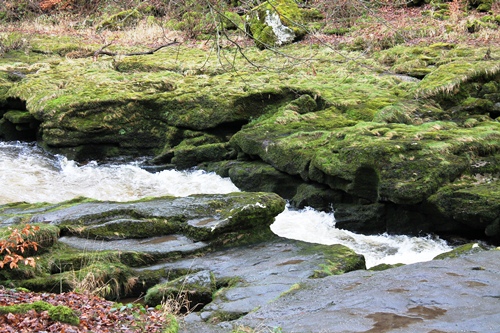
We had entered the grounds of Bolton Abbey just beyond the ruined walls of the old Priory, and parked the car down by the River Wharfe close to the Cavendish tea room. It was one of those mixed days, windy and overcast with the odd spot of rain, but the trees alongside the path above the river gave us good cover as we walked upstream in the direction of the narrows of the river known as the Strid. Our first view of the famous stretch of the came from above, the path a little way up the hillside, and it was hard to make out quite the force of the water as it rushed through. In fact, it even looked a little tame, which is apparently half of the problem.

Continue reading

After the trains have departed: The Schöneberger Südgelände Nature Park, Berlin

Süd1

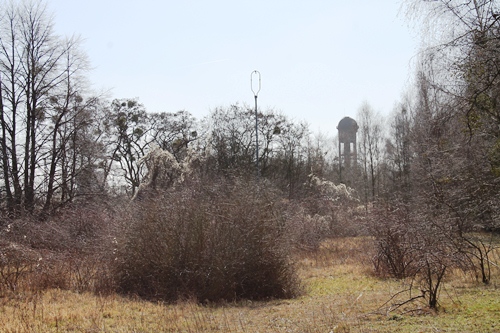
From the S-Bahn platform at Priesterweg we drop down to ground level and follow the signs for the Naturpark. Even before we have left the station building we come across a gate and a friendly chap leaning against a golf cart and wearing a bright red hat. He charges me the one euro admittance fee to the park and hands Lotte a map of the grounds. An hour or so later he will still be there, to wave us on our way with a pleasant “safe journey home…” That’s a nice job, I think, as we walk into the park towards the rusting water tower that stands at its heart as a reminder of what once occupied this strip of land between the S-Bahn tracks and the intercity railway lines.

Continue reading

Down by the canal

Canal1

I spent most of my childhood in a small town called Burscough in West Lancashire, where the Preston-Ormskirk railway crosses the Southport-Wigan line. Once upon a time the lines were linked, but the Burscough Curves were long closed by the time we moved there – having been victims of the railway cuts at the end of the 1960s – leaving us with a couple of “dead railways” that were the perfect, hidden, spot for den-building and, later, the first tentative sips from cans of warm beer.

Continue reading

The subversive urbanism of Venice

Venice1

Subversive Urbanism is a blog by Phil Wood that takes us on an exploration through the urban environment “ready to question the ‘common sense’ or ‘expert’ ideas about the way our cities are and have to be.” According to his bio, Phil has been described as “cultural planner, urban therapist, intercultural innovator, insurgent anthropologist, psychogeographer…” and I have very much enjoyed reading back through his archive of work. Phil has kindly given us permission to re-publish the following piece on Venice – a city that is more subversive than you might think…

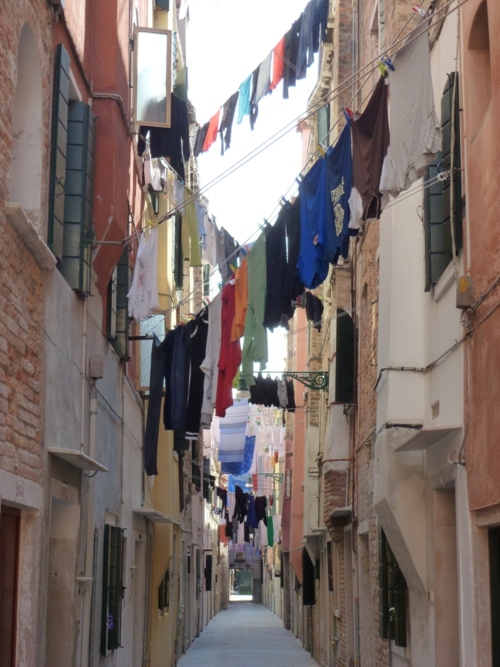
Venice… subversive? When I made a short visit to Venice I wasn’t expecting to be inspired to write anything in this blog about subversive urbanism… but I was wrong.

After all, isn’t Venice the ultimate clichéd example of a city that has lost all point and purpose other than to offer itself up as an open air museum, hawking its illustrious past along with an over-priced cappuchino and a souvenir tea towel?  Well that’s certainly one way of looking at Venice and there’s plenty of evidence for the prosecution, even on an off-season Tuesday in March. There’s something dispiriting about those hordes of visitors trekking dutifully across the Rialto and into Piazza San Marco. Judging from many of their faces it seems hardly more pleasurable than the job, in the office or call centre, they’ve had to endure in order to raise the money to pay for the trip to La Serenissima in the first place. Somehow it’s a reciprocal obligation both they and the city must perform but which no-one really enjoys.

Continue reading

Fragments of Tokyo – Part Two

2_Shrine

Just less than a week in a Japan and it remains a jumble of memories in my head. Here is the second half of my fragmentary tale of a journey to the other side of the world…

On a Sunday morning we take the train to Hibuya and then walk through the wooden gate into the grounds of the Meiji Shrine. This was once parkland where the Emperor Meiji – the man who opened Japan and ushered in a half century of incredible change, including a social, economic and industrial revolution – and his Empress Shōken has been known to visit for periods of rest and reflection. The paths leading through the woodland to the shrine that was built in their honour is flanked with billboards telling some stories of the Emperor and the Empress, as well as their poetry and other reflections. Only a short stroll from busy city streets, and despite there being a lot of people walking the gravel trails with us, it is a peaceful place. The crowds get thicker at the shrine itself, drawn to the site of the wedding party walking through the grounds. At the front the couple are in traditional dress. Behind then men are in smart suits, the women in dresses, and all the bags that dangle from their arms carry the name of famous designers from around the world. The bag that it comes in, it seems, is as important as the gift contained inside.

Continue reading

A Journey to Scotland

Scotland1

By Julia Stone:

Ever since I was a small child my mom has been telling me how great Scotland is, the beauty of the landscapes and the friendly people that she met, and how she really wanted to eat haggis… the delicacy that she missed on her first trip over 35 years ago. So in October we made a trip – her return to Scotland – for our annual mother-daughter journey together.

Continue reading

A walk in the woods: Wendisch-Rietz, Brandenburg

Wendisch1

The history of this village at the bottom end of the Scharmützelsee lake about an hour from Berlin is all there in the name. The Wends were West Slavs, who settled in the land between the Elbe and the Oder rivers over a thousand years ago. Divided into a number of different tribes, they were the majority population of the area that now makes up most of the state of Brandenburg until the arrival of German colonists between the 12th and the 14th centuries. By the 18th Century most of the Wends had been assimilated into the German population, except for the Sorbs, who continue to live as Germany’s only indigenous minority in the Spreewald region, not far from Wendisch-Rietz.

Continue reading