Category Archives: Memory

From the rocks at Kenmore, Scotland

Kenmore1

At the entrance to the village a sign warns us of free-running dogs and wild chickens. Not being a fan of either, I proceed with caution down the muddy track to the collection of cottages around an open green that makes up the tiny settlement of Kenmore on the banks of Loch Fyne. The green space between the cottages was no accident, it was the place to dry the fishing nets in this village that long made its living from the produce pulled from the loch.

We follow the path down the side of the green (no sign of the dogs) until we reach a stone beach and a rocky promentory. The cloud is low, hiding the surrounding hills. The water is flat calm, glassy. A grey heron flies by with long, beating flaps of its wings. Down on the shore oystercatchers pick their way over the stones. At the top of the rocks the shells of their catch lay battered and smashed, a crunchy confetti. A twin-sailed boat makes slow progress down the loch. Not far away a group of divers, heads and bodies encased in black, slip over the side of their motor dinghy.
Continue reading

An old summer camp in winter… Kühlungsborn

Camp1

I took the bus north, from the shabby concrete concourse of the Berlin ZOB. Waiting for the bus reminded me of travels that seem a long time ago now, catching the bus from Zagreb to Sarajevo or along the Croatian coastline, the entire series of Rocky films dubbed into the local language playing above my head as some of the most spectacular landscapes in the world passed by in darkness. As I stood in the cold with my fellow passengers I thought of Cape Town to Durban and the loss of feeling in my legs after thirty-odd hours, and the longest journey of all, from Berlin to Ormskirk via Hannover, Amsterdam and London. I have never been particularly fond of long distance bus travel.

Continue reading

Seventy years since Auschwitz-Birkenau

???????????????????????????????

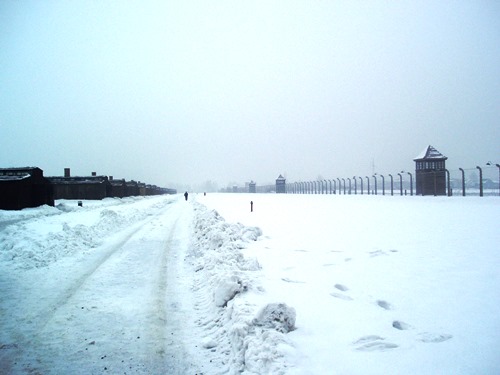
Today is the seventieth anniversary of the liberation of the Auschwitz-Birkenau extermination camp in German-occupied Poland. As events are held across the world to commemorate the anniversary, I dug out an article I wrote based on a visit to Krakow in the early months of 2006. Katrin was pregnant, and we had travelled to the Polish city to scout locations for an international hostel conference she was organising. A few months later, when the conference took place, we had to travel overland as Katrin was no longer allowed to fly, but on the first visit we landed at the airport and were driven into town through socialist-era suburbs that reminded us of Berlin to the beauty of the old city centre:

On a clear winter’s day, with a light mist hanging overhead, weak sunshine bathes the Old Town of Krakow in a gentle, almost dream-like light. It softens the cobbled streets, the towers and spires, the market square – a more beautiful city in Europe is hard to imagine. In the bone-chilling cold people move at a brisk pace. Young women students scurry between university buildings wrapped in heavy scarves and jackets, hats pulled low, their round, pretty faces open to the elements. Only tourists loiter – that’s what tourists do – framing the city through digital lenses. But in January they are few in number. As the city ebbs and flows, people go about their daily business. For them beautiful Krakow is commonplace; while visitors gaze in wonder, local eyes rarely rise above street level.

Continue reading

Water and Concrete: Walking Cologne and the Rhine

Cologne

By Marcel Krueger:

I turn away from the plastic people and plastic boutiques of the Belgian Quarter, and cross the Friesenplatz and its puke pancakes from the night before. On my way to the cathedral and the water I pass through Steinfeldergasse, a small lane where every one of the small colourful low-rise buildings on either side is owned by the Catholic Church or a Catholic association. The church is still a dominating presence in this town.

I arrive at the cathedral shortly afterwards, walking past Komödienstrasse and An den Dominikanern, where a cameraman of the US army filmed a tank battle in March 1945. A German Panther tank destroyed a Sherman, killing three of its crew, and was in return blown up by a Pershing tank destroyer in one of the last tank fights in the destroyed city. The dramatic manoeuvres and firefights amidst the rubble around the cathedral could have been scripted by Hollywood, but the dismembered dead were all too real, futures obliterated by high-explosive shells. Now, on the streets where they died, I could buy an ‘original German cuckoo clock’, or pause to eat a döner kebab.

Continue reading

Travelling by numbers

???????????????????????????????

By George McKinney

Number 200 was rather special, and not just because it was the target-number.  The weather was hot and sticky as we were visiting the Delta de l’Ebre (Ebro Delta for non-Catalans).  Not even the mosquitoes could spoil the view out over the browning rice fields and past the large-tired machines needed to harvest the crop.   Come to think of it, number 190 was rather fine too as I swam on my back in the hotel pool and looked up into the skies above Rodalquilar in Almeria, Southern Spain.   But, of course, number 1 was the reason I started this list as it acted as a trigger for this one-year experiment.

We all remember places we have visited in different ways.  This year many of my memories have numbers associated with them; as you can see.   By now you may have guessed that the bird, a Black Stork which had deviated from its more usual territory and flew over our cortijo in the Sierra Nevada mountains of Southern Spain on the 1st of January, inspired me to keep a list of all the bird species I identified throughout the year.   That is why this year’s travel memories are associated with my progress towards listing 200 different species.

Continue reading

Exploring Olympic Berlin

Bell

We have been to the Olympic Village before, a few kilometres outside of the city limits, built for the athletes and their entourage when they came to compete in the 1936 Olympic Games. It was supposed to be a triumph for Hitler and the National Socialists, who had come to power three years earlier, but it would be remembered for the exploits of a black man from across the ocean. Jesse Owens made the Games his own, with four gold medals, and a recreation of his bedroom stands at the heart of the exhibition – most of which is in the open air.

It is a strange place. Many of the buildings are peeling and crumbling, although some renovation work has been done. There are photographs and information boards to tell you what was once here, although not so many further into the complex, when you stumble across the ruins of some more recent buildings – the remains of the Soviet military base that occupied the site during the GDR years, when this whole area was off limits for anyone without special permission to be here.

Continue reading

No more night trains?

???????????????????????????????

The night train is one of the great travelling experiences, and sadly – according to this article in the Guardian – it is one that is under threat. I have taken many night trains across Europe, from a first experience in an eight person compartment between Prague and Budapest that probably should have put me off the idea for life, to the journey we took a couple of years ago from Paris home to Berlin, introducing Lotte to the excitement of falling asleep as the train moved through the suburbs of one city and waking as a new city in a new country came into view. That service is one of the night trains that will no longer be running by the end of the year, and it is not only a great shame, but one that feels shortsighted in an era when we should be looking at ways of reducing the environmental impact of our travels.

Continue reading

Scenes from South Stack, 1833 and 2014

SouthStack1

“Amongst the auxiliaries which art has contributed to give interest to Holyhead, the most picturesque and not the least important is the lighthouse, erected upon the South Stack. This singular Pharos stands upon a rocky island, the surface of which is elevated one hundred and twenty feet above the sea. It is separated from the mainland by a deep chasm, across which a chain suspension foot-bridge is thrown, from the mural cliff on the land side to the island. The descent from the top of the cliff to the bridge is effected by many flights of steps, cut in the front of the rock. The transit of the bridge is rather a nervous ceremony, and the fine craggs of serpentine rock, which overhand the gulf, are unequalled in the mineral kingdom, for variety of pattern and brilliancy of colouring …

Continue reading

A love letter to my favourite place in the world…

Rhos1

We arrived in Rhoscolyn at around midnight, the headlights of our hire car jumping with each rut of the gravel track as we made our way to Cerrig-yr-Adar. Otherwise we were surrounded by darkness. At the bottom of Holy Island, in the north western corner of Wales there are very few streetlights, and though the stars can give you some spectacular illumination, on this occasion they were hidden behind the clouds. But of course it did not matter that we could not see the view in front of us as we crested the small hill just before we finally got there, for we know it so well, as regular readers of Under a Grey Sky will know. This is a place that I spent most of the summers of my childhood, a place that is close to the hearts of so many of my friends and family that if they were all to descend on Outdoor Alternative at the same time we would fill all the beds and probably most of the campsite for good measure. So it did not matter that we could not see across the bay to the beacon, or to the coastguard lookout on top of the hill, or across to the bay windows of the White Eagle pub, as we knew it was all there, in place, waiting for us as it ever does.

Continue reading

If you know your history… Prora, the Colossus of Rügen

Prora1

I first visited Prora, just up the coast from the seaside town of Binz, back in 2006. As we pulled into the car park on that November day, surrounded by tall pine trees, it did not seem up to much. There was a ramshackle building topped with a sign advertising “Rügen’s Largest Nightclub”, a building beyond the trees that was under renovation – it would open a year later as a youth hostel – and otherwise not much else beyond an eerie sense of abandonment.

The building clad in scaffolding was just part of an enormous complex that had been conceived of by the Nazis in the 1930s as the first of five massive resorts that would be run under the organization Kraft durch Freude (Strength through Joy). Prora was to house 20,000 holidaymakers at a time, sleeping in one of eight buildings each half a kilometre long that were to be laid out along the Prora Wiek, arguably Germany’s finest beach.

Continue reading