Category Archives: Memory

Just like going home – Rhoscolyn, Wales

Rhoscolyn1

Long time readers of Under a Grey Sky will have seen pieces about Rhoscolyn before, and here comes another one, but I make no apology. As someone who left the UK at the age of 22 and has lived in Berlin for almost 15 years, and whose parents no longer live in the town that I grew up in, the idea of “home” has always been an interesting one to me. And if there is one constant in my conscious memory, the one place that has changed through the years but – really, when it comes to my emotions about the place – always stayed the same, then that is Rhoscolyn, and specifically Outdoor Alternative, home to my Uncle and Aunty, cousins and whatever it is kids of cousins are to me or to Lotte (we have this discussion on every visit).

Over Easter we returned again, to that field with the views across from Holy Island to Anglesey and beyond, to Snowdonia. When the weather is good it feels as if you can make out the climbers reaching the top of those peaks. When the weather closes in you can feel as if this collection of buildings along a dusty track is the very end of the world. This time, on arrival, we did as we always do and walked the headland around to the beach, following at the same time the waymarked trail of the Anglesey Coastal Path but also the personal topography of memory and my fellow members of the Red Devils, who explored every patch of heather and gorse, sandy cove and rocky inlet, and gave them names and stories and drew maps that made the place truly ours… and now, as we walked that headland again, I could still picture those maps in my head as I told some of those stories to Lotte.
Continue reading

27 Years

Memorial

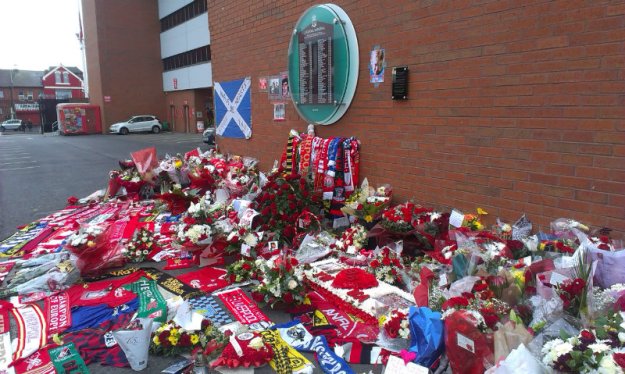
On the 15th April 1989 I was nine, and I can remember playing a game with my younger brother Sean. We were in the bedroom of our house in Burscough, messing around on the bunk beds. At some point we wandered downstairs, to get a drink or a ‘Toronto Snack’ – a fruit salad like the ones I used to get at nursery in Canada when Dad was teaching there for a year and Sean was just a baby. In my memory we came into the living room to find him watching the television.

“Something’s happened at the match,” is what I remember him saying. I remember the green of the pitch and the blue of the sky and the people milling around on the grass. People running as they carried others on makeshift stretchers. A line of police. As the afternoon progressed we learned of the deaths. 10, 20, 30… until it got to 95. Mum and Dad never hid the truth of the world from us, and so we knew what had happened but of course, at nine years old, I don’t know if I could really comprehend it. That night and over the next days Dad met many of the survivors as they returned from Sheffield. He knew, we knew, the truth from the beginning, whatever that newspaper wrote. A week after the disaster we went with Mum and Dad to Anfield, to pay our respects and to leave scarves on the pitch in front of the Kop. At 3.06pm we were in Stanley Park and held the line of scarves that linked Liverpool and Everton. It was the start of a bond between the two clubs, between the two sets of fans – between the people of Liverpool – that remains to this day.

# Continue reading

City of Memory, Prague

Memory1

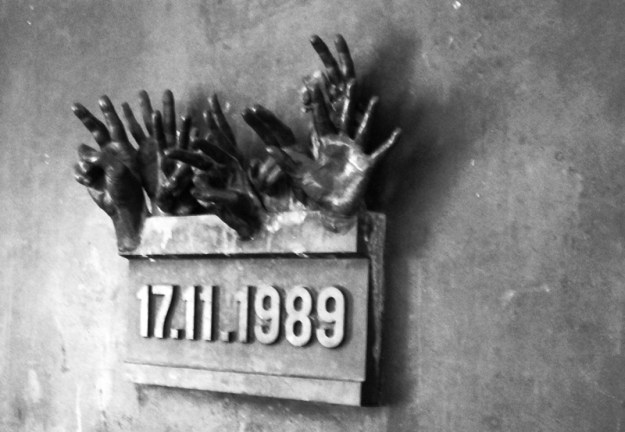
On the 17 November 1989 a group of students set out on a candlelit procession through the streets of Prague, following the funeral route of Jan Opletal, a medical student killed by the Nazis in 1939. Fifty years later, with central and eastern Europe revolting against Communist rule, the students of 1989 were in no mood to follow the agreed route. Instead they made their way along the river bank to the National Theatre and turned right onto Národní třída, heading for Wenceslas Square. Met by riot police they held out flowers, put their candles on the road in front of them, and held out their bare hands to show their non-violent intentions. The response was brutal, and truncheon blows rained down on the students and the other men, women and children that had joined the peaceful demonstration. It was, in the words of Timothy Garton Ash, “the spark that set Czechoslovakia alight”.

The memorial to mark this momentous first step in the Velvet Revolution that would end Communist rule in just a couple of weeks, is pretty difficult to find. It is on Národní třída, hidden in a small passageway at the point on the street where the students met the riot police. It is close to the Cafe Louvre, where Kafka and Einstein once hung out, and the Reduta Jazz Club where President Havel took President Clinton during a visit that seemed to take in more basement watering holes that palace reception rooms. The simple memorial shows a set of hands. “We have bare hands,” the students told the police, and regardless of the violent response, the protests would remain peaceful. That, and the speed of change, is one of the remarkable achievements of the events of November and December 1989. Continue reading

Above the invisible city – Black Mountain, Belfast

BM1

The day after Christmas we drove through the streets of West Belfast until they began to rise to meet the lower slopes of Black Mountain. Not that we could see it. As we reached the last house on the left, where Feargal lives, the fog not only blocked our view of anything above us but also the city we had left behind. So the visibility was poor and the ground was surely to be sodden, after the rain of the previous couple of nights, but we gathered together with Feargal and his friends the mood was good.

Just past the house a river runs beneath the road and there is a sign dedicated to Feargal’s dad Terry, whose poetry has appeared on these pages and who did more than anyone to get access to the Belfast Hills. The story is on Under a Grey Sky here, and sadly Terry died not long after. I never got to meet him, but my dad and Deena did and by all accounts he was a remarkable man. So we were walking in his memory, and that of Feargal’s brother – also called Terry – who was killed in 1998 and who had also loved these hills and the outdoors in general.

Continue reading

A year to elsewhere and back

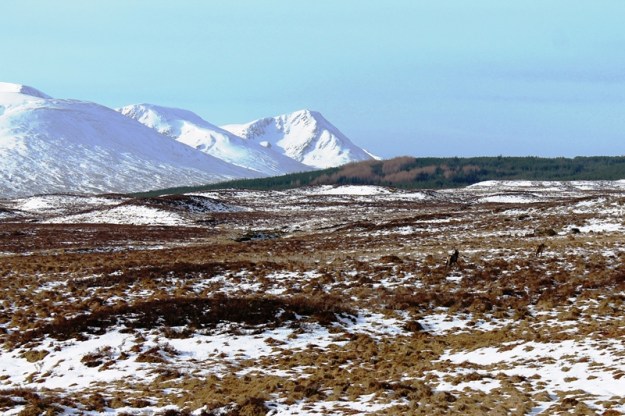
Rannoch

It was in these quiet days between Christmas and New Year in 2011 that I started Under a Grey Sky, so as well as a look back on what has been going on over the past twelve months it is also something of a birthday. Although I haven’t been able to keep up the intensity of posting here over the last year or so, I remain very proud of the writing that I have published here in 2015 and remain incredibly pleased that so many people continue to read about my (and our) adventures beyond the front door.

At this point a year ago I had a couple of plans for the 2015. I had just finished work at The Circus after five years looking after their company communications and a decision to return to the world of freelance work. The first major plan was the launch of Elsewhere: A Journal of Place with my friend Julia. We published Elsewhere No.01 in June, followed by Elsewhere No.02 in September. Along the way we built a small team here in Berlin who helped us get the journal out there and put on a couple of events, as well as working with some excellent writers, photographers, musicians and illustrators from around the world. I am incredibly proud of Elsewhere and can’t wait to show everyone No’s 3 and 4 which will be published in 2016.
Continue reading

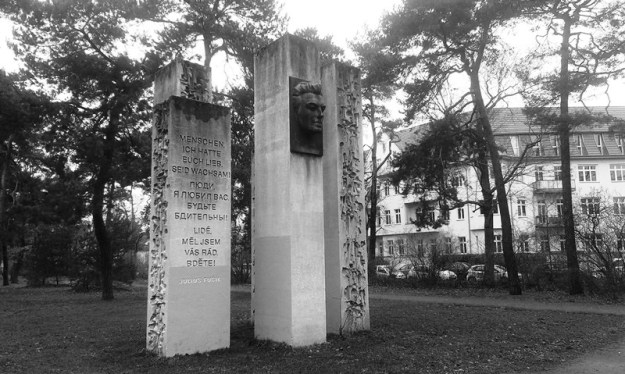
Meeting Julius Fučík in Pankow, Berlin

JuliusFucik

The park is deserted. I have walked here from home, a couple of kilometres along the Panke river from our apartment, past the garden colonies and old factories, past the football pitch and where the Berlin Wall once stood. It is a walk I have made many times, a corner of Berlin I have written about many times. More often than not we go this way in the summer, aiming for green open spaces of the park or the beer garden at its heart. We have celebrated birthdays here. Met friends. But on a weekday in December we have the park to ourselves.

The playground is empty, the swings gently rocking in the breeze as the sound of a plane coming in to land at Tegel fills the scene. The path by the river is muddy, churned by the bicycles of the school run or the journey to work. I look for the grey heron but he is not around today, just a handful of ducks on the embankment, heads buried in their own feathers. The bandstand is deserted. The beer garden too. A solitary runner enters at the far end, a flash of reflective orange from her jacket, but then she is lost to the path through the trees. Continue reading

Chasing memories and the sound of church bells, Berlin

IMAG0842

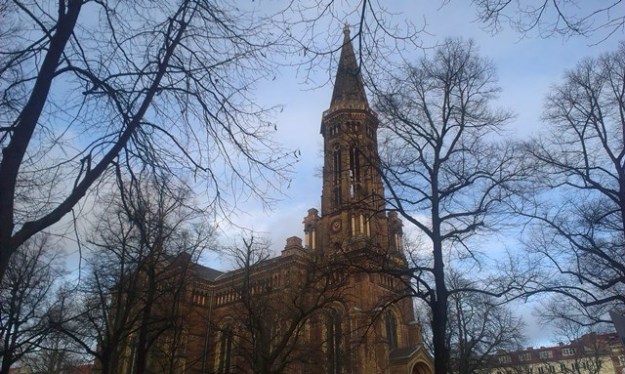
Last Saturday as part of our Printed Matters indie publishing day in Berlin that we hosted through Elsewhere, I led a neighbourhood walk in the area around the venue. The walk took us to two squares – Arkonaplatz and Zionskirchplatz – my home neighbourhood for about a decade before we moved a few kilometres north about five years ago. So as I was telling stories of industrialisation and the divided city, I was also walking through some very personal memories. A few days later I decided to go back on my own and chase some of them down.

Arkonaplatz. One of the first pieces I ever had published was a short piece in the Guardian Weekly. I wrote about the Sunday flea market at the end of the road and the bargain hunters chasing GDR-kitsch. I wondered whether we had a potential goldmine in our basement on Wolliner Straße, just around the corner, or whether Katrin’s family had such treasures in theirs. I wrote that piece in the summer of 2006, not long after we had moved to Wolliner Straße and just after Lotte was born. Now she is approaching her tenth birthday, we have been gone from the apartment on Wolliner Straße longer than we ever lived there. We have lost some of our family too. I write this at Katrin’s grandmother’s desk. Wine glasses and bowls stand in the cabinet. Too many memories from when we knew each other, and for Katrin, even longer. Too precious for any flea market.

On the square I stop and watch a couple of guys play table tennis on the concrete tables, despite the single-digit temperatures and the cold late-November wind racing through the cobbled streets. These streets were built as part of Berlin’s great expansion in the second half of the 19th century, when the city was transformed from garrison town to Weltstadt. Northern Mitte, Prenzlauer Berg and Wedding were industrial neighbourhoods, working class and poor. Heinrich Zille, the cartoonist famous for his illustrations of working class life in Berlin, once painted the Christmas Market at Arkonaplatz, the twinkling lights losing the battle against the grime and the smog. Now Arkonaplatz has some of the highest real estate prices in the city. Continue reading

Among the trees and above the ruins, Beelitz

Beelitz1

The Beelitz Heilstätten stands in the forest some 35 minutes by train south of Berlin’s Zoologischer Garten station. This hospital and sanatorium complex opened in 1898 as one of the biggest tuberculosis clinics anywhere in the world, and by the outbreak of WW1 had developed to include its own power station, water tower, laundry and restaurant, farm and post office. Between the wars it developed even further to occupy over 200 hectares of the forest, and following its use as a military hospital during WW2 it was occupied by Soviet forces until their final withdrawal in 1994.

The Beelitz that we explored earlier this week under soft October sunshine is the crumbling ruins of an almighty complex abandoned with the Soviet retreat and pretty much left to nature and the attentions of (sub-)urban explorers and graffiti artists. The buildings are landmark protected, but the scale of the complex makes it hard to imagine what kind of project could bring life back to these structures in the woods. And so they are left, trees and plants growing on balconies and roof-tops, the buildings slowly being swallowed by the forest as people walk amongst them, for it seems that ruins – and not just of the antique variety – hold an endless fascination for many. Continue reading

The Lost Neighbours of Rathenow, Brandenburg


Rathenow1

At the harbour in Rathenow on a sunny, summer’s day, the atmosphere is fine. People take pictures of the “lock spitters”, a memorial to the piece workers who used to kill time whilst waiting for the barges to pick them up by holding spitting competitions against the canal. Others queue at the specially-erected wooden info stands for their maps and tickets for the BUGA, Germany’s premier flower show being hosted in 2015 by Rathenow and other communities in the west of Brandenburg. The BUGA has brought many people to the town, and it seems well-scrubbed in anticipation of their visit. The streets are clean and the bicycles lanes smooth, the balconies of the GDR-era Plattenbau filled with flowers, and every shop and cafe seems to be welcoming the flower-peepers to their corner of Westhavelland, proud of their town.

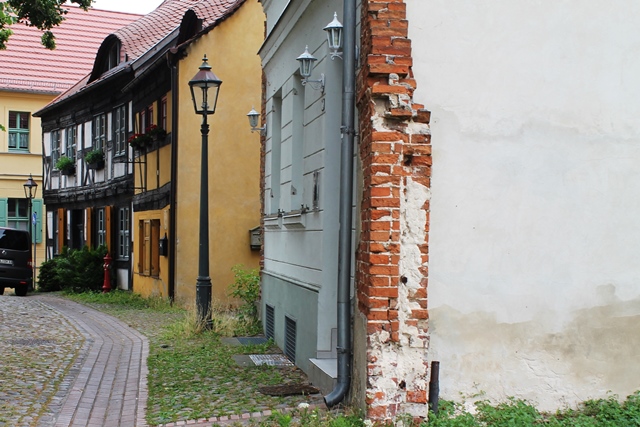
But as we cross the bridge from the harbour and into the old town – a collection of cobbled streets around the church – I get the sense of something missing… the old town itself. For in Rathenow, the Altstadt only contains a handful of pre-war buildings. The red brick church (itself needing massive renovation over recent decades) and some half-timbered houses, but otherwise most of the the old town seems to have been built either during the years when Rathenow was part of the German Democratic Republic, or even since. It is not that it is bad, or it is ugly, but just you cannot help but get a sense of loss as you walk the streets… and you want to find out more.

Continue reading

The Possibility of an Island

Island

The Possibility of an Island is a better title than it is a book. Indeed, although I have read it I cannot for the life of me recall a single scene from Michel Houellebecq’s book, but the title has stayed with me. To me islands always seemed to be filled with possibility; they are an endless source of fascination. Perhaps it is because they are contained, a world in and of itself, that can be explored and mapped. There is an end to an island. A natural border.

A few weeks ago I read about a short journey I have always wanted to take. The writer Richard Carter had climbed into a canoe on Coniston in the Lake District and, slowly but surely, made his way across the lake to Wild Cat Island. No matter that the island’s real name is Peel Island, for any readers of Arthur Ransome’s wonderful Swallows and Amazons will know what it is really called, and thirty five years after reading the book for the first time (about six or seven years before I did), Richard discovered the magic was based on reality:

We drift past a low, rocky promontory and some rocks. This is so right: it’s just like in the book! We’re almost past it before I see it: back to our right—I mean starboard—a steep-sided, narrow channel leads straight into the heart of the island. A few feet to either side of here, and the channel would be invisible, obscured by rocks and headland. This is the place! We’ve found the secret harbour! Continue reading