Category Archives: Memory

Under Trees – The Germans and the Forest

I wrote about the connection between the forest and the German imagination in my post on the Grunewald not that long ago, and for those of you in Berlin – or if you will coming here before the end of March – the German Historical Museum has a special exhibition on that very topic. From the website:

In Germany the forest is more than just the sum of the trees. When trees are threatened, Germans go on the warpath. For in our country the forest is not only a cultural landscape formed through forestry and the result of modern recreational activities ranging from GPS-guided hikes to treetop trails. At the same time, the woods and trees possess great symbolic, spiritual and fairytale-like charismatic powers and have always been celebrated in German poetry, art and music. In this way the forest is deeply rooted in the German consciousness – not only when we are meandering under trees.

The exhibition will visualize this special relationship of the Germans to the forest, focusing first on the Romantic Age around 1800, when the forest and the trees first became a matter of scientifically based forest management and at the same time enriched literature, music and the graphic arts as subject and theme. It was above all painting – the core of the exhibition – that shaped patterns of perception that have marked our view of the forest up to the present day.

Under Trees: The Germans and the forest is running until 4th March 2012. Here’s the link.
Memories of Quilmes, Argentina

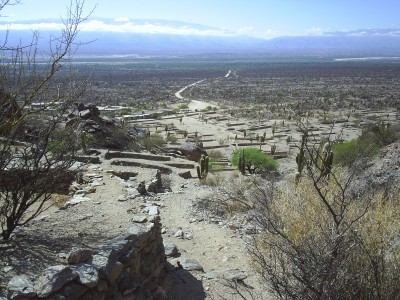
Tom Salmon on a journey through Argentina to the ruins of a fortress city and the history of the Diaguitan people that once called it home:

It’s amazing, and pretty primeval, how your senses can take you back to a place. I got home last night to find frost already settling on the ground, it was a clear and crisp January night in Yorkshire. After putting the kids to bed it was time to eat. Steak, thin chips, salad and malbec wine had been planned in homage to Argentina.

But it was the Quilmes beer that we drank after the meal that really brought the memories flooding back from our six week trip around Argentina in 2006. My highlight from that adventure was the region around the colonial Andean city of Salta, spending the days exploring high altitude deserts and the nights eating tamales, humitas and locro in piazzas around the city. Salta, founded in 1582, was once the most important administrative centre in Argentina and the region was extremely wealthy in the time before Buenos Aires became the capital. Continue reading

Ghost towns of California, Keeler and Darwin


A photo diary from Julia Stone:

A handful of people still live in the old mining towns just beyond Death Valley, although in Keeler we only saw crazy cars – apparently still in use – as there were no people around. This was not surprising, due to the time of day and the temperatures, but in Darwin we met Jay. Jay either moved in a few years before or moved into the trailer that is now his home after his house burned down a few years back. It was hard to follow his story. Jay talked a lot… Continue reading

The last big freeze, Lake Constance

Three countries share Lake Constance, the communities of Switzerland, Germany and Austria facing each other across the water. Nowadays you can cross the border without formality – don’t tell anyone, but I spent an afternoon in Austrian Bregenz without a single piece of identification having left it behind in Germany – and there are plenty of boats that criss-cross the lake. The owner of our apartment lived in one country, worked in another, and no doubt went on Sunday bike rides in the third. There is another way to make these international journeys, although on average the opportunity strikes only a couple of times a century, if that, and that is when Lake Constance freezes over. Continue reading

Facing the past: From the Wannsee shore to Indian Island

(Photo: Indian Island Tolowot California / Wikimedia Commons / Ellin Beltz)

Tony Platt travels from Berlin back home to California, comparing the ways in which societies deal with past, and the hidden history of the ‘outdoor paradise’ of Humboldt County:

In October I spent a few days in Berlin, not for oompah and pretzels, but to check out memorial culture. I don’t know of another country that assiduously remembers the worst of its history as Germany does. Fortunately, the nation that carries the weight of Nazism did not take Ronald Reagan’s advice when he visited Bitburg cemetery in 1985 – “I don’t think we ought to focus on the past.” That could be the mantra, though, for his home state. Back in northwest California, I’m struck by how scrupulously the region forgets its sorrowful history.

Throughout Germany there are close to two hundred “authentic sites of remembrance” of Hitler’s regime, as well as a lexicon of terms to describe the extraordinary variety of commemoration: memorials of apology, memorials of honor, active museums, memorial cemeteries, memorial plaques, thinking sites, learning places, documentation centers, and so on. In Berlin alone, you can spend a week going from site to site, as I did, and still not see everything. Back home in Humboldt County, a couple of hours once a year is all you need. Continue reading