Category Archives: Diary

Postcards from the Edge, Part Three: Parkfriedhof Marzahn

unknown-soldier_webbw

Over the next few months I will be walking around the outskirts of Berlin, starting each walk where I finished the last, until I complete a loop of the edge of the city. These walks will be written up for a new book project, and here on Under a Grey Sky I will publish some postcards from along the way…

Across the street from the Eastgate shopping centre, on the other side of the S-Bahn tracks, is a cemetery. This has been a place of burial for decades; a pauper’s graveyard long before the S-Bahn came, the high-rise apartment blocks and the shopping mall. The memories contained in these spaces between the trees, tell the stories of this corner of the Berlin outskirts. Of villagers from when this was the countryside beyond the city limits. Of more recent residents of the huge housing estates built during the GDR. Of the victims of war and the Nazi regime.

Just north of cemetery is the spot where the Nazis interned hundreds of Sinti and Roma, brought here during the 1936 Olympics. From Marzahn they would be later shipped east, to the concentration camps and the extermination camps. A memorial stands in the cemetery and another outside the gates, telling their story. There are other memorials too, to the forced labourers of nearby factories and to Red Army soldiers who died during the battle for Berlin. To the victims of fascism and the victims of Stalinism. And on the grass, between the trees, row after row of small headstones. I kneel down to brush the snow from the stone closest to the path.

UNERKANNTER
SOLDAT
1945
1939-45

It is the resting place of an unknown soldier. Of tens of unknown soldiers. All that can be remembered is the year they died and the conflict that killed them. But in their numbers, these comrades have a power that is perhaps even heightened by their anonymity. It makes me think of the words of the old East German anthem, written on the walls of another graveyard, a few hundred kilometres north of here:

Dass nie eine Mutter mehr / Ihren Sohn beweint

That never again, a mother mourns her son. That is the message the unknown soldiers have for me, on this cold and bitter February morning.
Postcards from the Edge, Part One: Tegeler Fließ

blogonebw

Over the next few months I will be walking around the outskirts of Berlin, starting each walk where I finished the last, until I complete a loop of the edge of the city. These walks will be written up for a new book project, and here on Under a Grey Sky I will publish some postcards from along the way…

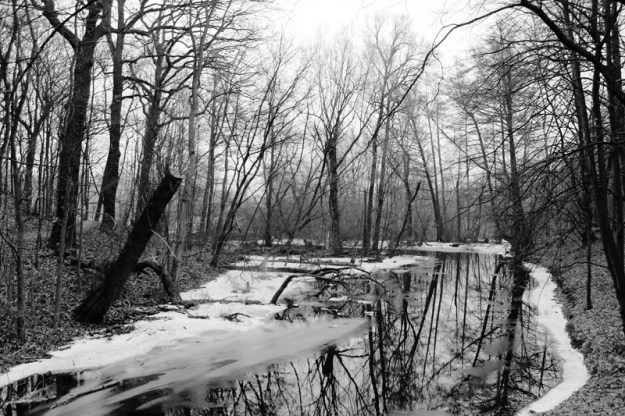
At the Heimatmuseum they tell me that the first human settlements in Berlin were here, eleven thousand years ago. Reindeer hunters who caught the migrating animals as they crossed the river on their back and forth journeys each year, before the planet warmed and they headed north, to the Arctic, for good. I stand on the path and look out across the reed beds, the alder marshes and the stream itself, winding this way and that. On this side of the path it is easier to imagine the reindeer hunters. On the other, a row of suburban gardens and their collection of trampolines, compost bins and patio furniture. Looking this way, the leap of imagination is further.

This contrast between the two sides of the footpath continues as I walk on, following the waymarked Barnimer Dörferweg across the northern edge of Berlin. Gaps in high fences offer a glimpse at neat lawns and greenhouses in one direction. Signs warning me to keep to the path because these wet meadows are the nesting ground for rare birds in the other. So I stick to the prescribed route, here at least, and the sound of my feet crunching on the grit and the ice, and the rat-a-tat-tat of a woodpecker hitting a tree. At least, I think it is a woodpecker. It might also be the sound of an early riser, lifting the shutters of their bedroom window, to let in the half-light of this January morning on the outskirts.

Words & Picture: Paul Scraton

Zabriskie and a year in five books

advent6

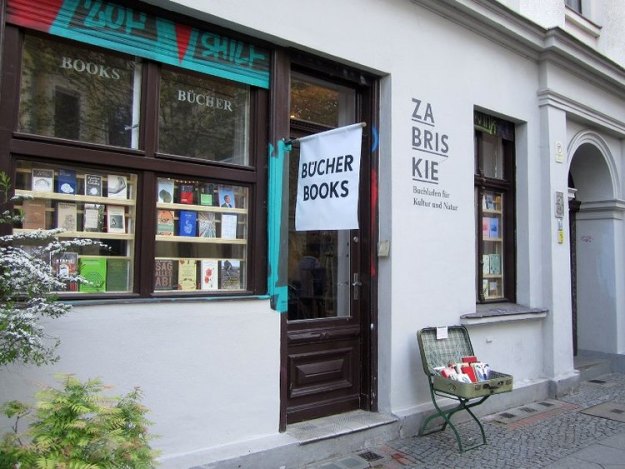
One of my favourite discoveries of 2016 was Zabriskie, a bookshop focused on ‘culture and nature’ writing and a place where I am always certain to find something new and tempting and I know I am about to emerge back onto the streets of Kreuzberg a few euros poorer but as always with books, infinitely richer. They have been strong supporters of Elsewhere – we wrote about Zabriskie on our blog – and in November they hosted an evening of stories from the journal, and I read alongside my colleagues Saskia Vogel and Nicky Gardner.

This week Zabriskie sent out their newsletter, featuring the book selections of a number of writers who appeared at events in the bookshop over the past twelve months. I was delighted to be included, and also thought it would be nice to share my choices here. The books did not need to be published in 2016 but read in that year… an approach that more ‘best of…’ lists would be well-advised to take. When combined with the rest of the choices on the newsletter, I think there is at least a year’s worth of inspiration for further reading, so go check it out hereContinue reading

Fleet: A London Walk

fleet1

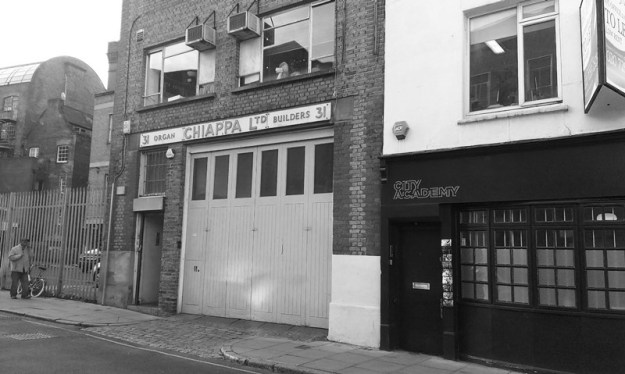
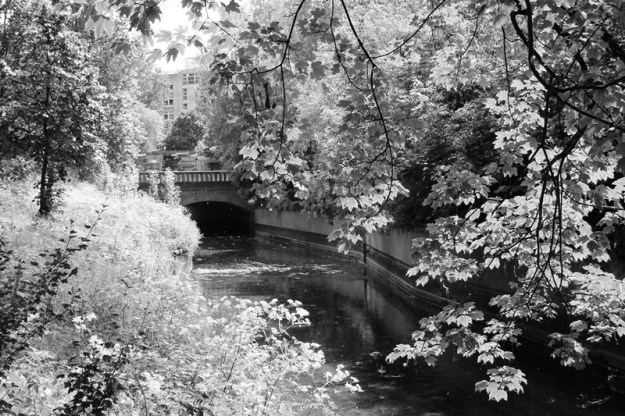
How do you plan a walk through a city? I am in London, ready to walk, and already lost in the sense of possibilities that the city has to offer. I could follow the Thames, this way or that. I could choose a neighbourhood and try and walk every street. I could follow a famous road, or the quickest route between two well-known landmarks. Or I could follow a river, a lost river, buried beneath the city streets.

Standing at Blackfriars Bridge, looking back across the river to the south bank from where I came, across to the Shard and the other buildings that remind me I have never spent enough time in these city to be able to account for and date the changes, it is the last of these ideas that I am putting into action. Inspired by Tom Bolton and his London’s Lost Rivers I am going to follow the route of the Fleet, the best I can, from Blackfriars to King’s Cross and to see what I see along the way.

Continue reading

On Heinrich-Heine-Straße, Berlin

hhstrasse

I am early, so I take some time on the corner with the man who is always there, looking out across the junction towards the kebab shop and the U-Bahn station; to where the crowds gather waiting to gain entrance to the club; to the Plattenbau walls and their balconies; beneath the wintergarten windows still shining with the lights of a Christmas already past. The cars move along the street that bears the name of the man for whom this memorial – surrounded by trees atop a small plaza of crooked flagstones – was built. Beneath the ground the U-Bahn trains stop at the station of the same name, a station that was closed for 28 years when the wall divided the city and divided the street a few hundred metres to the south, complete with barriers, checkpoints and border controls.

Heinrich-Heine-Straße is one of those corners of Berlin I had never had any real reason to spend time in, although my daughter’s friend lives down the street so I have emerged onto this corner a few times recently, and usually too early. When I do, I spend some time at the memorial, following the man’s gaze as he looks out across the street and the traffic. Heinrich Heine lived in the first half of the 19th century, a writer of narrative poems, plays, essays and travelogues; a man who wrote the words “where they burn books, they will ultimately burn people too” in 1821. In 1933, 102 years later, Heine’s books were among those burned on the Bebelplatz by the Nazis in Berlin, and those sadly prophetic words are now engraved at the spot.

Continue reading

Five years under grey skies

5years

It was on the 29th December 2011 that I launched this blog by looking back over the previous twelve months, which included trips to Spain and Anglesey, the Baltic coast and walks in and around Berlin. I am not really sure now, five years on and once more immersed in the not-unpleasant limbo of the Christmas-New Year period, what I was hoping to do with this website. Early on I searched for and encouraged others to contribute to the site, launching (and the quietly abandoning) ideas for different series of posts, before it settled down to being what it is now.

So what is it? It is a place where I can write about the things that interest me; the places I have visited, the ideas and reflections that are inspired by “adventures beyond the front door” – the original tagline for the site. It turned from a collaborative project to a personal one, for my words but also for the photography of my partner Katrin. We realised over the five years that Under a Grey Sky was becoming an inspiration to us as a family, to get us out that front door and down the river bank, up the hill or to a new neighbourhood of the city. “It’ll make a good blog,” became the rallying cry; reason enough to visit someplace new or head back for another look at a familiar haunt.

Continue reading

The walk to the top and the possibilities of the mountain: Slemenova špica, Slovenia

summit1

We drove up the Vršič pass, that high mountain road built by Russian POWs during the First World War that crosses the Julian Alps and links the Soča and Sava river valleys of Slovenia. The road consists of a series of seemingly endless hairpin bends, back and forth, passing the Russian Chapel built in memory of those POWs killed by an avalanche during the construction of the road. Up we drove, this time beneath blue skies, the walls of the high peaks rising up above the autumnal colours of the trees that lined the road. I had that flutter in the belly, the sense of excitement that comes with arriving in a mountainous landscape. The anticipation of the walk ahead. Imagining the views from the top and how it would feel. The possibilities of what was to come.

“The remoteness of the mountain world – its harshness and its beauties – can provide us with a valuable perspective down on to the most familiar and best charted regions of our lives.”
– Robert Macfarlane, Mountains of the Mind

Continue reading

The forest compound and the lake, Wandlitz

wandlitz1

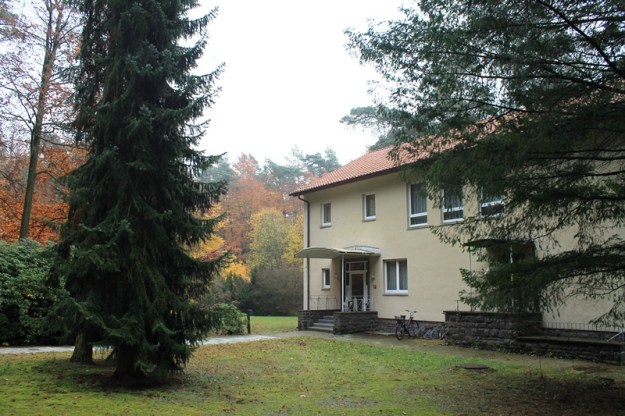
During the first years of the German Democratic Republic, the leading members of the Socialist Unity Party took homes in Pankow, in a crescent of villas close to the Panke river and the palace at Niederschönhausen. After 1953, when Soviet tanks rolled onto the streets of East Berlin to quell an uprising of the workers, and the 1956 Hungarian Revolution, which ended in much the same way, those head honchos, including Walter Ulbricht, Erich Mielke and Erich Honecker, decided things were not secure enough even in the leafy Berlin suburbs. Five years after Brecht had written his Buckow Elegies as a response to the events of 1953, the leadership – unable to dissolve the people / And elect another – moved north, to a fortified compound in the woods, just outside the town of Wandlitz.

They remained there until the Berlin Wall came down in 1989 and the eleven-month transition that followed, resulting in German reunification on the 3rd October 1990. Not long after the Wall came down, at the end of November 1989, the first journalists were admitted into what had become known as Volvograd, after the Swedish cars the Politbüro members drove along their special motorway between Wandlitz and East Berlin. Although the myth and rumour of the GDR had created an impression of the leaders of the GDR living in unimaginable luxury in the Waldsiedlung (‘Forest Settlement’), the reality of life in the compound was, like so much in the GDR, a little more banal. Continue reading

Waiting for the fog to lift: Bled, Slovenia

bled1

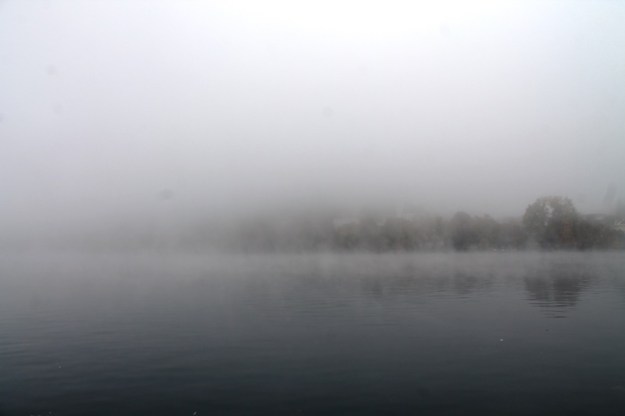
Down by the lake there was nothing to see. The fog had descended overnight, filling the valley and hanging above the surface of the water. On the path along the shore runners and dog-walkers appeared as ghostly visions. Somewhere, out there, was the island of a million postcards, the castle on the rocky outcrop and the high peaks of the Julian Alps. Somewhere. But not for us, not yet.

We started to walk, following the shoreline path clockwise around the lake. The road was busy with tour buses travelling the short distance from the town to the place where the wooden boats are punted across to the island and its picturesque church. Above we could see the sun forcing its way through the fog. Visibility on ground level was barely fifty metres, and yet above there was already the first hints of blue sky.

Continue reading

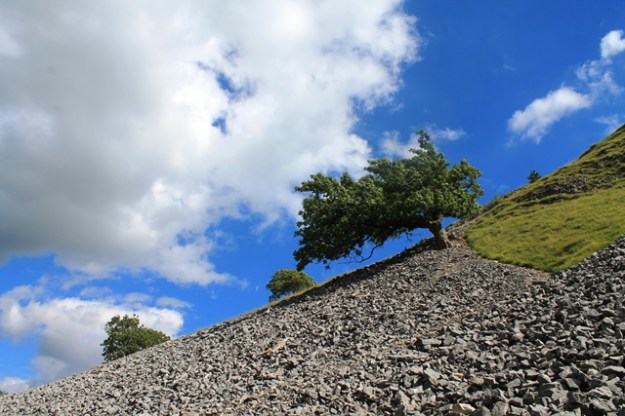
Up Conistone Dib, Yorkshire Dales

conistone1

We stopped at the village crossroads, a walker’s picnic on the bench of sandwiches and misshapen chocolate bars, while a pair of cyclists leaned their bikes against the stone wall and debated on which road they would do battle with speeding drivers next. A car stopped, its driver leaning out of the window to ask directions to a pub somewhere hereabouts. None of us could help, but a local woman in wellies could, sending him back the way he came. Summertime, lunchtime, in Conistone.

We had followed the river from Grassington, from the car park above Linton Falls and then upstream before taking a back road popular with speeding cyclists until we reached the village. After lunch our aim was upwards, following the path around the side of some cottages where family played cricket in the garden, right through the middle of their game. Around the back of the last house the limestone rocks from which this part of the world is built started to close around us. This gorge, formed most probably as a glacial drainage channel, was the aim of the walk.

Continue reading