Due to Germany’s role in World War II and the crimes of the Nazi regime, the expulsion of millions of Germans from territories in the east of Europe received little sympathy at the time, and little recognition later. But the Germans of East Prussia – territory that would become part of the Soviet Union and Poland in the re-ordered post-war Europe – left behind lands in which the German culture had flourished for centuries, a land of forest, lakes and legends of the Teutonic Knights, birthplace of Immanuel Kant and Käthe Kollwitz, and a place that of course still exists and yet has been changed so dramatically over the past half a century that it can truly be described as the “Forgotten Land” of the title of Max Egremont’s book.
Category Archives: Books
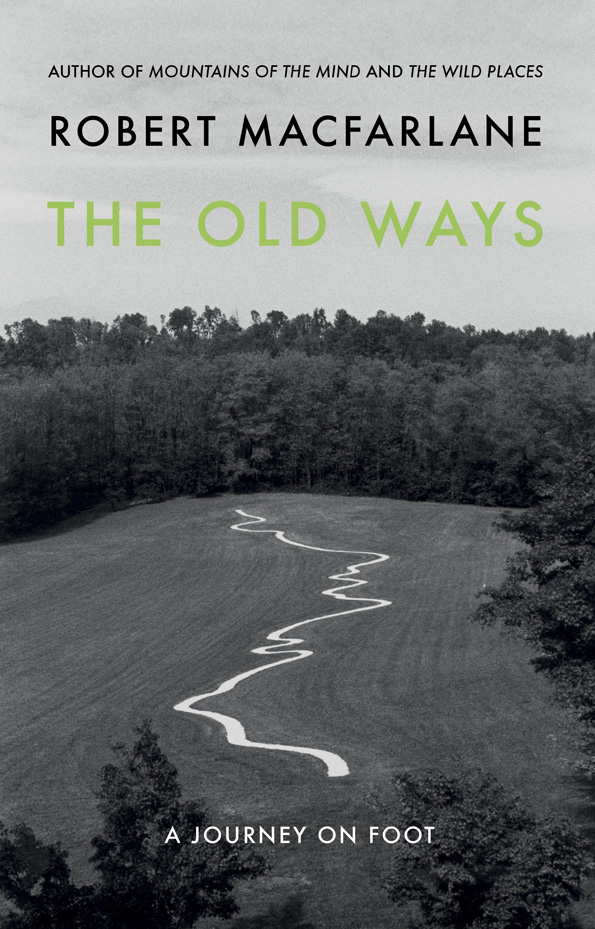
The Old Ways, by Robert Macfarlane
Review by Sharon Blackie:
‘I have met with but one or two persons in the course of my life who understood the art of Walking’, said Thoreau in his essay on precisely that subject: ‘… that is … who had a genius, so to speak, for sauntering .’ One suspects that Robert Macfarlane, as presented in his latest book The Old Ways, would have met with Henry David’s approval. For whatever else there may or may not be in this book, there is indeed a clearly displayed ‘genius for sauntering’, as Macfarlane sets off to explore a disparate collection of ancient paths by land and sea, in the British Isles and elsewhere.
Finding joy under a grey sky
By Miles Richardson, author of Needwood, a search for deep nature in the local landscape and a celebration of the joy that can be extracted from ordinary things in the natural world:
My book Needwood was written on foot. It takes a simple journey into an ordinary rural English landscape with no obvious grandeur, wilderness or drama. So the ordinary things are enjoyed: the oak, the rook, the river; the solace of the risings, the calm of the water meadows and the lifeless hedgerows of winter under a leaden sky. In this ordinary landscape, searching for ordinary things, I found a universal story about our connection to nature. Some of the most compelling moments took place under grey skies and below are two days from my year long journey; the first from February, the second from November.
Swallows and Amazons, Red Devils, and Alntorps Island
When I was younger I loved the Swallows and Amazons series of books. It was not so much the “adventure” aspect, but the fact that the things the kids got up to, and the dangers they faced along the way, were so completely believable. Of course, even my younger self got recognise that this was another world that Arthur Ransome was writing about – from the freedom granted to the children to the gender politics expressed in the stories – but I think that the books and the stories told therein were massively influential in the games that we would play each summer in Rhoscolyn.
We were from a few different families and we called ourselves the Red Devils. We mapped the headland and (with Capt’n Rob) took to the high seas, went exploring and made a magazine… it is amazing to think back now about the range of ages in the group, and somehow we all managed to play together as we created our own world in and around Cerrig-yr-adar and the Outdoor Alternative campsite.
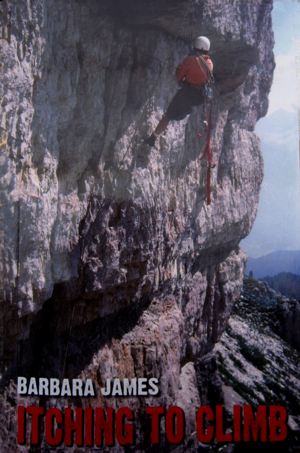
Itching to Climb by Barbara James
Review by Sheila Scraton:
“By now I’d led two classic climbs, graded hard severe plus, in the Llanberis pass. They were on a dramatic lump of rock, Dinas y Gromlech, usually abbreviated to The Cromlech that stood, like a vertically opened book, above a steep scree slope. The well- protected ‘Cenotaph Corner’, in the ‘spine’ of the book was a mixture of bridge and balance moves but ‘Cemetry gates’, a climb on the vertical right-hand wall was harder. I needed strong arms because hanging from the fingers of one hand, I needed the other to reach upwards and insert a protecting runner. I used my powerful thigh muscles as much as possible to move upwards”
This book, about the life of the climber Barbara James, stirred many personal memories for me as I read about her many exploits both on and off the rock. ‘Itching to Climb’ is a very personal account of Barbara’s life, particularly her traumatic struggles with eczema and other serious allergies. The book is the story of a determined, capable woman that not only provides an interesting read but is also focused on encouraging others to follow their dreams and pursue their goals.
Words on Water
Here on Under a Grey Sky I have often mentioned my admiration for the good folks of Caught by the River, a website that sits firmly at the top of my bookmark lists and was one of the main inspirations for what I wanted to do here. As well as the daily entries on the website, which can be anything from thought-provoking essays, poems, songs, all inspired by the world around us, they have also published a number of different printed works including, in 2009, a “Collection of Words on Water”.
Unfortunately, I had not discovered Caught by the River three years ago, so was very happy to hear earlier this year that they were re-publishing the collection in paperback. A few weeks ago a hand-addressed parcel arrived with the book inside, and the first thing I noticed was of course the wonderful cover artwork by James Lewis. Yeah, yeah, never judge a book… but it has to be said that once I started to read the words inside – all about being on or at the banks of the waterways of the United Kingdom and Ireland – it was clear that the cover was a perfect fit.
Unnamed and unacknowledged: exploring the Edgelands
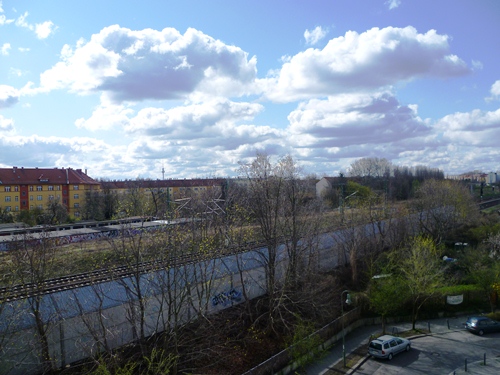
(above: Pankow, Berlin – Garages, Railway Lines and Allotments)
Edgelands: Journeys into England’s true wilderness is written by Paul Farley and Michael Symmons Roberts and is a fascinating book, exploring as it does those places that are neither city or countryside, but the edgelands in between. The two writers have a clear and obvious passion for these edgelands, which they describe in the introduction:
“Somewhere in the hollows and spaces between our carefully managed wilderness areas and the creeping, flattening effects of global capitalism, there are still places where an overlooked England truly exists, places where ruderals familiar here since the last ice sheets retreated have found a way to live with each successive wave of new arrivals, places where the city’s dirty secrets are laid bare, and successive human utilities scar the earth or stand cheek by jowl with one another; complicated, unexamined places that thrive on disregard, if we could only put aside our nostalgia for places we’ve never really known and see them afresh.”
Blazing Paddles: A Scottish Coastal Odyssey
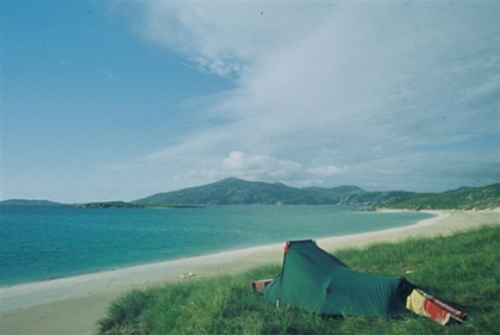
(above: Camp above the incomparable machair and beaches of west Harris, photo: Brian Wilson)
Alone in his tiny kayak, Brian Wilson set off on an 1800-mile adventure around Scotland’s grand cliffscapes, unspoiled shorelines, fearsome sea passages and Hebridean islands. The story of this journey is told in Blazing Paddles: A Scottish Coastal Odyssey, published by our friends at Two Ravens Press. With their kind permission we publish this extract:
Independently of archive and history text, the tradition of Hebridean hospitality has happily retained living substance, so that soon after approaching the little croft at the head of the bay with my request for a gallon of water I was seated by the fire at the kitchen table of Mrs Catherine Ross.
Her ‘You’ll be staying for a cup of tea’ was more of a forceful suggestion than a statement of ‘second sight’, but Hebridean ‘tea’ equally deserves a place in immortal folklore and is not to be missed, for the reference of the word is far wider than on the mainland. Within minutes I was tucking into homemade scones, oatcakes and several mugs of strong, hot brew under the jealous gaze of Bobbie the labrador, who could apparently see no reason why such service was denied to him.
The homely chat and kitchen warmth began to make me drowsy and I was concerned that the kayak should be hauled securely above the incoming tide; but I was only able to leave that croft by accepting a bag of fresh scones and butter and promising to let Mrs Ross know when my journey was safely completed, for until that time she would not sleep for worry. ‘It’s a good thing you’re not married – and it’s sorry I am for your poor mother!’ Smiling, I made my way back to the tent, my hands warmed by the scones only slightly less than her kindness had warmed my heart; but it was not ‘kindness’ that I ate so gratefully for breakfast next morning.
Outside the shelter of Loch Finsbay a heavy swell began to trouble me as I headed towards Renish Point, the southern tip of Harris. An increasing south-easterly from the Minch, and decreasing visibility, made the five-mile journey to Rodel a hard push and by the time I reached the shelter of the small harbour my lungs were heaving. Continue reading
The Ted Hughes Poetry Trail at Stover Country Park
By Tim Halpin:
I sat on a rustic bench – a sawn section of trunk mounted onto two stumps – beside The Warm and the Cold, point two on the Poetry Trail. Twenty metres behind me was my car. I could have heard it ticking as it cooled down, but the sound was drowned out by wave after wave of cars on the A382, just the other side of the car park. Equally incessant was the birdsong. A robin sat halfway up a young oak growing beside The Young and the Cold, furiously exchanging trembling phrases with another robin in the trees shading the car park. The South West of England was blanketed by a warm trough of air in a stable high pressure system whose centre covered the whole of the Bay of Biscay. It was a warm Spring day, and Ted Hughes’ similes seemed strangely out of place.
Moonlight freezes the shaggy world
Like a mammoth of ice.
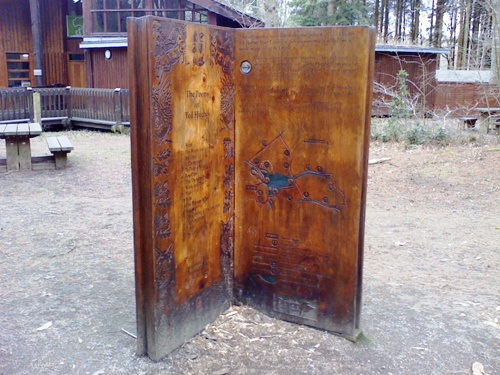
Of course, they were out of place. The trail began at a giant book carved out of wood, engraved with a map of the park and a short introduction to Ted Hughes. The poems themselves had escaped from the book, to be written on granite tablets along the Poetry Trail. The Stover Country Park had done what I do, and taken the writing outdoors. But it seemed that they’d gone further than me, taking the poems so far out of their literary context that they do not even mention which poetry collection they are from. The idea was that the poems would add to the visitors’ enjoyment of the park. I was more interested in what the park does to the poems. Continue reading
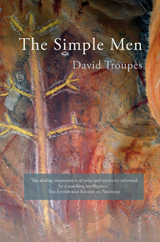
The Simple Men
New release from our friends at Two Ravens Press:
The Simple Men is the second full collection of poetry from David Troupes, an American poet living in West Yorkshire. He applies an assured, eccentric craftsmanship to innovative forms and ambitious insights. The poems of The Simple Men range over hills and down rivers, through truck stop diners and wedding parties, renewing at every turn our relationship with land, love and the self.
An extract from The Simple Men
The Allagash
We were a long time getting there,
an eight-hour succession of highways
past hayfields and pinewoods, potato country,
blink-and-miss-them towns rich
only in poverty, a great
weathergray barn in the middle of its century-
slow ooze down the hillside,
the old God-lump of Katahdin
saluting as we passed, until what we call America
became what we call Canada,
though we weren’t heading that far, but instead
doubled back south, driven now
by the outfitter, the old-timer,
down seventy miles of dirt logging road
deep into the Great North Woods where
like a bird on its eggs
Maine waited—somewhere in the healing mess
of what we did, in the pollen haze
as evening cooled—waited somewhere
under the cloud-rinds as we launched
ourselves into the golden river
and the pace of the unhurried Allagash became
the pace of everything—waited
as daylight lingered in the treetops and we found
not fifteen minutes into it
a female moose and her calf wading the warm
stone-shallow waters, calmly nosing for their meal—
the time they took to raise their heads
and weigh us up and walk into the dark weave
of the forest—my God,
the time they took—