A recent survey in Russia suggested that over two thirds of Russians want Lenin’s embalmed body removed from Red Square, at a time when the mausoleum is closed for renovation and speculation is rife as to what the future holds for the former Soviet leader. It is almost exactly five years since we stood on the cold expanse of cobblestones on a grey February day, and the mausoleum was closed for repairs that day as well, just a week before the election that saw Putin replaced as President by Medvedev. Putin is back in charge again, and he recently appears to have come down in favour of leaving Lenin exactly where he is.
Monthly Archives: January 2013
Memory and memorials in Berlin
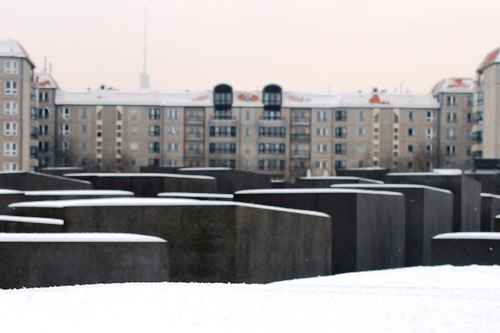
Sunday 27th January is International Holocaust Remembrance Day, an event with obvious resonance here in the German capital. It has been cold over the past few weeks, with temperatures falling below zero and snow on the ground, snow which covered the slabs of the Memorial to the Murdered Jews of Europe when Katrin went by on Thursday to take some photographs. The Memorial was subject to a lot of debate at its time of building, and has since been joined by nearby memorials to Homosexual victims of the Holocaust, as well as the more recent memorial to the Roma and Sinti who perished at the hands of the Nazi regime. All cities have memorials to their past, sometimes glorious and glorifying, other times reflective and sorrowful. Berlin has so many you fear that you will start to look through them, to no longer reflect on what they mean and what they stand for as they become simply part of the fabric of the city.
A walk on the Contraviesa, Southern Spain
By Sheila Scraton:
We were staying at our cortijo in the Alpujarras that lie to the south of Granada on the slopes of the Sierra Nevada. We had had a great family Christmas in Bad Saarow, Germany and were now enjoying unusually mild winter weather in Spain. Most people who know that we visit Spain seem to think that this means an escape from the cold weather of the UK and relaxation in warm Spanish sun. Whilst this can be the case, we have regularly experienced long icicles from our patio roof and deep snow making even access to the house a bit tricky.
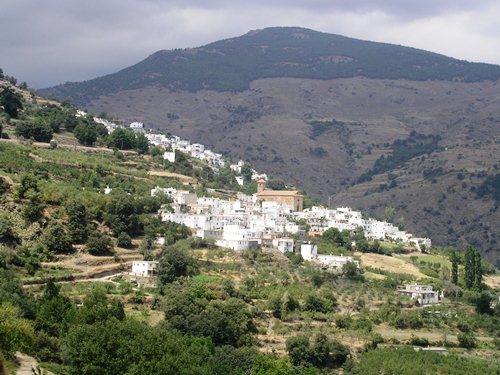
However, this January we had two weeks of wonderful weather – blue sky and warm sunshine. The air temperature can be cool, we are at over 1500 m (above the height of our highest mountain in the UK, Ben Nevis, at 1344m) but this is more than compensated by the strong sun coming directly from the south and North Africa. Today we met up with our friend, Jeremy, who has lived and worked in the Alpujarras for 20 years as a walking guide. We were doing one of our favourite walks at this time of the year, along the Contraviesa, the mountain range between the Sierra Nevada and the Mediterranean Sea. It is a favourite winter walk because its mild location means that it’s not possible, or at least comfortable, to walk here in the summer months. It is also the area that we look across to each day and evening from the patio of our cortijo, making it a nice change to reverse the view and look back to our village and the high mountains behind.
In the city after dark, Greifswald
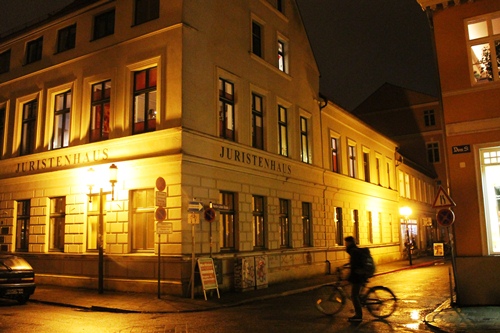
“Any serious flaneur walks by night as much as by day; for by day it’s too easy to be drawn into a complacent acceptance of normalcy. This much we plainly know: the panel truck disgorging toilet paper; the smoking secretary with laddered tights; the dosser senatorial, sporting a sleeping bag for a toga. But by night these are shape-shifters, capable of defeating our expectations.”
The quote comes from Will Self and an Independent column from six years ago on the pleasures of night walking. He is a fan of the nocturnal ramble and describes one such walk from a restaurant to his hotel through the dark streets of Glasgow. I can see him as I read, imagination stimulated by the words on a page, but despite his enthusiasm for walking under the glow of streetlights there remains a sense of foreboding or threat, and I am relieved for him when the automatic doors swish open and he steps inside at the end of his walk. This almost definitely says more about me than it does about him, and my own mild fears of being out – whether in the city or beyond – after dark.
Memories of the road, USA
By Anja Ahrens:
We were only in the United States for two weeks – a flying visit really – and we had decided to spend three of those days driving through the desert. With a four year old child and my in-laws in the back seat. Everyone said we were crazy, and maybe we were. But we loved it. During those days on the road I understood how fascinating the mountains can be, how the desert does not stay the same (as you might imagine) but instead the landscape was changing every twenty minutes, or with every bend in the road. The back seat passengers were happy and so were we.
My memories of that trip begin with the turn off along the old Route 66 and an abandoned town, my son playing cowboys amongst the buildings before it was time to hit the road again towards the Grand Canyon. We drove along a dead straight road for hours, passing only a lonely hotel and an airstrip to deliver those tourists who flew in rather than driving across the desert. We got to the canyon with fifteen minutes before nightfall, the amazed guard of the National Park surprised that we wanted to enter. Within less than an hour all daylight had gone, an incredibly fast process that we were not used to, and so we picked our way through the darkness to find our hotel.
The dead remind us – the Memorial to the Socialists, Berlin
“Freiheit ist immer Freiheit der Andersdenkenden”
(Freedom is always the freedom of the one who thinks differently) – Rosa Luxemburg
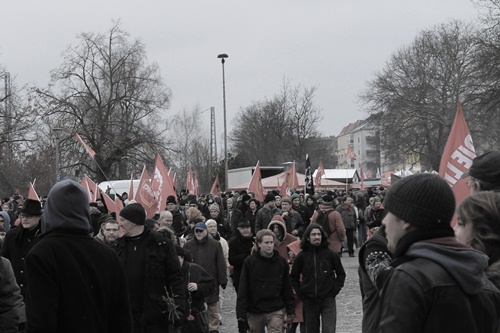
Alexanderplatz was frozen and empty on Sunday morning, the shops shuttered against the cold wind that seemed to be blowing in directly from Siberia along the Karl-Marx-Allee. From the station in the shadow of the TV Tower we climbed down the stairs to the underground line east, catching the U5 to Lichtenberg. It was busy, surprisingly so for a Sunday morning. But the occasional rolled and red flag leaning against the side of the carriage, or the more common sight of a bunch of red carnations carried in gloved hands told the story of all this early morning activity. At Frankfurter Tor half the carriage emptied, at Lichtenberg the other half did likewise. Different departure points but they – we – all had the same destination in mind; the Memorial to the Socialists at the Friedrichsfelde Cemetery.
Ainsdale Woods, the Sefton Coast, UK
By Chris Hughes:
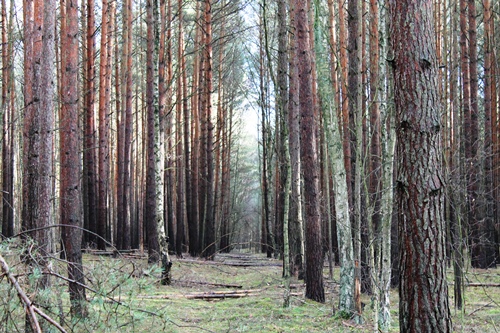
Following the article that featured the wonderful photographs of Michael Lange of the forests of Germany I revisited the photographs I have taken in the woods of Ainsdale Nature Reserve just a 10 minute walk from my house. No-one would say that we live in the countryside but we are very privileged to enjoy the proximity not only of the woodland but one of the finest dune systems, beach and both salt marsh and freshwater marsh environments in Europe. This is the Sefton coastline, stretching 21 miles from Crosby in the south to Hesketh Bank in the north.
The woodlands were planted well before the Nature Reserve was established in 1980, initially in the 18th century but more so in 1887 and in 1893 when the first Corsican Pines were planted and by 1925 most of the woodland of today had been planted. Now managed by Natural England and The National Trust the woodlands do provide a supply of timber now that the trees are fully mature but far more importantly provide a habitat for animals, birds and plants, many of which are rare and found only in unspoilt dune systems.
Where the seagulls follow the trawler – Wieck, Germany
At breakfast we watch the small fishing boat, the crew of three wrapped up in their waterproof overalls, as it chugs through the narrow channel at the mouth of the river and into the bay. We are in Wieck, a small village that belongs to the Hanseatic city of Greifswald in the north east of Germany, and our hotel sits right on the point where the river Ryck meets the Griefswalder Bodden – a huge bay enclosed by the island of Rügen and the sweep of the mainland east of Greifswald to Usedom. During East German times the Wieck harbour was home to a Marine Training School and the military sailing boat the “Wilhelm Pieck”, named for the former President of the GDR. Now the training school is a holiday camp for school and youth groups, and the sailing boat has been renamed the “Greif”, although a cocktail bar at one end of the old complex maintains the old institutional name for posterity.
Burning houses and a walk in the woods
The third part of our Bad Saarow diary, in one of our favourite places only an hour or so by car or train from Berlin:
A lot of the joy of our trips to Bad Saarow is, as I mentioned in the first part of this diary, the joy of the familiar… returning to a place that you know well can be comforting as well as filling you with (hopefully) happy and positive memories. But I am always happy when you have the possibility to discover something new about a place that you thought was fully explored, and the small footpath we stumbled upon during our Boxing Day walk was one such happy discovery.
It was not long, perhaps a hundred metres or even less, that linked a small estate of houses set back from the main road and the footpath that follows the edge of the Wierichswiesen, a half-farmed marshland surrounded by villas that include the marital home of famous boxer Max Schmeling (who died in 2005, aged 99) and the family home of his wife, the actress Anny Ondra. They married in Bad Saarow in 1933, and moved into a villa overlooking this marshland following the ceremony. When that house burned down, having been hit by lightning, they moved into the house of Ondra’s mother. That too would burn down, twenty-odd years later; a fate that appeared to befall many of these villas around the marshland, and which perhaps explains why the fire station is only a single street away.
The New Year in Belfast
Last year on Under a Grey Sky Phil Scraton took us on a Saturday morning walk from his house in Belfast. After another such walk last weekend, he reflects on the current situation in the city:
It’s the 5th January, midwinter in Belfast. At this time of year the sun appears briefly above roof-tops before slipping away. Yet it warms my face as I walk through the park. It’s only 9.30am and the joggers are out in shorts and vests, the golfers cheerful in short-sleeved shirts, the birds singing prematurely anticipating Spring.
At this time two years ago the big freeze and sudden thaw wrecked the back of our house yet today the temperature reaches 13 Celsius. The Southern light breeze encourages walkers to remove gloves and scarves and busy squirrels are clearly content as their food comes easy.
Down on the Lagan the rowers are in full flow, instructions barked by megaphone from their cycling coaches. The water is like glass until disturbed by the bows of the sleek boats. There has been little rainfall for over a week but the river is tidal and high. A heron, startled by the kerfuffle rises from the overgrown riverbank and heads upstream.