Monthly Archives: February 2012

Embassies of Prenzlauer Berg

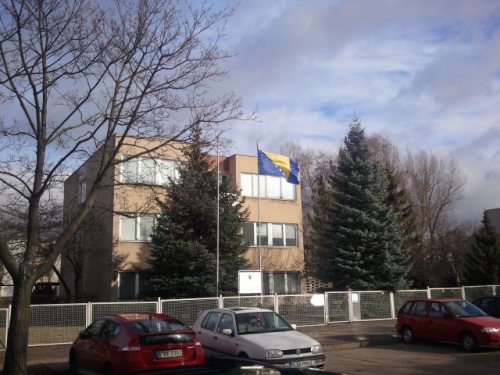
Walking through Berlin you often stumble across reminders of the long division of the city. There are of course the famous examples, such as the stretches of Berlin Wall at the East Side Gallery or on Bernauer Straße, the Checkpoint Charlie museum or the line of cobblestones that cross city streets along the path of the wall to remind you how this incredible, brutal structure split Berlin in two. There are other symbols as well that are perhaps less obvious. The tram that runs past my house is one of only a couple of stretches of working tram-track that run through the western districts of the city. Before the division the whole of Berlin was served by the tram network, but in the west they were replaced by buses. Now, in parts of the city, they are returning but in general you can apply the rule; if you can see a tram, you are in the old east. Then there are the differences in architecture, the newspaper reading habits in different neighbourhoods, and even voting patterns… Berlin is coming together, but it could take more years than the wall actually stood before all the traces of the division have been removed from the city. Continue reading

Footprints in the Spanish snow

Sheila Scraton on a high walk in southern Spain:

Usually a winter holiday in Spain conjures up pictures of sun, sand and warm days as the welcome heat seeps into your bones after the long winter in northern Europe. We were visiting our cortijo (Spanish farmhouse) in the Alpujarras in Southern Spain for a couple of weeks, hoping for some warmth but realistic about the fact that the house is situated at about 1500 metres which is above the height of Ben Nevis (1350m), the highest mountain in the British Isles. The cortijo is above the village of Bérchules, a lovely mountain village perched above a spectacular river valley, the source of the Guadalfeo which flows from high in the Sierra Nevada to the Mediterranean sea.

As always the air is cool and clear in February but as soon as the sun appears from the south and shines straight at the cortijo, the heat can be felt and, even at low air temperatures, sun cream is needed!  Each morning we managed to enjoy breakfast outside on the patio although one morning we awoke to quite a surprise.  Overnight several inches of snow had quietly fallen and, as we opened the shutters, a black and white scene had replaced our normal February view of pink and white almond blossom across on the Contraviesa hills. As the sun arose opposite, the black and white was quickly replaced with a wonderful orange glow as the sunlight glittered on the snow flakes and the sky moved to a deep blue. Continue reading

Patience (After Sebald)

I have not been able to find this film here in Germany, but it looks wonderful:

.

From the Guardian review:

Happily, though, director Grant Gee has made something still and beautiful – an art documentary in the very best sense – that seemed to me to evoke perfectly the melancholia of Sebald’s book while hinting at the horror which lies at the heart of its labyrinth.

Weather and the sense of a place

By Sharon Blackie:

We are told by the older residents of our local crofting townships that this autumn and winter have been the worst in living memory here in the Outer Hebrides. Wetter and windier. It’s true that we seem to have been battling gales since October, and the already boggy ground has been sodden for months. In November, on our personal blog, I wrote a post, The Gods of Days, in which I talked about wind and suggested that there was little point in living in a place where the dominant weather was wind and rain, and then sitting indoors and complaining about it when it was windy and raining. Of course, a lot of wind and rain has happened to us since November … and a couple of normally hardy friends are now jumping up and down and demanding that I recant and admit that wind and rain is a terrible thing and that I wish it were mild and sunny like everyone else does.

At one level there’s no question about it – I’m tired of battling the wind and sloshing about in the mud when it’s time to feed the animals and walk the dogs twice a day, because this has to be done whatever the weather. I’d be ecstatic if a few mild and sunny days happened along, and I’m eagerly anticipating spring like everyone else … but the truth about weather, about our relationship with weather, is very much more complicated than that. Continue reading

Cycling the Trans Pennine Trail

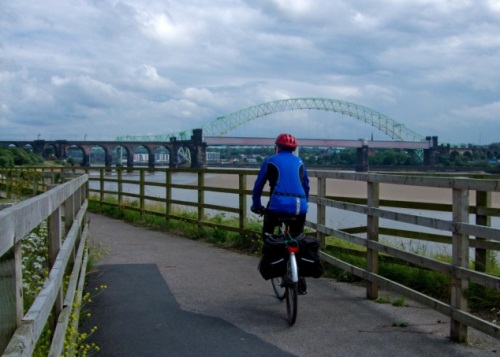
Last year, Chris Hughes set out from his home near Southport to ride the Trans Pennine Trail (TPT), a route that links the North and Irish seas via the Pennines, along rivers and canals and through some of Northern England’s most historic towns and cities:

The Trans Pennine Trail starts (if you are travelling east) or ends (travelling west) on the new sea wall at Southport just three miles from my house. The first few miles of the Trail have been regular cycle rides for “Three Old Gits” cycle group for some time and slowly the idea that we could actually ride the full length of the Trail began to sneak into my mind. Steve was up for the challenge – probably while sitting comfortably in a pub with a refreshing pint and a plate of Lancashire hot-pot – and slowly the plans were laid.

After a couple of false starts and mix-ups we were at last ready to set off, the weather forecast kind and the wind at our backs. Accommodation was booked and the panniers packed. Adding to our own keenness to undertake the challenge of the ride was the motivation of a significant amount of sponsorship from our kind-hearted friends and relatives for The Pahar Trust Nepal, which would benefit from our completion of the Trail. Continue reading

Public spaces and the right to roam our city streets

The latest Letter from Europe from our friends at Hidden Europe is concerned with the liberation of public spaces, especially in our cities, from the domination of the automobile:

“Many of Europe’s town squares and iconic city centre spaces have happily been rescued from the car. From Paris to Perugia, lovely central squares were for too long used as car parks. Now they have been reclaimed for pedestrians. The taming of traffic has massively improved Trafalgar Square in London and the Brandenburg Gate area in Berlin.”

The best parts of most cities are the spot where you feel like the pedestrian is winning over the car and bus, even if many “pedestrian zones” are nothing but open air shopping centres. It is true, for example, that you can drive your car alongside the Corniche in Beirut but the promenade along the sea-front is so wide and filled with walkers, joggers, food vendors, fishermen and cyclists that if you want a decent view out across the rocks and the water you’d better get out from behind the wheel and walk. Continue reading

Snow in the morning

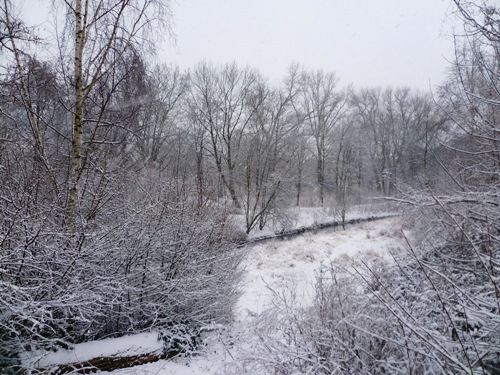
At seven o’clock this morning there was no snow on the ground. By nine o’clock all but the roads with the churning wheels of rush hour traffic was covered. It feels too warm for the snow to stick around, let alone fall in the first place, and on the U-Bahn the reality of the weather up on the surface had yet to penetrate the report on the info screens that were insisting on rainfall in the daily forecast. The snow will most likely all be gone by this evening, but it left us with some beautiful moments from that shortest of periods between the snow settling and the daily life of the city trampling it to mush. Continue reading

Walking the Suffolk Coast

I discovered Laurence Mitchell’s writing in Hidden Europe magazine, where he takes the reader to some of the more off-the-beaten-track corners of our lovely continent. It is not surprising then, that Laurence is also the author of guidebooks to Serbia, Kyrgyzstan and Belgrade. But when he is not out exploring eastern Europe and beyond, he is working on projects a little closer to home. He is already the author of a “Slow Travel” guide to Norfolk and Suffolk, and through Cicerone has just released a new guide to walks on the Suffolk coast and heaths. Continue reading

Steam bending by Tom Raffield

Tom Raffield makes furniture and lightening at his workshop in Redruth, Cornwall, using a technique called steam bending, drawing inspiration for his designs from the wilderness, tranquility and natural beauty of his surroundings. Despite being extremely busy, he was kind enough to answer some questions about his work and process.

Can you expand a little on how your surroundings have influenced your work?

I really learnt to appreciate my surroundings. We lived in quite an isolated area growing up and as I grew older I started to see the beauty within the nature surrounding me. I always loved drawing and making things and these abstract shapes and forms I drew or made were either directly or indirectly influenced by what I saw. I am very happy in this kind of environment and this helps me be more creative. Continue reading

Beyond the gallery walls – Museums and technology

David Salmon explores how museums are using technology to get their collections and exhibitions out from the gallery and onto the streets:

Last month the Museum of London gave a sneak preview of their new app, Dickens Dark London. It uses an interactive map of Victorian London which can be superimposed on to a map of today’s mean London streets and combines this with short graphic novel-style interactive books illustrated by David Fodvari and narrated by actor Mark Strong. Basically it looks frickin’ cool.

The launch of the Dark London reminded me that I still hadn’t used their StreetMuseum app, although it been sitting on my smart phone for a while. StreetMuseum is a free app for smartphones that overlays images of London from the Museum’s collections onto your phone so you can look at them when walking around town. Continue reading