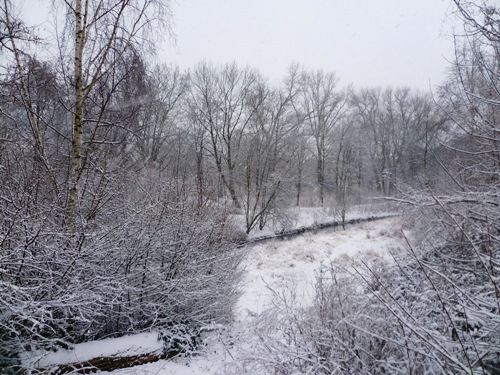
At seven o’clock this morning there was no snow on the ground. By nine o’clock all but the roads with the churning wheels of rush hour traffic was covered. It feels too warm for the snow to stick around, let alone fall in the first place, and on the U-Bahn the reality of the weather up on the surface had yet to penetrate the report on the info screens that were insisting on rainfall in the daily forecast. The snow will most likely all be gone by this evening, but it left us with some beautiful moments from that shortest of periods between the snow settling and the daily life of the city trampling it to mush. Continue reading
Walking the Suffolk Coast
I discovered Laurence Mitchell’s writing in Hidden Europe magazine, where he takes the reader to some of the more off-the-beaten-track corners of our lovely continent. It is not surprising then, that Laurence is also the author of guidebooks to Serbia, Kyrgyzstan and Belgrade. But when he is not out exploring eastern Europe and beyond, he is working on projects a little closer to home. He is already the author of a “Slow Travel” guide to Norfolk and Suffolk, and through Cicerone has just released a new guide to walks on the Suffolk coast and heaths. Continue reading
Steam bending by Tom Raffield
Tom Raffield makes furniture and lightening at his workshop in Redruth, Cornwall, using a technique called steam bending, drawing inspiration for his designs from the wilderness, tranquility and natural beauty of his surroundings. Despite being extremely busy, he was kind enough to answer some questions about his work and process.
Can you expand a little on how your surroundings have influenced your work?
I really learnt to appreciate my surroundings. We lived in quite an isolated area growing up and as I grew older I started to see the beauty within the nature surrounding me. I always loved drawing and making things and these abstract shapes and forms I drew or made were either directly or indirectly influenced by what I saw. I am very happy in this kind of environment and this helps me be more creative. Continue reading
Beyond the gallery walls – Museums and technology
David Salmon explores how museums are using technology to get their collections and exhibitions out from the gallery and onto the streets:
Last month the Museum of London gave a sneak preview of their new app, Dickens Dark London. It uses an interactive map of Victorian London which can be superimposed on to a map of today’s mean London streets and combines this with short graphic novel-style interactive books illustrated by David Fodvari and narrated by actor Mark Strong. Basically it looks frickin’ cool.
The launch of the Dark London reminded me that I still hadn’t used their StreetMuseum app, although it been sitting on my smart phone for a while. StreetMuseum is a free app for smartphones that overlays images of London from the Museum’s collections onto your phone so you can look at them when walking around town. Continue reading
A bungalow by the sea
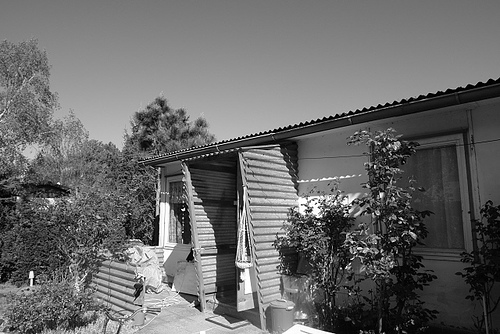
Sea mist hangs over the rutted, ploughed fields. It hangs between the long line of poplar trees and the narrow dirt track that leads from the bungalows, through the dunes to the beach. Down there, looking out to sea, visibility is perhaps fifty metres at most. Waves roll through the mist, the world enveloped in grey, the air damp and chilly.
Most of the bungalows that stand in this colony beneath the poplar trees during the days of the German Democratic Republic. They are in varying states of repair, some peeling and flaky as if the last substantial work was done during the socialist era, whilst others are mini-palaces complete with satellite dishes and fine collections of cheerful garden gnomes. Continue reading
Postcards from the Panke, Berlin
Last week I sent an email to the guys at Caught by the River about the Panke river here in Berlin, and today they published it on the site. You should take some time to read through the archives, as it is a website I really enjoy that was quite an inspiration for Under a Grey Sky. I also thought, having picked out a few pictures to send them, I would take the opportunity to show a few more. Continue reading
Wanderlust: A History of Walking, by Rebecca Solnit
“A solitary walker is in the world, but apart from it, with the detachment of the traveller rather than the ties of the worker, the dweller, the member of a group.” – Rebecca Solnit
Why do we walk? For some of us, walking is a normal part of our everyday transport. The walk to school, or to work, or down to the pub. We might go for a walk on the weekend, for fresh air or to spend time with friends. There are others for whom “walking” has become compartmentalised – there is a wonderful section in Wanderlust where Rebecca Solnit describes outdoor enthusiasts driving from the car park of one equipment store to the other, even though they are basically on the same street, in order to compare prices on the high tech equipment that they will need to take to the hills. It is not necessarily that these people are being lazy, saving their legs for the part of the week designated as time set aside for hiking in the nearest national park, but because even if you wanted to, this particular city has been made so unfriendly to the pedestrian that to walk from one clothing store to the other would be to put oneself in harm’s way. Continue reading
Last exit before the autobahn: the Plötzensee, Berlin
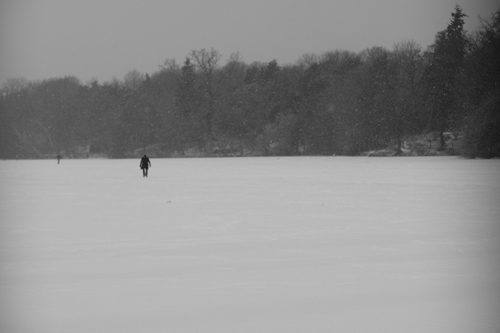
We took the tram from outside our building to the end of the line. There were only a handful of passengers when we got there, the tram stopping just before the point where the Seestraße becomes the autobahn and normal city life is handed over to the roar of car engines or, more likely, the traffic jams of rush hour. A disembodied voice told us in two languages to climb down from the tram and into the cold. Most turned left, into the enormous campus of the hospital. We crossed the street in the other direction, towards the frozen expanse of the Plötzensee. Continue reading
Banff Mountain Film Festival in the UK
.
Here is something interesting for UK readers, discovered through Outdoors Magic: The Banff Mountain Film Festival is currently touring the United Kingdom, with a selection of incredible-looking films about climbing, skiing, snowboarding, exploring, mountain-biking and anything else you can get up to in the high hills. Not only will the scenery be impressive, but the stories as well. You can get a taste from the trailer above, or check out the Banff Mountain Film Festival website for ticket information, a preview of the different films, and much more. The first couple of dates have already taken place, but here are the upcoming events:
11 FEB STOCKPORT/ MANCHESTER
17 FEB BIRMINGHAM
18 FEB BRISTOL
21-24 FEB LONDON
25 FEB NORWICH
2 MAR BRIGHTON
3 MAR POOLE
8 MAR BATH
9 MAR PORTHCAWL/ BRIDGEND
10 MAR CARDIGAN
Dance of the paddles: A reflection on sea kayaking to the Skerries
Andy Short on a winter paddle off the coast of Anglesey:
The Isle of Anglesey, off the North coast of Wales, is renowned within the sea kayaking community. Its location may be a mystery to many in the UK, but sea kayakers from Scandinavia to the States wax lyrical about classic trips the island offers, and ‘the Stacks’ and ‘the Skerries’ are foremost among them. These are trips which conjure among the initiated visions of epic tide races and awesome overfalls.
Anglesey – Ynys Mon in Welsh – is a large squarish lump of rock 25 miles from end to end, protruding impudently into the Irish Sea. Its very existence is like a challenge to the sea, whose tides sweep past on their daily lunar rituals, filling the Irish Sea with waters from the Atlantic and then returning them to whence they came. On stormy days it seems the Island is about to be washed away but the rock here is made of stern stuff. The exposed north and west coasts bear the brunt of the sea’s ravages, and include some of the oldest rocks in the UK. Psammites and Pelites formed some 550 million years ago with pre-cambrian limestone thrown into the mix provide for the robust cliffs that give sea kayaking trips here such a dramatic backdrop. Continue reading