Blossom on the Berlin Wall Trail

North along the Berlin Wall Trail from Bornholmer Straße, the route runs along the Kolonnenweg between the railway tracks and the allotments. After the wall came down, this stretch was lined with cherry trees that were given to the people of Berlin by the citizens of Japan to mark the occasion. The pictures with the post were taken a little further along the route, close to the Wollankstraße station and the entrance to the Bürgerpark in Pankow, where more cherry trees mark the route – this time sandwiched between the railway and the backsides of the houses on Schulzestraße. It was a beautiful Sunday morning, and the pink against the blue sky was striking. I wish someone would give me a cherry tree as a present, and that I had a garden to put it in… Continue reading

Women Climbers: From Lily Bristow to Lucy Creamer

.

By Sheila Scraton:

Last week in the Guardian I was fascinated to read a piece about women’s involvement in mountaineering in the early days of the development of the sport. It talks about some of the women pioneers, such as Lily Bristow and Lucy Walker, examples of the Victorian and Edwardian women who sought Alpine adventure and so often outraged those who thought that women had no place in such activities. This story certainly wasn’t new to me as I have been involved in women’s sport including mountaineering and climbing for the past forty years myself. The article traces the development of women’s early climbing, from the days when a woman sharing a tent with a man on an Alpine ascent scandalised society, through to the early part of the 20th century when women climbed the Matterhorn in skirts, making tenuous links between these early pioneers and the developing suffragist and feminist movement.

What was most interesting was not only the article itself but the responses it provoked on the site the next day.  As always many criticised the article for failing to mention certain pioneering climbers and not recognising the achievements of climbers today. Of course these criticisms are valid although no brief newspaper article can cover everything. What it did for me was get me reminiscing about my early days climbing! I never managed to be a pioneer of mountaineering or indeed a hard climber. I learnt to climb in the 1970s. By then women were benefitting from those who had gone before. I don’t mean Victorian women but women such as Nea Morin, Gwen Moffat, Jill Lawrence, amongst others, who throughout the 60s and 70s were pushing the boundaries of their sport.  My memories are of early days in the Llanberis Pass, Cwm Idwal, the cliffs on Holyhead mountain, the Devil’s Slide on Lundy Island. Of course there are many other days out in Scotland and the Lake District but it is these that are most precious in my memory bank. Continue reading

After the Woods and the Water: Tenuous, traceable threads

Since December 2011 Nick Hunt has been walking from the Hook of Holland to Istanbul, following in the footsteps of the late travel writer Patrick Leigh Fermor who made the journey in 1933 and 1934, and whose two books based on the journey offer a fascinating portrait of a continent that would soon be wiped away by the Second World War. Nick will publish his own book based on his travels, and you can follow his progress on his blog After the Woods and the Water. What follows is a post from early January:

I’ve been walking for over two weeks, and it’s only just starting to occur to me that travelling this way is so much slower – indescribably so much slower – than any other form of transport. Apart from walking backwards, perhaps, or crawling on my belly. It’s an interesting adjustment. Bicycles pass me with speed and grace that I envy, but at least recognise as just a faster version of what I’m doing – making my way from one place to another – while cars, to my pedestrian eye, travel so incomprehensibly fast I have already started to think of them as something quite alien, engaged in an activity entirely different to my own. I’m wondering if the same is felt by geese when an aeroplane thunders in the distance. Continue reading

On Morecambe Bay

.

by Phil Scraton:

It is often remarked that death knows no hierarchy: born naked, die naked. Yet how the living transform death’s meaning. Understandably when tragedy strikes we stand emotionally and physically alongside the bereaved as they mourn their loved ones. In the aftermath of multiple deaths the intensity is collective. The randomness of disasters, of who survives – who perishes, reminds us that it could have been me, my brother or sister, my mother or father, my son or daughter, my friend or neighbour. Towns, cities, villages become forever blighted by the deep sadness associated with their names.

Throughout the year, particularly in summer, the sands of Morecombe Bay, to the west of Lancashire’s coastline and the south of Cumbria’s beautiful Lake District, attract thousands of walkers. The most famous Morecambe Bay walk crosses the mouth of the River Kent, from Arnside to Kent’s Bank. Guides understand the complex movement of the tides and the channels they weave between and within the ever-shifting sand banks. What attracts walkers – the miles of flat sand against the backdrop of the northern mountains, the desolation and openness – is also its inherent, seemingly benign, danger. Continue reading

A Favourite Walk – The Rhoscolyn Headland

By Paul Scraton:

If there would be one walk I would love to have available to me every Saturday morning, it would be the short loop from Outdoor Alternative, around the headland to Borthwen, and then back up the gravel track to home. It is not a long walk, and if you don’t stop for the views across Anglesey to Snowdonia, or to explore the rock pools and sandy cove of Shelly Beach, or a quick ascent of Red Devil Rock, you can be out and back in less than half an hour. Continue reading

Spiritualized – Lay Back in the Sun

.

From the review of the recent Spiritualized concert in Manchester on Louder than War:

“‘Lay back in the Sun (good dope, good fun) is the original feel good hit of the Summer and brought a smile to the glowing crowd no doubt topping off a rare lazy Sunday spent drinking in back gardens or in overpriced smoking areas of pubs.”

Reading those words and listening to the song I am taken back to our old back yard on Raven Road in that last summer in Leeds, to the beer gardens of Headingley, and then even further, to the final evening of Glastonbury in 1998, caked in mud and yet happy as the sky cleared for the only time of the weekend as Spiritualized took to the stage to perform as the sun went down, a glorious, epic and uplifting hour to send us deliriously on our way in the middle of the night to be pulled from the car park field by a tractor before driving along the country lanes through the night to Malvern. At least, that’s how I remember it now…

Words: Paul Scraton

Saturday morning in Kreuzberg

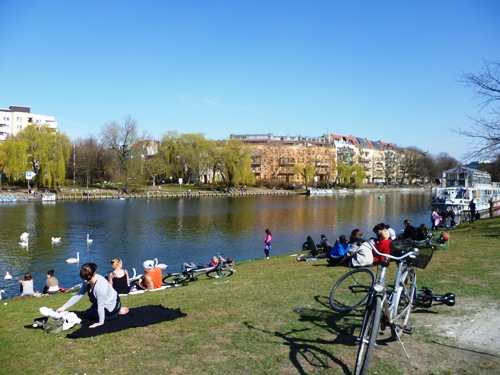
Hard to imagine that it is the middle of March, as we walked along the Landwehr Canal in Kreuzberg, ice creams in the hand as others unfurled picnic blankets on the grassy banks, filled the terrace tables outside cafes and bars, and enjoyed the sunshine and the unseasonably warm temperatures. Berlin is a city of notoriously late risers, to the point that even large chain stores don’t bother opening until 10am, but perhaps it was the excitement of the weather and the feeling that – at this time of the year – you need to take every chance you can get to grab some fresh air, as it felt like the city woke as one, with a spring in their step as if about to burst into a song from the Muppets movie at any moment… Continue reading

Giddy with the first taste of spring

Or how Berliners feel when they can finally leave the winter behind…

It is the first fine weekend of the year, and it feels as if the streets and the transport system are being over-run by the crazies and the daytime drinkers who have been – where? – throughout the winter but have re-emerged into the beautiful sunshine that makes Berlin and Berliners (a grey city with gruff locals) threaten to even smile at one another and share a kind word.

The first few sunny days of the year are always slightly disconcerting, as if everyone has forgotten how to deal with the freedom of walking the uneven pavements without the restriction of heavy coats, hats and gloves, or the freedom to sit at outside tables or take a blanket to the park… it is not that those people on the U-Bahn are really crazy, or that the daytime drinkers are going to necessarily make a habit of it, it is just the excitement of spring. Everyone is simply a little giddy. Continue reading

The art and craft of Jonathan Newdick

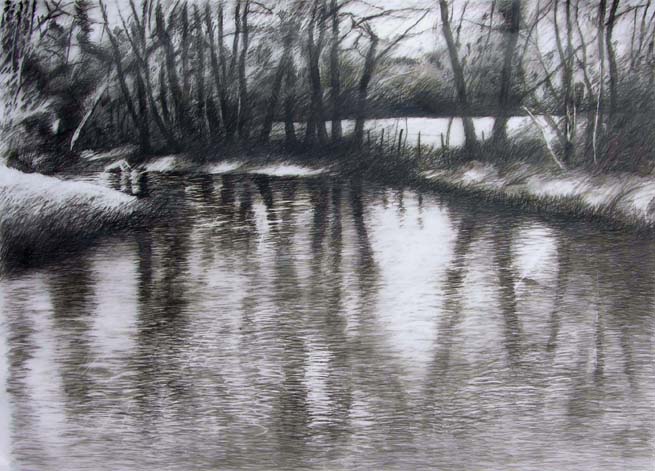
The Wylye
Graphite on paper
790 x 1140 mm
2006

We discovered the work of Jonathan Newdick through good friends, and then spent a happy hour or two exploring his website, not only the beautiful drawings and prints (such as the example above) but also the writings collected there. Jonathan kindly agreed to let us re-produce some of his work on Under a Grey Sky, and there are some more drawings below and a biography from his website. I think they are wonderfully atmospheric, and we hope that you enjoy them too. Continue reading

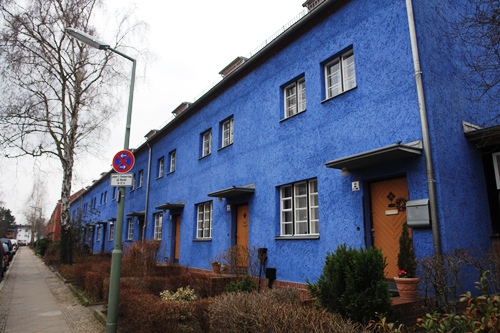
The Horseshoe of Berlin-Britz

Exploring the social housing estate that is recognised by UNESCO as one of the finest achievements of modernist architecture:

Between 1875 and 1900 the population of Berlin more than doubled from 970,000 to over two million, a growth that began with the unification of Germany and industrialisation driven by the development of the railways. Many of these newcomers ended up living in tenement blocks built around a series of dank and dreary courtyards. By the end of the First World War the average one-bedroom apartment was shared by five people. This situation obviously had health implications, but was also a social and political challenge for the post-War Weimar Republic.

It was this challenge that led to the birth of a number of different cooperative building societies in the 1920s, whose stated aim was to bring social reform approaches to solving the housing crisis. In contrast to the tight and cramped tenement blocks of the 19th Century, the Modernist architects employed by the building societies laid out plans for housing that would be open and airy, with green spaces, public areas and playgrounds, and part of a re-imagining of the city that was to have both positive social and political consequences. Continue reading