Our Garden Birds by Matt Sewell

.

We found this film thanks to Caught by the River. Not only does Matt Sewell’s Our Garden Birds look absolutely lovely, but I think this is one of my favourite examples of “book trailer” that I have seen. It seems to have become a new trend. Anyway, the animation at the end is superb and the book looks as if it will be as well.

Take some time to explore Matt Sewell’s website as well, for more examples of his work as well as his bird illustration of the week.

Spirit of Place – the art of Diana Hale

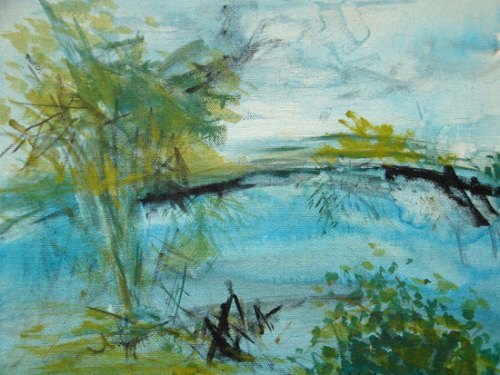
(above: Low Tide – Evening, 40 x 30 cms, acrylic on canvas, 2010)

We discovered Diana Hale’s art through her blog, and really enjoyed not only her paintings but also the words that accompanied them. We asked her to write a post on how the sense of a place influences her work:

Having nearly always lived near water, I do feel drawn to paint watery landscapes, whether rivers, streams, ponds, lakes or estuaries and marshes, shorelines. I like the ever changing nature of moving water and tidal variations. The same place can appear entirely different at different times of day. Changing light effects are enhanced by water. Water inevitably creates open spaces, often empty spaces. A sense of space is something I am aware of whenever I step outside into the open air and I can’t help but feel an immediate sense of liberation. Painting is one way of capturing this feeling.

It is possible to find empty spaces even in the city and I have several paintings of the Thames at low tide near the South Bank which show this. They could in reality be anywhere and I like the fact that they have a particular meaning and location to me but not necessarily to anyone else. They are both subjective and objective spaces.

Continue reading

Climbing the Flak Tower at Humboldthain

Last weekend we decided to climb the rubble hill of Humboldthain to take a look at the remains of the Flak Towers that stand there among the trees, looking out across the city. I have been in this park many times, but for whatever reason I had never been up to look at the towers that were built between 1941-42 as part of the anti-aircraft defences of the city during the Allied bombing raids of the Second World War. The tower, that was designed to be bomb-proof, also provided an air-raid shelter for up to 15,000 civilians.

Continue reading

This Storm Is What We Call Progress

by Tom Salmon:

London’s Imperial War Museum takes a seemingly paradoxical approach in its mission to explore the impact of modern warfare. Military hardware, tanks and other tools of war are removed from bloody battlefields to become the objects of children’s fascination. Meanwhile, a series of art and photography exhibitions like Don McCullin’s Shaped by War invite visitors to reflect more deeply on the human tragedy of conflict.

Ori Gersht’s exhibition This Storm Is What We Call Progress was one of the museum’s more philosophical exhibits, dealing with conflict, survival, memory, history and geography.

Continue reading

Remembering 15 April: Reflections on Memory and Place

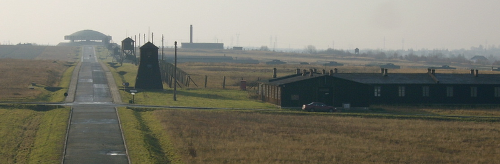
(above: Majdanek concentration camp. Photo: Ralf Lotys)

by Phil Scraton:

We left the coach quietly, idle conversations of the journey overtaken by due reverence to our destination. Wandering the path through well-kept grass speckled by bright red poppies, I entered the red brick building alone. Inside it was barren, empty. Above my head were rusting shower heads. A bath house, a death chamber into which Zyklon B was released to gas people of all ages and diverse backgrounds; naked not for showering, but for swift transportation to mass graves or incineration.

Overwhelmed and without warning I sobbed uncontrollably. Leaning on the wall against which the dying collapsed, I pressed my flushed cheek against cold brick as if to self-inflict pain. On leaving the desolation of the chamber to the blue sky, bright sun and rustling trees I trembled, overcome by vicarious grief. Walking slowly I looked across Majdanek where some 80,000 perished, over 18,000 on one November day in 1943. In the foreground stand the huts, fences, watch-towers and the Mausoleum containing the excavated ashes of so many who died. The backdrop is the busy Polish city of Lublin. Continue reading

Walking the Neighbourhood

Do you remember when, we used to sing…

This week the Pictoplasma festival of character design and art is taking place in Berlin, and alongside the conference and screenings that make up the central focus of the event, twenty venues mostly in the neighbourhood of Mitte (including The Circus) are hosting small exhibitions. Pictoplasma have distributed maps as part of this Character Walk, and people are tramping the streets to see what weird and wonderful things they can discover.

It is a lovely idea, and we joined in. What struck me as we were walking, first along the Torstraße and then along the Rosa-Luxemburg-Straße to Alexandeplatz and then back up past Hackescher Markt to Rosenthaler Platz, is that this triangle has been the centre of my Berlin life ever since I moved here over a decade ago, despite the fact that apart from the first weeks at the hostel, I never actually lived within it. It was in the small hostel bar on Rosa-Luxemburg-Straße (now an office) and then Kaffee Burger that I spent my first evening in the city. I ate kebabs from a shack where now the Wombat’s Hostel now stands.  I walked down to Alexanderplatz to buy the Guardian, and stopped for a coffee in a café that has long since disappeared.

Continue reading

Unnamed and unacknowledged: exploring the Edgelands

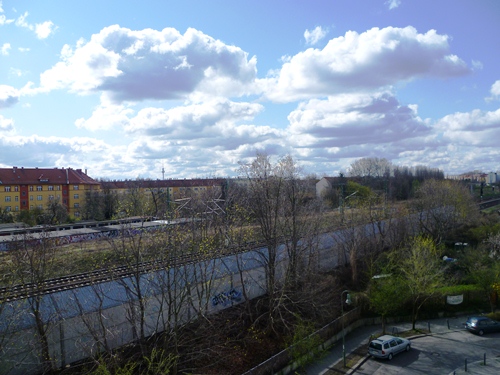
(above: Pankow, Berlin – Garages, Railway Lines and Allotments)

Edgelands: Journeys into England’s true wilderness is written by Paul Farley and Michael Symmons Roberts and is a fascinating book, exploring as it does those places that are neither city or countryside, but the edgelands in between. The two writers have a clear and obvious passion for these edgelands, which they describe in the introduction:

“Somewhere in the hollows and spaces between our carefully managed wilderness areas and the creeping, flattening effects of global capitalism, there are still places where an overlooked England truly exists, places where ruderals familiar here since the last ice sheets retreated have found a way to live with each successive wave of new arrivals, places where the city’s dirty secrets are laid bare, and successive human utilities scar the earth or stand cheek by jowl with one another; complicated, unexamined places that thrive on disregard, if we could only put aside our nostalgia for places we’ve never really known and see them afresh.”

Continue reading

Requiem for a Sycamore – Hatchet Field

(above: Hatchet Field, photo: Ciarán Ó Brolcháin)

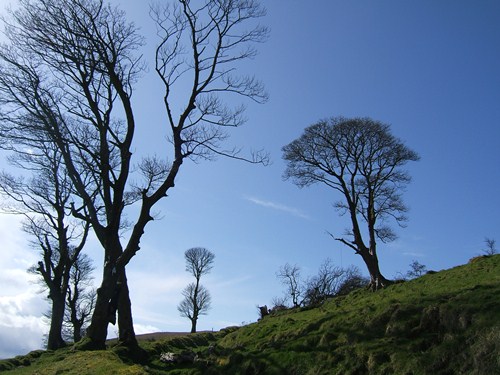
In yesterday’s article, Beatrix Campbell interviewed Terry Enright, whose poem Requiem for a Sycamore, pays homage to the small clump of trees that populate the Hatchet Field. The field is unique, its grassland and sycamores contrasting with the bracken and heather of the hillside.

Requiem for a Sycamore

I saw you looking down,
Majestic
Your mighty branches spread,
Like muscles on a giant,
500 thousand leaves, and more,
Love letters carved on your bark
The beauty of the hill

You were my shelter from the sun,
Cover from the rain,
I sat in the silence of winter snow,
A single Wren stared at me,
Wondering
Voices whispering in the wind,
High above everything

War in the streets below,
Spies in the grass,
Watching
Happy children swinging on a single rope,
Flying over Belfast without wings,
Oblivious
To the pain and joy you have seen

Now I sit on your prostrate corpse,
Felled by November storms,
I lament your passing,
Nature, like life itself,
Demands a price, we all must pay,
Still I cherish, the pleasure we have shared,
High up in the Hatchet Field Continue reading

Open to all – the tale of Black Mountain

(above: Divis and Black Mountain, taken from Cave Hill. Photo: Phil Scraton)

This month is the 80th Anniversary of the Mass Trespass of Kinder Scout, an act of disobedience by ordinary ramblers that had a massive impact on public access to open countryside, but there would remain many places that were off limits. In 2005, the people of Belfast finally regained access to the Black Mountain that overlooked their city. The following article by Beatrix Campbell originally appeared in the New Statesman, and we are grateful to Bea for her permission to re-publish it here:

The man stands at the peak of the Black Mountain and his eyes scavenge the startling Mediterranean blue of the sky above Belfast. “Where is the little bastard?” he murmurs. “Ah, there he is. Now isn’t that lovely?”

He’s spotted a skylark. The soundscape is silence and skylarks and meadow pipits and his feet on heath and heather and lush, black bog. It is the beginning of June 2005, and before the month is out the Black Mountain will be open for the first time to the people.

Terry Enright slowly turns 360 degrees. “I’ve never seen this before,” he says. “It’s never been so clear.” What he sees is Scotland far over to the east, and the Isle of Man, and when he turns inland there is Lough Neagh – the biggest lake in these islands – five of the Six Counties and Donegal on the west coast. Down below is the bowl of Belfast. “The people of Belfast never saw this. They live here but it’s not been part of their life.” Enright lives here, too, on a Ballymurphy council estate nesting at the bottom of the mountain that skirts the city skyline. But he made it his mission to move around the mountain. Continue reading

Blazing Paddles: A Scottish Coastal Odyssey

(above: Camp above the incomparable machair and beaches of west Harris, photo: Brian Wilson)

Alone in his tiny kayak, Brian Wilson set off on an 1800-mile adventure around Scotland’s grand cliffscapes, unspoiled shorelines, fearsome sea passages and Hebridean islands. The story of this journey is told in Blazing Paddles: A Scottish Coastal Odyssey, published by our friends at Two Ravens Press. With their kind permission we publish this extract:

Independently of archive and history text, the tradition of Hebridean hospitality has happily retained living substance, so that soon after approaching the little croft at the head of the bay with my request for a gallon of water I was seated by the fire at the kitchen table of Mrs Catherine Ross.

Her ‘You’ll be staying for a cup of tea’ was more of a forceful suggestion than a statement of ‘second sight’, but Hebridean ‘tea’ equally deserves a place in immortal folklore and is not to be missed, for the reference of the word is far wider than on the mainland. Within minutes I was tucking into homemade scones, oatcakes and several mugs of strong, hot brew under the jealous gaze of Bobbie the labrador, who could apparently see no reason why such service was denied to him.

The homely chat and kitchen warmth began to make me drowsy and I was concerned that the kayak should be hauled securely above the incoming tide; but I was only able to leave that croft by accepting a bag of fresh scones and butter and promising to let Mrs Ross know when my journey was safely completed, for until that time she would not sleep for worry. ‘It’s a good thing you’re not married – and it’s sorry I am for your poor mother!’ Smiling, I made my way back to the tent, my hands warmed by the scones only slightly less than her kindness had warmed my heart; but it was not ‘kindness’ that I ate so gratefully for breakfast next morning.

Outside the shelter of Loch Finsbay a heavy swell began to trouble me as I headed towards Renish Point, the southern tip of Harris. An increasing south-easterly from the Minch, and decreasing visibility, made the five-mile journey to Rodel a hard push and by the time I reached the shelter of the small harbour my lungs were heaving. Continue reading