Palace of Tears, Berlin

Just outside the Friedrichstraße station is a simple building that – when I first came to Berlin – housed a nightclub called “Tränenpalast”… Palace of Tears. The name came from its former function, as the border departure hall for people travelling from East to West Berlin. The doors of this pavilion would have been last point of goodbye, as western visitors headed back across the border that split the city in two, and left their family and friends behind.

Continue reading

To the market – Kollwitzplatz, Berlin

The market at Kollwitzplatz takes place every Thursday and Saturday, on this square in the neighbourhood of Prenzlauer Berg – a neighbourhood that was once the centre of bohemian life in East Berlin and has become, since the fall of the wall, one of the trendiest districts of the city and a central flashpoint in the gentrification debate. Here’s what our friends at Slow Travel Berlin have to say about the market itself:

Continue reading

Liverpool

I have never lived in Liverpool, although for family reasons and one of the football teams, it is probably the city that I identify most with back home. Living in Berlin, and working in the hostel, it was the answer I gave when asked where I was from – unless the asker was from the UK, in which case I would add a “near” to the “Liverpool.” It was only if I heard a trace of a Scouse accent would I admit to Burscough which, despite its L40 postcode, never had the purple wheely bins.

Last summer we spent a couple of weeks back across the water, and I returned to Liverpool for the first time in a decade. Most cities will be different after a ten year absence, but I was struck by the dramatic nature of some of the changes in the centre of town, a re-development spurred (I presume) by the year as Capital of Culture in 2008. I couldn’t tell whether it was an improvement or not, and I guess I will leave that up to the locals to decide, but it was slightly unnerving to be standing in a place that I thought I knew and having absolutely no sense of direction or idea where I was in relation to anything else.

Continue reading

Along the Ku’damm, Berlin

Back home from a walk along the Kurfürstendamm, West Berlin’s most famous street, I search the bookshelves for Joseph Roth. I have been to the Ku’damm many times, but never explored its entire length, and I want to know what the master of observation thought. With my feet aching a little from the adventure, the following passage jumped off the page:

“And so the Kurfürstendamm stretches out endlessly day and night. Also, it’s being renovated. These two facts need to be emphasized, because of the way it’s continually ceding particles of its true self to its designated cultural-historical role. Even though it never stops being “a major traffic artery”, it still feels as though it weren’t a means to an end but, in all its length, an end in itself” – Joseph Roth, What I Saw.

It still does. Predictions of the “death of the West” have come and gone over the past two decades since the fall of the Wall, as attention on the city moved across the Tiergarten to the historic centre of the city, but whenever I return to the Kurfürstendamm – infrequently – I am always struck by the fact that the street and the neighbourhood around it are doing fine thank you very much, regardless of the hype and the development going on over in Mitte.

Continue reading

A Wintery Flinders Sunday Afternoon…the Fondest of Childhood Memories

By Bree Carlton:

After a frantic Sunday morning spring cleaning and gardening, we decide to venture out with Isaac and Oskar down to Flinders Beach. It’s a wintery, devilishly freezing day but the weather is changeable. On our drive down the coast we move from fits of drizzle to bursts of sunshine. The sky is yellowy golden and dramatic; the big billowy white and purple clouds scattered and interspersed with deep patches of blue and dramatic rainbow arcs.

Flinders is located on the tip of the Australian state of Victoria where Western Port Bay flows into the Bass Strait. It is well known for its picturesque national parklands and wildlife, crisp air blown fresh off the Antarctic, and its beautiful safety and ocean beaches. But for me Flinders holds the richness of fond childhood memories. Mum and Dad used to take my brother and me there when we were kids. Years ago Dad made our livelihood as a ceramic artist. On weekends he used to deliver his wares -crockery; vases; tea and dinner sets- to various art galleries and craft outlets up and down the Peninsula coast. Bittern, Red Hill, Balnarring and Flinders were just some of the places we visited on listless Sunday afternoon drives.

Continue reading

Watching football on the Rosenthaler Platz

“Aus dem Hintergrund müsste Rahn schießen, Rahn schießt – TOR, TOR, TOR!”

When did it start? The first tournament I watched in Germany was the Japan/Korea World Cup in 2002, and certainly bars and cafes broadcast the games, often pretty early in the morning, and those highly-paid superstars strutted their stuff on the perfectly manicured lawns of Tokyo and Seoul whilst the late-rising Berliner gazed bleary-eyed at the screen across the top of a foaming Milchkaffee. It was the same two years later in Portugal, although for the European Championships the games were at a more sensible hour, when drinking a beer during the first half was more socially acceptable…

Continue reading

Ghosts of Gone Birds

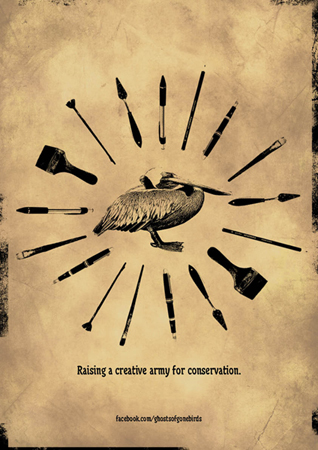
Ghosts of Gone Birds is about raising a creative army for conservation through a series of multimedia exhibitions and events that are concerned with breathing artistic life back into extinct birds species, whilst raising awareness of those species that teeter on the edge of extinction but can still be saved. Over 120 artists, writers and musicians took part in the London phase of the project, which featured a couple of events in the English capital last November.

Alongside the events, the website features a gallery of images by the different artists involved, a shop where you can buy limited edition prints (including some wonderful drawings by legendary illustrator Ralph Steadman) and a series of “Ghost Stories” in association with BirdLife International as part of their Preventing Extinctions programme. Here’s an example:

FISH HOOKS DON’T JUST HOOK FISH. THEY CATCH AND KILL 100,000 ALBATROSS. EVERY YEAR.

Dying at a rate of around one every five minutes, the albatross family is fast becoming the most threatened family of birds in the world. In fact, they are disappearing at a rate faster than they can actually breed – so 18 out of the 22 species of albatross are now facing global extinction.

BirdLife International set up the Albatross Task Force to work with local fishermen in countries throughout the world to introduce new practices that would reduced the life-threatening danger to seabirds.

And as a result, in countries like South Africa there has been a 85% decrease in the number of seabirds caught in fishing lines.

It is the combination of the creative with the campaigning that gives Ghosts of Gone Birds such a persuasive message, and it will be really interesting to see what they have planned for future exhibitions and events. You can see a complete list of the artists involved in the project so far here.

Words on Water

Here on Under a Grey Sky I have often mentioned my admiration for the good folks of Caught by the River, a website that sits firmly at the top of my bookmark lists and was one of the main inspirations for what I wanted to do here. As well as the daily entries on the website, which can be anything from thought-provoking essays, poems, songs, all inspired by the world around us, they have also published a number of different printed works including, in 2009, a “Collection of Words on Water”.

Unfortunately, I had not discovered Caught by the River three years ago, so was very happy to hear earlier this year that they were re-publishing the collection in paperback. A few weeks ago a hand-addressed parcel arrived with the book inside, and the first thing I noticed was of course the wonderful cover artwork by James Lewis. Yeah, yeah, never judge a book… but it has to be said that once I started to read the words inside – all about being on or at the banks of the waterways of the United Kingdom and Ireland – it was clear that the cover was a perfect fit.

Continue reading

From desert to bog, and back again

The latest installment of the Uig Journal from Sharon Blackie, editor of Earthlines Magazine:

I fell in love with my first desert before I fell in love with my first bog. That first desert was in southern California in the mid-’80s, where I (a young PhD student who had seen very little of the British Isles, let alone the world) was attending an international conference on neuroscience. I’m sure the impact that the desert had on me was all the greater for having spent the best part of a week navigating the lunacy of Disneyworld-obsessed Anaheim, and dealing with a curious sense of panicked dislocation caused by the impossibility of getting around it safely – or, sometimes, at all – on foot. I remember the first time that orange-pink shimmering landscape opened up like a flower draped around the stalk of the long straight road ahead. I remember more than anything the heart-stopping sense of freedom and possibility that seemed to unfold in the simple vastness of it – because this was the first time I’d experienced anything so radically beyond the confined and enclosed landscapes that were typical of the places I knew. I remember too the clarity and calmness that I felt, wandering for a while through that vivid uncluttered country. I went on to fall in love with other deserts, from Arizona to Alice Springs, but the memory of that one is sharper somehow, like the memories of other first loves.

Continue reading

Storkower Straße, Berlin

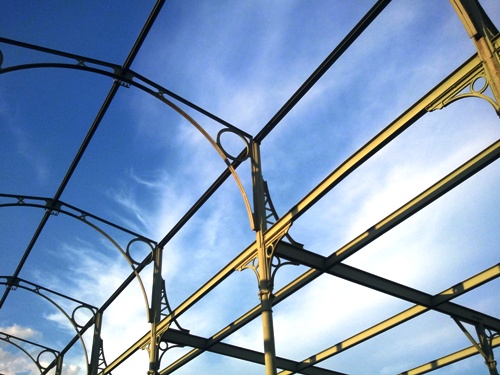
Walking to Sean’s new apartment on Friday we had to pass through the strange open spaces just south of the Storkower Straße S-Bahn station. This was once the central stockyard and slaughterhouse for Berlin although on even my old GDR maps this was referred to as its “former” function and until the 1990s it appears to have been little more than a wide open space. In the past decade or so the area immediately around the station has been filled with car parks for box-like shopping halls, some of the stores have built themselves into the old frameworks of the former buildings. Other metal frames have been left open and uncovered, standing in a patch of parkland, with grass growing beneath the iron skeleton, and locals drinking beer or grilling on those disposable barbecues as kids ride their bikes along ad hoc, dusty pathways.

Continue reading