Flâneur – Franz Hessel’s ‘In Berlin’

?????????????????????

“Walking slowly down bustling streets is a particular pleasure. Awash in the haste of others, it’s a dip in the surf. But my dear fellow citizens of Berlin don’t make it easy, no matter how nimbly you weave out of their way. I always catch wary glances when I try to play the flaneur among the industrious. I believe they take me for a pickpocket.”

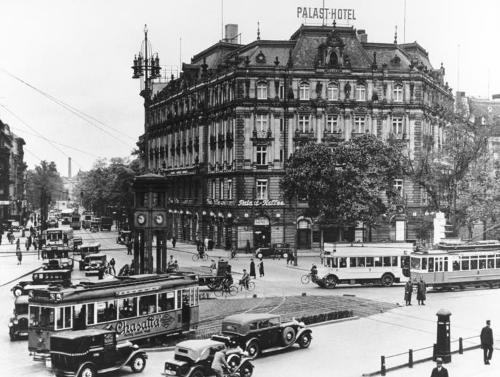
And so begins Franz Hessel’s The Suspect, the first of two essays that make up In Berlin, a flâneur’s view of the city by day and by night in the 1920s, translated by Amanda DeMarco and about to be published this October as part of a new series of small-but-perfectly-formed books from Readux, based here in Berlin.

Franz Hessel was born in 1880 and grew up in Berlin, before moving in his twenties to Munich and Paris. Into the 1920s and 1930s he worked back in his home city as an editor, whilst writing widely praised novels and essays, as well as translations of Proust, Casanova, Stendhal and Balzac. In 1938 he fled to France, where he would end up in an internment camp, passing away shortly after his release in 1941.

Continue reading

On Ilkley Moor…

Ilkley

This weekend we were back in Yorkshire for just a couple of days, celebrating a very special birthday with close friends and family, including quite a few Under a Grey Sky contributors! The images and text below were actually put together during a trip a month or so ago… this time around there were no views from the airplane as Leeds Bradford was shrouded in mist. In fact, we were unable to land and we were diverted to Doncaster…

Coming in to land at Leeds Bradford airport I look out of the window and can see Ilkley Moor, squat and smooth, not so much towering over the surrounding towns and villages as hulking in its presence. Perhaps it is because we don’t have much in the way of moorland in Germany that the sight of it always makes me feel as if I have returned home, even if the wheels have yet to touch down on the runway tarmac.

Continue reading

Watching the Berlin Marathon

Marathon1

It is a tradition that every year when the Berlin Marathon comes around we head down to Unter den Linden to cheer on the finishers as they head into the last kilometre. Our spot is usually by the Russian Embassy, just after the point where the runners turn the corner and catch a glimpse of the Brandenburg Gate for the first time. Once the elite runners and the best of the rest have come through – those more concerned with placing and time than anything else – it is a joy to watch the realisation on the runners’ faces as they see the famous old gate and know that a remarkable achievement is within their grasp.

Continue reading

How I Ruined Hackney (& the Mystery of “The Hackney Slap”)

Marsh-Hackney-Slap

Gareth Rees, aka The Hackney Marshman, has been chronicling his explorations of the Lea Valley Nature Reserve and the secret life of the Hackney and Walthamstow Marshes since early 2011. With his book about to come out, he has kindly given us permission to re-publish this piece that explains how he has ruined his home neighbourhood and is single-handedly responsible for the gentrification of the area, and all before the book even hits the shelves…

On a bright afternoon I was on Walthamstow marsh with my dog Hendrix, walking beneath the brow of the old aqueduct path where the brambles grow. He was coming the other way, a stocky man, late 40s, with a collie.

“Watch out for her!” he said, pointing at his dog, “She’s on heat.”

“Oh, don’t worry,” I said, “he’s been done.”

The man’s head began swinging angrily from side to side. He held onto his thoughts for a few paces then blurted: “Why the hell would you want to do that? Why? Why? Why would anyone do that to a dog? You’ve ruined his life! Why take away his manhood? YOU ARE IN THE POCKET OF THE VET!”

Hendrix, poor sod, was castrated because he was born with a serious eye-defect. It was unethical to allow him to pass on his genes. But really it was none of this man’s business.

“It’s none of your business,” I said, as we crossed paths.

The man’s face darkened. By now he was walking backwards away from me, and I walking backwards away from him.

Continue reading

On the southern shore of the Müritz

Muritz

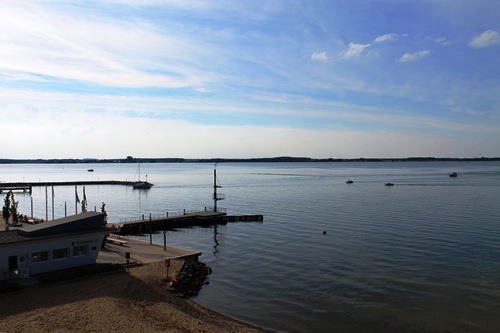
On Saturday morning I walk out of the house and follow the paved path alongside the harbour to where it opens out into the lake. Behind me the resort village is quiet… houses empty or the occupants sleeping. The cleaning crew move amongst the houses on a cart that is so silent it can only be electric, and their voices carry clearly over to where I stand, a conversation full of Friday night gossip and small town exploits. I look out onto the lake – the Müritz – the largest such body of water to be completely contained within the German borders. Lake Constance is bigger, but the Germans must share it with the Swiss and the Austrians, and anyway right now it does not matter whether the Müritz is the biggest, or the second biggest, because there is a mist swirling all around us and visibility is down to about thirty metres. The electric cart moves off and is soon swallowed, but the voices continue to carry across the empty resort plaza to the water’s edge.

Continue reading

Walking the City

Postboxes in Wedding

“I love to read about the city, to live the city, to walk the city.”

This quote comes from a fascinating New Yorker article about William Helmreich, a sixty-seven year old sociology professor who has just spent four years walking every block of New York, some six thousand miles, and whose new book about his walks looks like it is going to be an absolutely fascinating addition to the literature of exploring our urban environment on two feet. As readers of Under a Grey Sky will know, this is something close to my own heart, as walking the city has become something of a passion of mine, not only through corners of Berlin or elsewhere that are new to me, but also by stepping out the front door and taking the time to explore my immediate surroundings.

During the summer I was walking to Pankstraße U-Bahn station. I do this probably five or more times a week, usually along a short stretch of the Panke river, peaceful and secluded, before emerging through a covered walkway onto the Badstraße – a bustling city street filled with kebab takeaways, call shops and travel agents… the tell-tale signs of a neighbourhood with a large immigrant population. These signals – the type of shops, the people on the pavement, the adverts in the kiosks – help us read neighbourhoods and districts, in the same way the buildings can give clues to the history of a particular quarter, and even the proliferation of election posters and how they are targeted in one part of the city compared to the next can help us make an educated guess as to which way one constituency might swing compared to another across the invisible administrative boundary.

Continue reading

Special places: Coniston

Coniston1

By Chris Hughes:

The English Lake District is well known to contain some of the most popular and celebrated landscapes in the UK. There will be as many people who disagree with that statement as do actually agree and no doubt arguments and debates have ranged for many hours over the remains of meals and empty beer glasses as to which landscape is the finest – the Snowdon Horseshoe, The Cuillin Ridge, the Cornish coastline, The Sussex Downs. The choice of the finest landscape is both personal and frequently changes dependent on mood, company and even the weather! But no doubt favourites are places that people will return to time and time again, will enjoy over and over without tiring of seeing and will rejoice in whatever the weather, time of day or company.

Continue reading

A visit to the Karow Ponds, Berlin

karow1

Earlier in the summer Lotte and I headed to the Karow Ponds in the north of Berlin. It resulted in an article that I wrote for Caught by the River, some nice pictures and some great adventures. On the walk to the ponds, Lotte told me: “Quiet Papa, I want to hear the nature…” and so we did, walking in silence towards the ponds set amongst the trees:

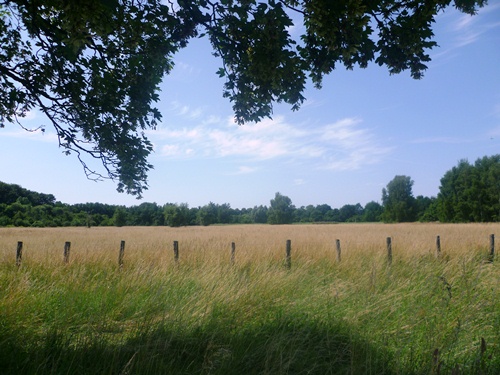
On a sunny Sunday we decide to escape the heat of Berlin by catching the S-Bahn north to the very edge of the city, where the Panke River runs alongside a small patch of marshland and meadows, pasture and ponds. We walk through suburban streets until a path takes us along the river bank and then in towards the Karow Ponds, a peaceful spot popular with strollers, runners and birdwatchers, where we can see bulls lounging in the fields and gaze across the ponds from viewing platforms to see cormorants, grebes, and a grey heron sunning itself on the far bank. Butterflies and dragonflies dart above the reeds, and an otter pulls itself ashore with a shake of its back. Berlin is a city filled with green spaces, but at moments like this I still marvel at the access we have to such places within a handful of minutes of our apartment, and how they managed to escape the rapid growth of the city that swallowed not only fields and forests, but entire villages, during the second half of the nineteenth century.

Read the rest of Caught by the River

Continue reading

Lindisfarne, Northumbria

Lindisfarne1

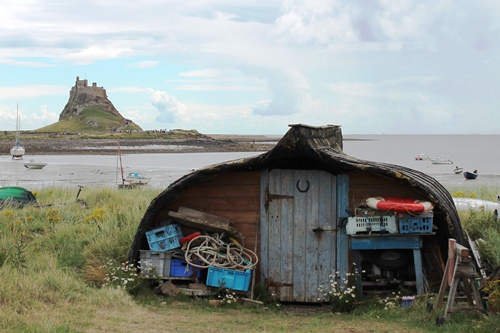
Just outside the Priory museum on Lindisfarne, there is a plaque dedicated to the lifeboat teams of the island and their rescues. The first recorded was in 1867, by the lifeboat Grace Darling – a name we will hear time and again during our trip to Northumbria – and the rescue of four lives from the fishing coble of Holy Island on April 29th. The final rescue, before the lifeboats of Holy Island were withdrawn from service, was in 1954 by the Gertrude, with 11 lives saved. On the day we visited in August it was drizzly but the seas were calm… however, looking out across the North Sea from the lookout tower along the coast south to Bamburgh, and the Farne Island lying low offshore, it was not difficult to imagine the sea violent and transformed, crashing boats against the rocks and then the bravery of those lifeboat teams as they pushed themselves out into the squall.

Continue reading