Category Archives: Reflections

To America…

America_Julia

Tomorrow morning we fly to the United States for a two week trip to two very different corners of the country; first to Orlando, Florida, and then on to Amherst, Massachusetts. It will be the first time I have set foot in the United States of America, although I have gazed across at it through the spray and the mist of Niagara Falls, and as with our journey to Paris last year, I am intrigued to see how this country that has played such a massive role in my own cultural life will live up to my expectations. Even more so than for the French capital, I think that it is an impossible task, as no other country lives so strongly in my imagination despite the fact I have never even been there. I cannot be the only one for, if you live in the west especially, American culture has been ever-present in our lives for the best part of a century.

In preparation for our trip I was looking through our bookshelves for something to read on the flight across the Atlantic, and I was struck by the number of books – and not just any books, but those formative books that shape your ideas and expectations – by American authors. However good certain books might be now, if I re-read them, they remain important to me because of the how and the when I first discovered them. Junky and Queer by William Burroughs, two slender volumes discovered on the shelves of Runshaw College library in my first year of Sixth Form. Fear and Loathing in Las Vegas, and  Fear and Loathing on the Campaign Trail, both bought at Manchester Airport on the way to Canada at the age of eighteen. Another Country, Giovanni’s Room and Notes of a Native Son, all part of a James Baldwin collection given to me by my dad during the first year of university and opened in the vast, cavernous hall of the Parkinson Building at Leeds.

Continue reading

Ghosts of Elephant and Castle, London

Heygate

Last week I was in London for work, and stayed for a night in a new hostel that has opened in Elephant & Castle and occupies the former headquarters of the Labour Party. Indeed, in the reception area – all shiny surfaces and plush carpets – the foundation stone as laid by James Callaghan occupies pride of place. The date too is symbolic, as the building work was begun in the summer of 1979, just after Margaret Thatcher’s election victory and the start of eighteen years of Conservative rule. I was born three days after that election, and would watch Labour’s victory in 1997 five days shy of being able to vote for them myself.

Across the street from the hostel is the southern edge of the Heygate Estate, once home to around three thousand people, and now empty as it awaits demolition and redevelopment as part of a regeneration strategy for the neighbourhood. Hmmm. As we walked the next morning down the road to find something for breakfast, there was a corner shop front filled with images of how the Heygate would look once the development was finished. The artists impressions painted a picture of sunny days and green spaces, of large balconies and evening strolls, but it made me wonder; how many of these shiny new flats and apartments would be occupied by former residents of the estate, and also, where have the three thousand that once called it home gone?

Continue reading

Special places and the joy of the familiar

Headland Shelly Beach Paul

With this post Under a Grey Sky reaches the milestone of two hundred articles, all published in just over a year, and featuring the words and pictures from contributors all over the world. It is the variety that has made this such an inspiring project to work on, as people have used the space here to talk about and document the type of the places that inspire them when they take a step out of the front door.

For the two hundredth post, then, I wanted to dwell a little not only the places that are special to me, but also those that have a meaning beyond perhaps an obvious beauty or an exotic location. They are the places related to personal history, to moments in the memory, that may also be special to others but not necessarily so. In his book, “The Wild Places”, Robert Macfarlane discusses this very issue;

Continue reading

A Moment in Time

Moment 1

By Chris Hughes

I have recently digitised my old colour slide collection and the moment came when I was certain all of them had been saved and the large pile of card and film was now completely redundant. It was still some days before I could finally take them to the bin, finally cast them in and know that the step was irreversible. I am now part way through scanning old photographs and while some have gone straight from scanner to shredder many of these are kept as the look and the feel of the old photograph cannot be replaced by the computer image, no matter how much I am able to improve it with the magic of Photoshop. These treasures will carry on until another generation makes the decision to cast them into the wheelie bin.

But…… some images have stuck in my mind as I have gone through this sorting process…

Continue reading

The Joys of Essex

Diana1

(above: Essex Marsh, by Diana Hale)

By Diana Hale:

Jonathan Meades‘ recent BBC4 programme ‘The Joy of Essex‘, replete with characteristic provocations, utopian visions and other little known eccentricities, inspired me to relive some of my own joys of Essex, searching out paintings and photographs and taking advantage of an opportunity for some biogeography, or topography of the self. Not difficult as I was actually born there, or at least in what used to be Essex, as was everything east of the River Lea at one time.

Although my birth certificate says the London borough of Redbridge as that was where the hospital was, in fact my parents were living with my grandparents in Buckhurst Hill, in the Epping Forest district of Essex. Appropriately, as it was where my father’s family had ended up, it is not far from Hale End (on the map between Walthamstow and Chingford).  Incidentally there is now a new Hale village next to Tottenham Hale, not that far away from Hale End and not far from where I now live – a pleasing circularity. ‘Hale’ apparently means ‘a hollow place’ in Old English so I think there are plenty around.

Continue reading

The Road Not Taken, Amherst

By Phil Scraton:

I was 17 when I first heard The Dangling Conversation. The song’s simple beauty contrasted with the complex emotion of its lyrics. The mood, the characters, caught my imagination. Written by Paul Simon, recorded with Art Garfunkel, we are introduced to the lives of two lovers caught in the quiet solitude of a seemingly lost relationship. ‘You read your Emily Dickinson’ and ‘I my Robert Frost’; we ‘note our place with bookmarkers’ that ‘measure what we’ve lost’.

Like a poem poorly written
We are verses out of rhythm,
Couplets out of rhyme,
In syncopated time
Lost in the dangling conversation
And the superficial sighs,
Are the borders of our lives.

In a ‘lost’ relationship, ‘out of rhythm’, ‘out of rhyme’ what was the relevance of the Emily Dickinson/ Robert Frost juxtaposition? I soon discovered that both were fine North American poets, two generations apart. Their personalities and lives had little in common; she a virtual recluse and a home-based correspondent, he an affable teacher with a love of the outdoors. Yet comparisons of their poetry have been endless – books, theses, articles, essays.

Continue reading

The heart of winter

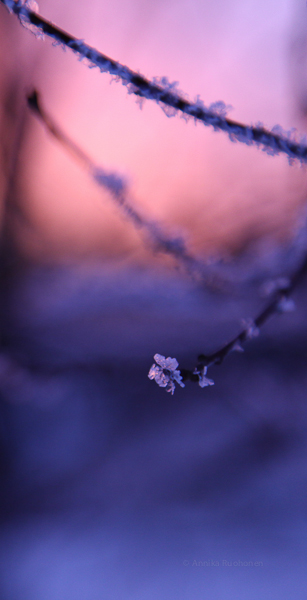
annika_winterA lovely and evocative snapshot of winter, by Annika Ruohonen:

The sound of snow under your feet marks the heart of winter. Prints in the snow hold stories like a bookshelf full of winter tales. There is the one rushing off to work. There is the one coming home from school, kicking an ice block ahead of him, stopping to examine sticks and rocks on his way. There is the one searching for food, ruffling up his feathers in the merciless minus degrees. There is the one who roams free, hunting birds and mice, paying the price of freedom in his search of a place for the night. Smoke rising from the pipes, frost popping in the corners. Time for the blue moment. Only a rare occasion in the course of the year. In the heart of winter.

This first appeared on Annika’s website and we are extremely pleased that she gave us permission to reproduce it here.

Memory and memorials in Berlin

Memorial1

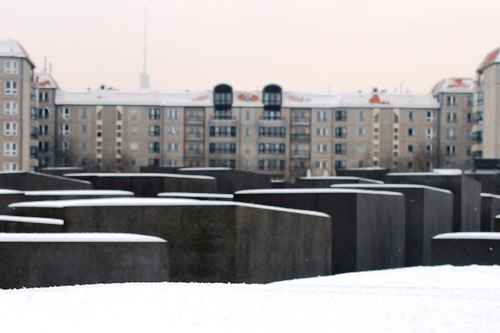
Sunday 27th January is International Holocaust Remembrance Day, an event with obvious resonance here in the German capital. It has been cold over the past few weeks, with temperatures falling below zero and snow on the ground, snow which covered the slabs of the Memorial to the Murdered Jews of Europe when Katrin went by on Thursday to take some photographs. The Memorial was subject to a lot of debate at its time of building, and has since been joined by nearby memorials to Homosexual victims of the Holocaust, as well as the more recent memorial to the Roma and Sinti who perished at the hands of the Nazi regime. All cities have memorials to their past, sometimes glorious and glorifying, other times reflective and sorrowful. Berlin has so many you fear that you will start to look through them, to no longer reflect on what they mean and what they stand for as they  become simply part of the fabric of the city.

Continue reading

Ainsdale Woods, the Sefton Coast, UK

Ainsdale_4

By Chris Hughes:

Following the article that featured the wonderful photographs of Michael Lange of the forests of Germany I revisited the photographs I have taken in the woods of Ainsdale Nature Reserve just a 10 minute walk from my house. No-one would say that we live in the countryside but we are very privileged to enjoy the proximity not only of the woodland but one of the finest dune systems, beach and both salt marsh and freshwater marsh environments in Europe. This is the Sefton coastline, stretching 21 miles from Crosby in the south to Hesketh Bank in the north.

The woodlands were planted well before the Nature Reserve was established in 1980, initially in the 18th century but more so in 1887 and in 1893 when the first Corsican Pines were planted and by 1925 most of the woodland of today had been planted. Now managed by Natural England and The National Trust the woodlands do provide a supply of timber now that the trees are  fully mature but far more importantly provide a habitat for animals, birds and plants, many of which are rare and found only in unspoilt dune systems.

Continue reading

Under December’s Grey Skies

paulscraton_illustration

The illustration that accompanies this piece is by a good friend Julia Stone, who created it as a companion to the Shadows and Reflections article I wrote for Caught by the River. It is a lovely series of posts, as the different contributors to the website reflect on the year that has passed, and having made my own contribution it also means that I do not want to go over the same ground here. What I would like to do in what will most likely be the final Under a Grey Sky entry of 2012 is reflect a little on this place, which began almost a year ago in those muted and melancholic days between Christmas and the New Year.

When I began Under a Grey Sky I had a loose idea of what I wanted to create. I knew that I wanted it to be somewhere that explored the nature of “place”, the adventures that can be had beyond the front door whether in the city, town or country, on the fens or in the high mountains, in the woods or on the water. I did not want to write it alone, and it has been the biggest source of pleasure during this first year of Under a Grey Sky that so many people have chosen to contribute their words and their pictures, and the list that you will find on this page shows the range of interests and locations of those who have been part of the project so far.

Continue reading