Category Archives: Places

On foot through Epping Forest

EF1

Buckhurst Hill

The underpass beneath the tracks at Buckhurst Hill tube station had that smell, that mix of urine and rain and absence of natural light, and so I quickened my step. I was running, not from anything in particular but because this is what I do most mornings and just because I was in Essex I saw no reason to change my habits. On the ramp up, back to fresh air, my footsteps startled an Arsenal fan, dressed for the match and on his way into town.

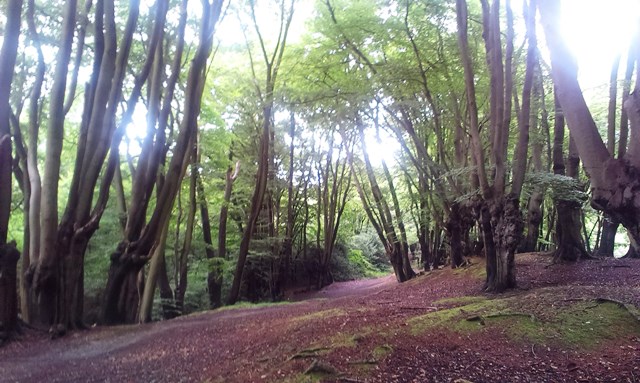
I had no real plan of where I was going to run, except a quick look at Google Maps offered up a green space on the other side of the railway from where we were staying. Lord’s Bushes and Knighton Wood. From the tube station I picked my way through residential streets until I came to a road called Forest Edge, and began to look for a way in. Forest Edge, because this collection of trees surrounded by the suburban streets of Buckhurst Hill and the north end of Woodford belong to Epping Forest, that ancient woodland that stretches from Forest Gate, not far from Stratford and the extravagant and impressive folly of the Olympic Park in the south, to Epping in the north. Continue reading
On cities and a bridge across the river, Erfurt

Erfurt1

The other day, as I was walking with a friend through the suburbs of Hamburg, I was telling her about two views of two particular cities that will live long with me. They are the two views that I see in my head whenever someone speaks of the anonymity of the metropolis, or a landscape that has been entirely shaped by human hands.

The first was in Beirut, standing on the balcony of a friend’s apartment to talk to another friend on a fuzzy and expensive mobile phone connection about the birth of his first child. As we talked I looked out across the rooftops, a jumble of buildings, of balconies and air-conditioning units, the streets invisible between them and the sea a hazy, unreal blue, seemingly miles in the distance. The second was from a hotel room in Tokyo and also high up, with high rise office blocks and hotels and a sense, even more so than in Beirut, of a city where every space was built upon and where nothing was more than a couple of decades old. The only trees I could see from that Tokyo hotel room surrounded nearby shrines, tiny green splodges of colour on a canvas otherwise painted in concrete and glass.

It is not that there is anything particularly wrong with this, and in any case it would be unfair to characterise Beirut in this way as during my time there we moved quickly between the city, the sea and the mountains. I found both cities fascinating and I have a strong desire to return. It is just that these views are what I think about when I imagine the cityscape that I love to visit but have no desire to live in, views that fascinated and repelled me at the same time.And I still find it a little odd that although I never really thought of myself as someone who would live long-term in a city, I have done so ever since I was eighteen (which, as suddenly occurs to me as I write this, is half of my life). Continue reading

Summer swimming and the Wedding Riviera

Lake1

This morning, as I walked with Lotte down the street towards the U-Bahn on her way to the second day of the school year, we noticed that we could see our breath in the morning air. Is the summer over already in August? It certainly feels that way, with school returning and the football season long begun. So it seems like a good time to reflect on the summer and to return to the grey skies of this website.

Our main trip this summer was to the Thuringian forest and then on to the Ardennes, with more trees and plenty of Trappist beer. There will be more on that journey in the coming weeks, but in some ways it was an unrepresentative fortnight when it comes to this particular summer as, if there was a theme of the last few months, it was finding some lake or other in which to jump in.

Almost all of our swimming (we could call it ‘wild swimming’ but then, how wild is it when a little further down the shore a couple of retired women are preparing for the morning swim, even the smallest lake has a Badestelle and every Berliner or Brandenburger has their own favourite lake?) took place in the waters around Berlin. There are hundreds, if not thousands of lakes in Brandenburg, and we found some pretty special ones. The Gamensee near Werneuchen. The Steckelsdorfer See near Rathenow. Both were connected to nearby campsites, but it felt like we had the lake, the water, the reeds and the big skies all to ourselves. Continue reading

The Lost Neighbours of Rathenow, Brandenburg


Rathenow1

At the harbour in Rathenow on a sunny, summer’s day, the atmosphere is fine. People take pictures of the “lock spitters”, a memorial to the piece workers who used to kill time whilst waiting for the barges to pick them up by holding spitting competitions against the canal. Others queue at the specially-erected wooden info stands for their maps and tickets for the BUGA, Germany’s premier flower show being hosted in 2015 by Rathenow and other communities in the west of Brandenburg. The BUGA has brought many people to the town, and it seems well-scrubbed in anticipation of their visit. The streets are clean and the bicycles lanes smooth, the balconies of the GDR-era Plattenbau filled with flowers, and every shop and cafe seems to be welcoming the flower-peepers to their corner of Westhavelland, proud of their town.

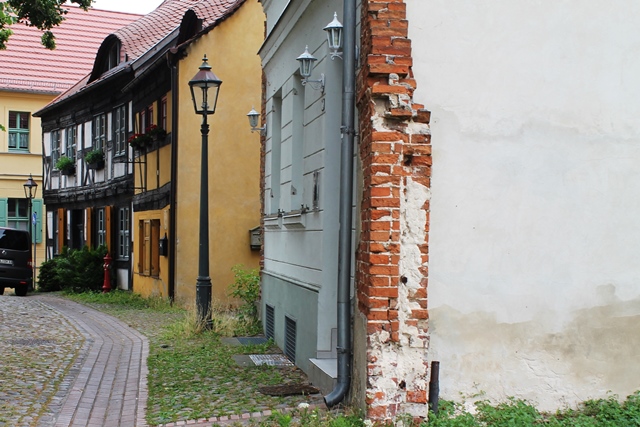
But as we cross the bridge from the harbour and into the old town – a collection of cobbled streets around the church – I get the sense of something missing… the old town itself. For in Rathenow, the Altstadt only contains a handful of pre-war buildings. The red brick church (itself needing massive renovation over recent decades) and some half-timbered houses, but otherwise most of the the old town seems to have been built either during the years when Rathenow was part of the German Democratic Republic, or even since. It is not that it is bad, or it is ugly, but just you cannot help but get a sense of loss as you walk the streets… and you want to find out more.

Continue reading

On the Regional Express

RegionalExpress

In the bowels of Berlin Hauptbahnhof the platforms are lined with trains that will take you are long way from the German capital. Czech railways. Polish railways. The slim lines of the ICE. But on platform eight – which is thronged with young people as three separate school groups have all just arrived for a few days in Berlin – there is a small train waiting, in orange and green, whose final destination is about an hour out of the city and the town of Rathenow, close to the Sachsen-Anhalt border but nevertheless still firmly in the state of Brandenburg.

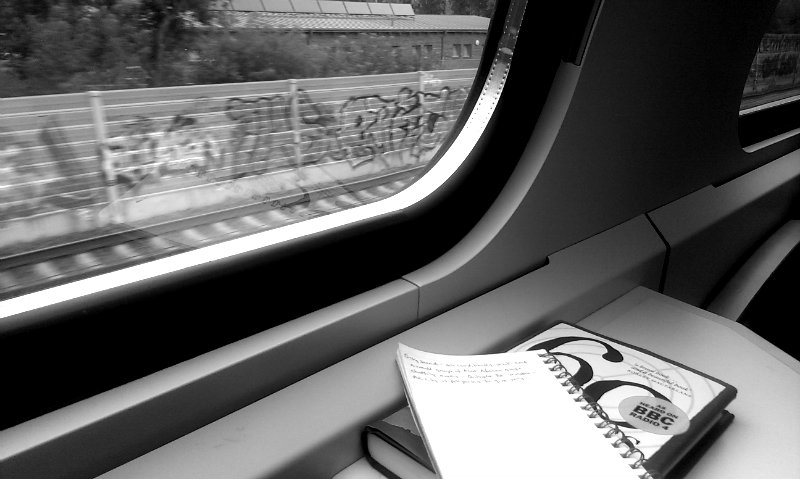
But a train is a train, and there is something special about Germany’s regional expresses. Often they are – as this one is – double-deckers, which mean they offer a fine view down over the embankments and fences that line the railway into back gardens or the forest, across the fields and the lakes. They move slow enough that you get a sense of really moving through the landscape, and they stop at every small settlement along the way. Berlin-Staaken. Dallgow-Döberitz. Elstal. These are all places we will pass through on the RE4 from Berlin to Rathenow, and although they may be small, some of them have their own stories to tell.

Continue reading

The Possibility of an Island

Island

The Possibility of an Island is a better title than it is a book. Indeed, although I have read it I cannot for the life of me recall a single scene from Michel Houellebecq’s book, but the title has stayed with me. To me islands always seemed to be filled with possibility; they are an endless source of fascination. Perhaps it is because they are contained, a world in and of itself, that can be explored and mapped. There is an end to an island. A natural border.

A few weeks ago I read about a short journey I have always wanted to take. The writer Richard Carter had climbed into a canoe on Coniston in the Lake District and, slowly but surely, made his way across the lake to Wild Cat Island. No matter that the island’s real name is Peel Island, for any readers of Arthur Ransome’s wonderful Swallows and Amazons will know what it is really called, and thirty five years after reading the book for the first time (about six or seven years before I did), Richard discovered the magic was based on reality:

We drift past a low, rocky promontory and some rocks. This is so right: it’s just like in the book! We’re almost past it before I see it: back to our right—I mean starboard—a steep-sided, narrow channel leads straight into the heart of the island. A few feet to either side of here, and the channel would be invisible, obscured by rocks and headland. This is the place! We’ve found the secret harbour! Continue reading

What can be found at the end of the line… Wittenau, Berlin

Wittenau1

It has been a crazy month. It appears that launching Elsewhere, a new journal of place, even more than a blog about adventures beyond the front door, means you spend more time in front of a screen, behind piles of paper, or in climate-controlled storage facilities (that are at least a kind of Elsewhere because they could indeed be anywhere) than you do exploring the world around you. I am reading submissions based on places in Australia and Rwanda, the islands of Scotland and the two sides of Budapest, and it is all very inspiring if only we had the t…

No. There is no need for this. In my diary I have a note, scribbled every Monday. UaGS. It means don’t neglect the blog. Don’t forget the blog. But I have been neglecting and forgetting, and then I remember… adventures beyond the front door. That is how all this started in the first place. You can go to Rwanda and leave it all behind. You can go to the islands of Scotland. Or you can take a morning and, if you live where I live, you can go to Wittenau.

Continue reading

From the rocks at Kenmore, Scotland

Kenmore1

At the entrance to the village a sign warns us of free-running dogs and wild chickens. Not being a fan of either, I proceed with caution down the muddy track to the collection of cottages around an open green that makes up the tiny settlement of Kenmore on the banks of Loch Fyne. The green space between the cottages was no accident, it was the place to dry the fishing nets in this village that long made its living from the produce pulled from the loch.

We follow the path down the side of the green (no sign of the dogs) until we reach a stone beach and a rocky promentory. The cloud is low, hiding the surrounding hills. The water is flat calm, glassy. A grey heron flies by with long, beating flaps of its wings. Down on the shore oystercatchers pick their way over the stones. At the top of the rocks the shells of their catch lay battered and smashed, a crunchy confetti. A twin-sailed boat makes slow progress down the loch. Not far away a group of divers, heads and bodies encased in black, slip over the side of their motor dinghy.

Continue reading

An update from Elsewhere

Elsewhere_GorgastFestival

Those readers of Under a Grey Sky who have been following the progress of my new project Elsewhere: A Journal of Place will already know most of this, but in case you missed it I wanted to record an update on the journal here on my personal blog as it is has been a challenging but rewarding process so far.

When Julia and I first met to talk about the project at the end of last summer, our aim from the beginning was to provide a platform for writing and visual arts that explores the concept of place in all its various meanings, whilst also committing to print and the desire to create a beautiful object with which to transport those words and pictures. A few days ago, after months of writing, editing, designing, crowdfunding, building an audience, meeting tax consultants, and all the various bits and pieces that we needed to do to get from there to here, we sent the first edition to the printers here in Berlin and now all there is to do is wait for the physical thing to arrive.

Continue reading