Monthly Archives: January 2012

Sweetness and Blood: Surfing the World


The film is a trailer for Michael Scott Moore’s Sweetness and Blood: How Surfing Spread from Hawaii and California to the Rest of the World, With Some Unexpected Results. In the book Mike travels the world – Israel, the Gaza Strip, West Africa, Great Britain, Germany, Indonesia, Japan, Cuba, and Morocco  – to explore surfing and surf culture, and since its publication (paperback last year, hardback in 2010) it has recieved some wonderful reviews:

“Moore writes in a spirit closer to Bruce Chatwin’s In Patagonia than the latest issue of Carve. … What he has done, subtly and beguilingly, is write a book about surfing that often is not really about surfing but about simply being alive (and, in some cases, dead).” – Andy Martin, New York Times Book Review

We will be posting an extract from the book here on Under a Grey Sky, probably by the end of next week, so watch this space.

Also check out: Michael Scott Moore’s website and blog.
Scotland’s Thousand Huts campaign

Interesting article from the Guardian about “hutting” in Scotland and the Thousand Huts campaign which is led by Reforesting Scotland and is centred around the idea of the hut as a “place, an experience, an endeavour, an ideal for all to enjoy,” taking their lead from other countries in Northern Europe – such as Norway and Sweden, where hutting is long established. The campaign is also interested in the practical aspect of hutting alongside its social and community benefits, with the belief that “building huts with local timber can revive skills that all rural communities once took for granted and strengthen community resilience.”

From the Guardian (05/01/12):

Gerry Loose calls it “the long view”. Standing a few yards from his moss-carpeted wooden hut in a Stirlingshire forest, Loose gestures towards the hill-line of the Campsie Fells, their peaks and flanks dusted with snow. The air is crisp, sharpened by the winter chill.

The hut is Loose’s retreat from urban Glasgow. Built about 80 years ago, its weathered green paint now peeling, the cabin has three small rooms and an outdoor privy built from salvaged timber. Still lit by prewar gas lamps, it has no electricity, no mains water and a brisk walk takes him to the nearest standpipe, which frequently freezes in winter…

Read the full article on guardian.co.uk

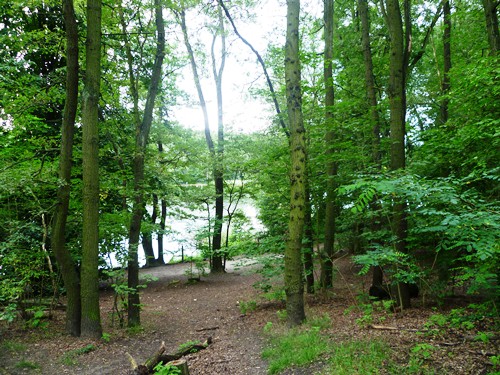
In the Grunewald Forest, Berlin

(Photo: View through the trees / Paul Scraton)

From the moment people began to make money in Berlin, they looked for ways to escape the city. The Grunewald, with its forest and lakes, became home to the mansions and villas of the rich at the end of the nineteenth century, and the neighbourhood was incorporated into Berlin in 1920. Not long after Christopher Isherwood was in town, and his impression of the place was less than favourable:

“Most of the richest Berlin families inhabit the Grunewald. It is difficult to understand why. Their villas, in all known styles of expensive ugliness, ranging from the eccentric-rococo folly to the cubist flat-roofed steel-and-glass box, are crowded together in this dank, dreary pinewood.”

A page or so later, on his way to teach the daughter of one of those rich Berlin families, he goes on to describe the place as a “millionaire’s slum”. But the wealthy and the well-to-do continue to be quite happy in their moneyed-sanctuary between the trees. Continue reading

Out from the studio – The art of Helen Mirra

Helen Mirra
Field Recordings, 7 x 5000 Schritte, in Berlin (Steglitz) 31 Juli
Detail / detail
Öl auf Leinwand / Oil on linen, 2010
80 x 170 cm
Courtesy of the artist

An exhibition currently taking place in Berlin is “gehend: Field Recordings 1-3” which is taking place at the KW Institute for Contemporary Art. Helen Mirra made these prints and rubbings on hikes around Berlin, Bonn and Zurich. She explains her philosophy on her website:

“After a number of years making discrete works in various materials, and considering various subjects, Mirra’s present rhythm of working takes the form of a kind of paced printmaking, made through walking. The activities are interdependent; the walking structures the printing, and the printing impels the walking. This rhythm is nestled into a cycle of exhibitions that perpetuates the project.”

For this exhibition she spent a month in each of the three locations, and spent almost every day walking. Every hour she would make a print of the ground before transferring this onto linen, collecting seven such prints a day. The aim of her work, according to the notes that accompany the exhibition, is to “resist idealised notions of nature” as well as to “open up spaces of association, in which the perception of small things is enlivened, and our ethical sense of responsibility regarding our environment and its diversity is addressed.”

Exhibition runs until the 29th January – Homepage

The Joy of Maps

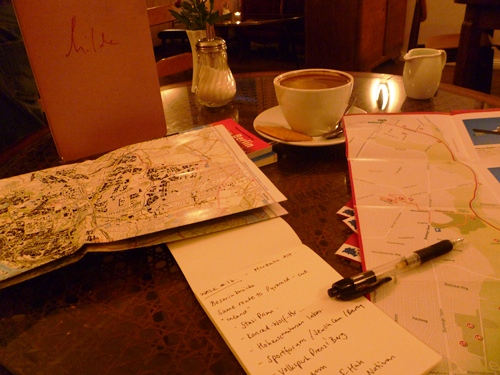
A beautiful morning gives way to a miserable and bitterly cold afternoon, the wind whipping down the avenues of Berlin as drizzle falls in the ever encroaching darkness. It may be nicer in general to be out of doors, but sometimes a refuge is needed, whether it is the bookshop, the pub, a café or the living room. I choose Café Hilde on the corner of Prenzlauer Allee and Metzer Straße, a sanctuary of flickering candles, gentle music and good books to browse on the shelves. Continue reading

Escape to the Alpujarras

“Mountain air and winter sun, chestnut trees and almond blossom, whitewashed village houses and reflective surfaces in the distance that may be the sea but could also be those plastic greenhouses that own the coast towards Almeria…” These are some of the scribbles in my notebook from the times we have been in the Alpujarras, these valleys only a short drive from Granada or the Mediterranean coast, and the words on the page fill me with dreams of escape and have me checking the cost of flights to Malaga. Continue reading

Stone Monkey

Worth a look: Johnny Dawes video from the Guardian.co.uk

Climbing for me provided a means of self-expression. Ability, too, can mean wider social acceptance, even if only in a superficial “one of the gang” way. To a young, socially immature person, that grew as a cancer, to a stage where my climbing was taken out of my hands to an extent. The end of this lies in photographs, sponsorship, ugly tights and a dead end with a bolted door.

Quote from his website. His memoir has recently been released, and the Guardian also wrote a profile of him that was put online last week and has now been updated to include the video – which is quite astonishing, especially the footage of him climbing bolders with no hands or, at one point, on one leg…

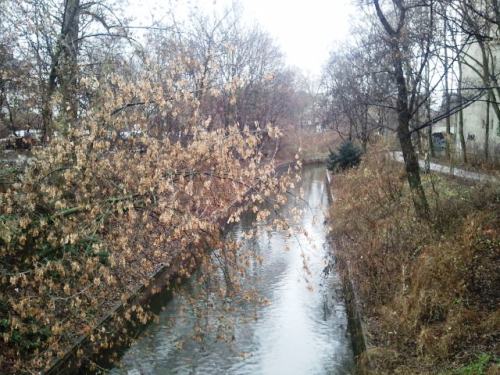
New Year’s Day, Berlin

(Photo: The Panke river on New Year’s Day)

As this is Germany it is a peculiarly organised form of chaos. On New Year’s Eve the locals (and the rest of us, but mainly the locals) launch the city’s debt-worth of fireworks into the sky, filling the night air with an almighty racket and a thick cloud of gunpowder-tinged smoke. The next morning the pavements and any open spaces are filled with the debris of last night’s celebrations, but some householders are already out on the street, sweeping it away from the pavement into piles for the binmen to collect. Continue reading