No history on the long ridge?

Barry Sheppard looks back on the town he grew up in, and reflects on the stories you can discover in the places that you thought you knew so well…

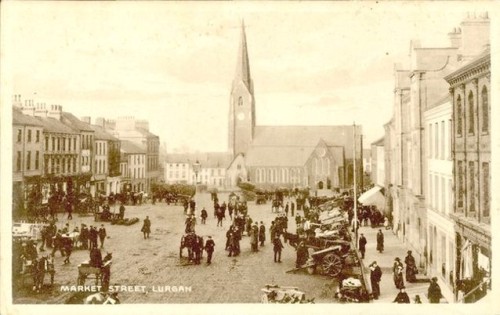
When I was told the name ‘Under a Grey Sky’, only one thought popped into my head; home. Growing up in Lurgan there were plenty of grey skies overhead.  I’m not saying it was dull, grey and boring – although it was at times like that – it is merely a passing comment on the usual state of the weather in that part of Ireland.  For the sake of clarity I should point out there are several town lands of Lurgan in Ireland, one in Co. Galway, one in Co. Mayo and one in Co. Cavan.   The Lurgan I spent the first nineteen years of my life is situated in Co. Armagh in the often disputed six north-eastern counties of Ireland.  For those who don’t know, the name Lurgan is the anglicised re-branding of the original Gaelic name an Lorgain which means ‘the long ridge’.

In the nineteen years I spent in Lurgan before departing its designated electoral boundaries, I can honestly say that not much out of the ordinary really happened.   Some may dispute this or say I have lightly glossed over the previous number of decades of conflict, but to that I would say that for my generation that was the ordinary.   Anyway, back to the long ridge.  In the norm people did the everyday things as they do everywhere; school, jobs, marriages, pub and bookies, and not always in that order.  It seems that it was the normal drill since time immemorial, or since the plantations.  It would be fair to say that there were not many who thought too hard about the history of their surroundings.
Continue reading

RSPB Marshside, Southport, UK

Chris Hughes on the birds of Marshside at the Ribble Coast and Wetlands Regional Park:

The River Ribble flows from Yorkshire via Settle, through Clitheroe and Preston in Lancashire and out into the Irish Sea between Lytham St Annes and Southport, a total length of 75 miles.  It is tidal for 11 miles up to Preston and the estuary is 10 miles wide.

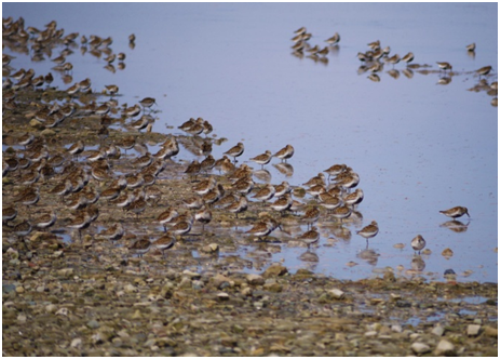
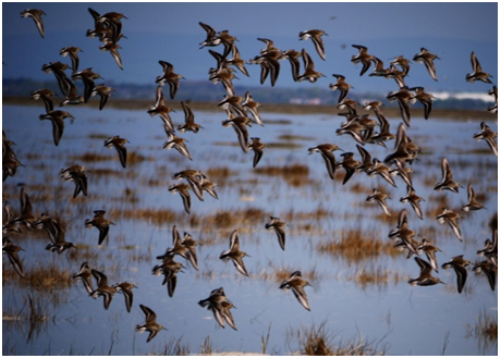
Up to 340,000 water birds over-winter on the Ribble estuary making it the most important wetland site in the UK.

In the 1960’s the last new sea bank was built north of Southport using household rubbish for the core of the bank and later the coastal road was built on top. Finished in 1976 it enclosed a large area of salt marsh which later became fresh water marsh. In 1994 the RSPB leased the marsh from Sefton Council and the RSPB Marshside Nature Reserve was created.

The reserve is now part of the Ribble Coast and Wetlands Regional Park, and is recognised as internationally important for several species of waterfowl.

Continue reading

Beers under a grey sky at Berlin’s Prater Garten

At Berlin’s oldest beer garden it is the first weekend in May, the flowers are blooming on the trees, but the shutters are most definitely down, behind which are locked beer taps that will not be flowing with Prater Pils. It seemed like the perfect time to head out for the first beer garden afternoon of the year. The skies may have been overcast all morning, and there is a slight chill in the air, but we have sipped beers in the rain here before, sheltering under those generous branches that provide shade on better days, or under the roof where they place the big screens for football tournaments.

Luckily the Prater has a restaurant, and they are more than happy to serve us some drinks to take out into the beer garden which we then have pretty much to ourselves. The kids do not have to wait for the swing in what is often both Berlin’s smallest and busiest “playground”, and we have our pick of the benches and tables. There is no sausages on sale, pretzels or pasta salad, but the burger place across the street is open and for once, there is no-one to object to us bringing in our own food.

Continue reading

What’s in a view?

George McKinney reflects on how we appreciate what it is we have before us, from the sun setting behind the island of Rhum to a Sea Eagle making graceful progress across the sky:

Of course the simple answer to the title-question is; whatever you see.  Line ten people up to watch the sun set behind the Scottish island of Rhum and you will find that each will see something different and the process of sharing their thoughts can add something for everyone.

This process is only disturbed if any of the ten argue to impose their own perspectives on the others or if one person adopts a position that seeks to degrade any other person’s contribution by suggesting that s/he is not competent to appreciate what is there before them all.

In his book, ‘How to be a bad bird-watcher’ Simon Barnes excellently captures this sentiment and defends the importance for individuals to have confidence to simply enjoy what they see.  If a bird is seen and the watcher marvels at its colours or actions, then that is absolutely fine as an end in itself.  The same is true for the feelings and thoughts that an individual might have when watching that sun go down behind Rhum.

Continue reading

Above the cliffs of Duino

In January 1912 the poet Rainer Maria Rilke was staying with the Princess Marie von Thurn und Taxis-Hohenlohe at the castle in the small village of Duino, just up the coast from Trieste. It was whilst staying there and walking along the clifftops, that the first line of what would become the Duino Elegies – one of his most celebrated works – came to him.

Who, if I cried out, would hear me among the Angelic
Orders? And even if one were to suddenly
take me to its heart, I would vanish into its
stronger existence. For beauty is nothing but
the beginning of terror, that we are still able to bear,
and we revere it so, because it calmly disdains
to destroy us. Every Angel is terror.

(Translated from the German by A.S. Kline, here)

Continue reading

By the Rummelsburg Bay

And we went down to the river…

We climb down from the S-Bahn inside the new hall at Ostkreuz station, all shiny and bright before dropping down the staircase to street level and into edgeland. Somewhere beyond the junkyard is a football pitch. Abandoned buildings peel in the shadow of the new train station. A lonely pair of houses still show some sign of life, and the memory of when they must have been part of a much longer row before… what? Bombs? Socialist planning? A change of mind?

One patch of wasteland by the river Spree has been snapped up, no doubt cheaply, by a company specialising in team-building exercise, and they have turned it into a giant playground for adults, complete with tree-houses and rope-slides, beach volleyball courts and a launch to get corporate middle-managers and their kayaks out onto the open water. As we pass it seems as if the day’s activities have come to a close, as the group sits on benches, with bottles of beer to toast a good day’s work.

Continue reading

The Ardnamurchan Peninsular

A journey to Scotland, by Sheila Scraton:

It all began with one of ‘those conversations’. “If you could have a holiday this April anywhere in the world where would you go?”  Well, having thought of Cuba, Costa Rica and other destinations that have always been on my wish list, I suddenly said “ Well, taking all things into consideration, what I’ve always wanted to do is rent a van and go to Scotland!” So, with partner in agreement the planning began and just before Easter we set off to pick up our rented vehicle in a little village called Saline, near Dunfermline, Scotland. Early April is always a weather risk in the UK but we were given great confidence by the unseasonable heat wave that hit Britain in March. However, as we packed to move north, snow was forecast with weather warnings reverberating around our ears.  I’m sure all who know us were saying, “A camper van in April in Scotland – you must be mad!”

We had decided to focus on the Ardnamurchan peninsular containing the most westerly point of the British mainland.  Ardnamurchan (Áird nam Murchan, headland of the great seas) is one of the most stunning and remote parts of the Scottish coast.  I have always loved the west coast of Scotland, walking and climbing in the Cairngorms, Torridons, Glencoe, Skye, Kintail. It just feels so special with dramatic, rugged mountains rising up straight from lochs and the sea, inspiring feelings of remoteness and majesty.

Continue reading

Saturday Morning in Belfast

Phil Scraton on a springtime walk through the city:

I’ve always resisted routine, not sure why. Saturday morning in Belfast is an exception. Out of the house, through the park, along the river, across Botanic Gardens, pick up the Guardian, into the University, water the plants, catch up on work and home for lunch. How did this sequence, steps retraced time and again, become so regular? Is there a suppressed inner self yearning for sequence, a wandering spirit in search of a comforting route? Even when I took up running, I altered course each day, rarely covering exactly the same ground.

Mid February and there’s been no snow, no frost, no winter. What a difference a year makes. Returning from Berlin a year ago the challenge was water pouring through ceilings. Today the news tells of a drought in South East England and record high temperatures in the Midlands. Tomorrow the mercury falls to almost freezing. The seasons have levelled to a kind of constant Fall.

Leaving the quiet of the house, the noise is deafening. A cacophony of birdsong as the choristers assume Spring’s premature arrival … little wonder – the buds on the horse chestnut trees have broken, their new leaves dancing free of constraint. School hockey matches are under way and shrill voices echo through the houses. Within minutes I’m walking the tarmac track through the golf course leading into Ormeau Park.

Continue reading

Levon Helm, music and place

.

We received an email from a friend of Under a Grey Sky, Chris Wright, who wanted to point us in the direction of an article in the Atlantic about the death of The Band’s drummer and vocalist Levon Helm. Chris wrote, “Perhaps you could find a space to link out to this one, as it does a very good job of celebrating the life and work of one of my all-time favourites and a mighty contributor to Rock & Roll, and his work has featured on your blog before.”

Continue reading

Spirit of Kinder trespass alive and walking

(above: Commemorative plaque of Mass trespass of Kinder Scout at Bowden Bridge Quarry, Hayfield, UK, by Marcin Floryan)

Thanks to Diana Hale and the Over The Hills blog for bringing the Kinder 80 campaign of the Ramblers to our attention. As today is the anniversary, it seemed fitting to post more details here:

80 years on and the journey to open up the countryside continues

In April 1932, much of the countryside in England and Wales was closed off to the public and hundreds of people risked imprisonment to walk up Kinder Scout as part of a mass trespass to open up the countryside. Now in April 2012, we can all enjoy a walk across mountains or moorland but there are still many beautiful places which remain out of bounds – says Ramblers.

On the 2nd April the Ramblers launched its Kinder 80 campaign to highlight the places in England and Wales we still can’t walk and the work the Ramblers is doing to open up and protect the countryside.

80 years after this landmark protest, the Ramblers has won the ‘right to roam’, helped to create National Parks and long distance trails but the journey to make Britain the most walker-friendly nation in the world isn’t over yet.

Continue reading